Redistribution of Charge Between Conductors
Introduzido| English | Significado |
|---|---|
| grounding/ˈɡraʊndɪŋ/ | aterramento |
| surface charge density/ˈsɜːfɪs tʃɑːdʒ ˈdensɪti/ | densidade superficial de carga |
Connect a big sphere to a small one — who gets more charge?
- Join two charged conductors with a wire and charge suddenly flows.
- It keeps flowing until something between them is equal.
- That something is potential, not charge — a subtle but key point.
- Get this right and you understand grounding, sharing, and lightning rods.
They end at the same potential
- Conventional positive charge flows from higher to lower potential; electrons in the wire move in the opposite direction.
- It stops when both conductors sit at the same $V$.
- At that moment no potential difference remains to push charge.
- Equal potential — not equal charge — is the end state.
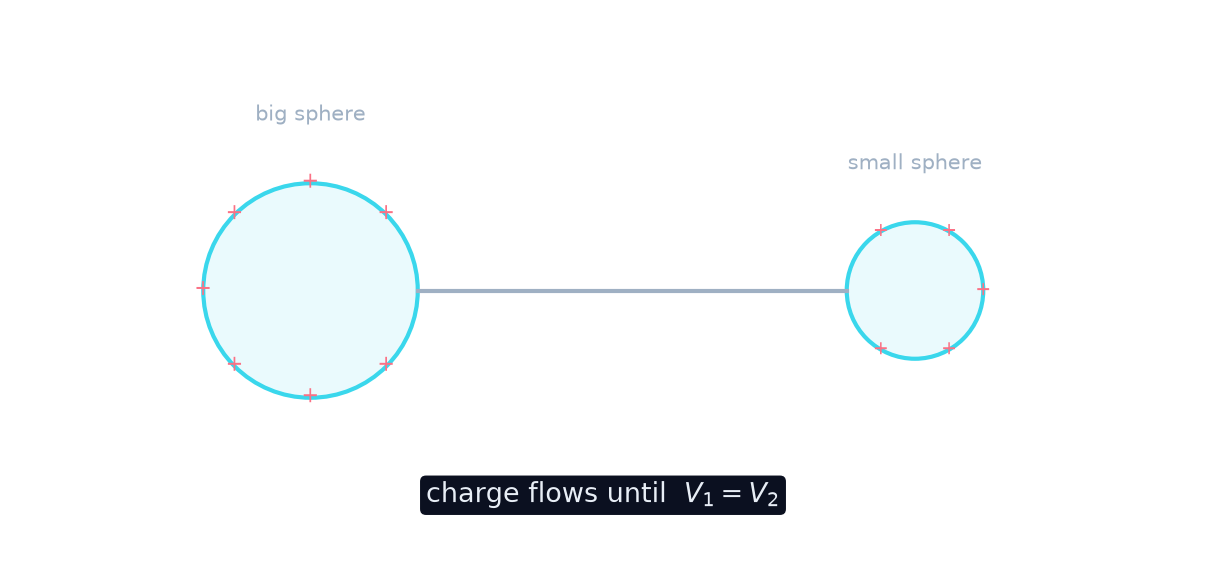
When two conductors are connected, charge flows until they have equal:
Dificuldade 1/5 · Moedas 100 + pequeno bônus na primeira conclusão hoje
Charge flows until the potentials are equal — no push remains.
Bigger conductors hold more charge
- For spheres very far apart compared with their radii, neglecting wire charge and mutual influence, $V \approx \dfrac{kQ}{R}$; equal $V$ gives $Q \propto R$.
- The bigger sphere ends up with the larger share of charge.
- Double the radius and it holds double the charge at the same potential.
- Size sets how much charge a conductor can hold per volt.
For two spheres very far apart compared with their radii and at equal positive potential, the smaller sphere holds more charge. Neglect mutual influence.
Dificuldade 1/5 · Moedas 100 + pequeno bônus na primeira conclusão hoje
False. $V = kQ/R$ equal means $Q \propto R$, so the larger sphere holds more charge (although the smaller one has the stronger surface field).
Two spheres of radii 3R and R are very far apart compared with their radii and connected by a thin wire. Neglect wire charge and mutual influence. At equal positive potential, how many times as much charge is on the bigger sphere?
Dificuldade 2/5 · Moedas 140 + pequeno bônus na primeira conclusão hoje
$Q \propto R$, so the $3R$ sphere holds $3\times$ the charge.
But the small one has denser charge
- Surface charge density 面电荷密度 is $\sigma \propto \dfrac{1}{R}$ — higher on the smaller sphere.
- So the small, sharp conductor has the stronger surface field.
- That is the lightning-rod effect again: sharp $=$ dense $=$ strong field.
- Big total charge and high density live on different conductors.
Sharing charge between conductors
When two conductors are connected, charge flows until they reach the same potential.
Two spheres of unequal radii are very far apart compared with their radii and connected at equal positive potential. Neglect mutual influence. Which has the higher surface charge density?
Dificuldade 1/5 · Moedas 100 + pequeno bônus na primeira conclusão hoje
$\sigma \propto 1/R$, so the smaller conductor is denser.
Select all true statements for two spheres of unequal radii, very far apart compared with their radii, connected at equal positive potential. Neglect wire charge and mutual influence.
Dificuldade 2/5 · Moedas 140 + pequeno bônus na primeira conclusão hoje
Equal potential, $Q \propto R$, $\sigma \propto 1/R$. The split is by size, not 50/50.
Grounding is sharing with the Earth
- Grounding 接地 connects a conductor to the enormous Earth.
- The Earth is so big it holds any charge at essentially $V = 0$.
- Charge flows until the conductor also reaches $V = 0$.
- That is how induction charging "drains" the unwanted sign.
Grounding connects a conductor to the Earth, pulling it to a potential of ____.
Dificuldade 1/5 · Moedas 100 + pequeno bônus na primeira conclusão hoje
The Earth holds any charge at $V = 0$.
Two spheres of radii $2R$ and $R$ are very far apart compared with their radii and joined by a thin wire; neglect wire charge and mutual influence.
- Equal potential: $Q \propto R$, so the big sphere holds twice the charge.
- But $\sigma \propto 1/R$, so the small sphere has the denser surface charge.
Connected conductors share to equal potential, not equal charge. Don't split the charge 50/50 — split it in proportion to size ($Q \propto R$ for widely separated spheres with negligible wire charge), and remember density runs the other way ($\sigma \propto 1/R$).
Connected conductors exchange charge until they reach the same potential. For widely separated spheres with negligible wire charge, $Q \propto R$ (the bigger holds more), while surface density $\sigma \propto 1/R$ (the smaller is denser). Grounding shares with the Earth, pulling a conductor to $V = 0$.
Write from the data given
- Two spheres of radii 3R and R are very far apart compared with their radii and joined by a thin wire. Their total charge is +8 microcoulomb; neglect wire charge and mutual influence.
- Find the charge on each sphere after they reach the same potential.
Two spheres of radii 3R and R are very far apart compared with their radii and joined by a thin wire, sharing +8 microcoulomb. Neglect wire charge and mutual influence. At equilibrium, what charge does each hold, and which has larger surface charge density?
Equal potential means Q is proportional to R. Of 8 microcoulomb, three quarters is 6 and one quarter is 2.
Two spheres of radii 3R and R, very far apart compared with their radii, share +8 microcoulomb through a thin wire. Neglect wire charge and mutual influence. How is the charge shared at equilibrium?
Dificuldade 1/5 · Moedas 100 + pequeno bônus na primeira conclusão hoje
The ratio of radii is 3 to 1, so the charges are 6 and 2 microcoulomb. Density goes the other way.