Simple Circuits
Introduzido| English | Significado |
|---|---|
| circuit/ˈsɜːkɪt/ | circuito |
| electromotive force/ɪˌlektrəʊˈməʊtɪv fɔːs/ | força eletromotriz |
One battery, one bulb, one loop — and light
- Connect a battery to a bulb with two wires and the bulb glows.
- Break either wire and the light dies at once — the loop must be complete.
- A circuit 电路 is a closed path that lets charge flow from a source and back.
- Learn to read this simple loop and every complex circuit becomes approachable.
The parts of a circuit
- A source (battery or cell) supplies the energy, its voltage the "push".
- Wires carry the current with almost no resistance.
- Components (bulbs, resistors) use the energy the current delivers.
- A switch opens or closes the loop, turning the current on or off.
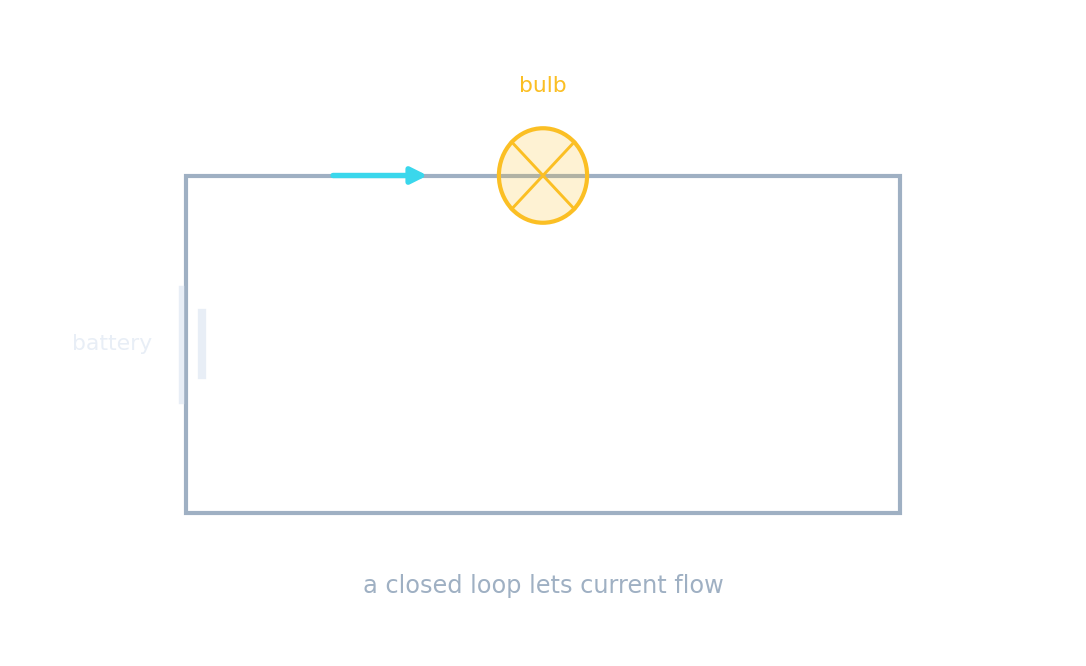
A single loop
Build a simple series circuit and see the same current flow through each part.
For current to flow in a circuit, the loop must be:
Dificuldade 1/5 · Moedas 100 + pequeno bônus na primeira conclusão hoje
A complete, closed loop is needed; any break stops the current.
What does a switch do in a circuit?
Dificuldade 1/5 · Moedas 100 + pequeno bônus na primeira conclusão hoje
A switch opens (off) or closes (on) the circuit loop.
Select todos parts of a basic circuit.
Dificuldade 2/5 · Moedas 140 + pequeno bônus na primeira conclusão hoje
A basic circuit needs a source, wires and a component. A magnet is not required.
EMF: the battery's push
- A battery's electromotive force (EMF) 电动势 is the energy supplied per unit charge; it equals terminal voltage when no current flows.
- With current $I$ and internal resistance $r$, a discharging battery has terminal voltage $V = \varepsilon - Ir$.
- The current is the same everywhere in a single unbranched loop.
- Energy is carried from the battery to the components and turned into light or heat.
The energy a battery supplies per unit charge is called its ____.
Dificuldade 1/5 · Moedas 100 + pequeno bônus na primeira conclusão hoje
The electromotive force (EMF) is the battery's energy per unit charge.
In a single unbranched loop, the current is the same at every point.
Dificuldade 1/5 · Moedas 100 + pequeno bônus na primeira conclusão hoje
With one path, the same current flows through every component.
Reading a circuit diagram
- Circuits are drawn with standard symbols: lines for wires, a pair of bars for a cell.
- Trace the loop from the + terminal, through each component, back to the −.
- If the loop is unbroken, current flows; a gap (open switch) stops it.
- This shorthand lets us plan and analyse circuits on paper before building them.
A circuit only works if the loop is complete. A single break anywhere — a loose wire, an open switch, a burnt-out bulb in series — stops all the current, not just at that spot. In a single loop the current is the same at every point.
A bulb in a single-loop circuit burns out. What happens to the current elsewhere in the loop?
Dificuldade 1/5 · Moedas 100 + pequeno bônus na primeira conclusão hoje
A break in the single loop stops all current, not just at the bulb.
A $6\ \text{V}$ battery is connected to a single bulb, and $2\ \text{A}$ flows.
- The current is $2\ \text{A}$ everywhere in the loop — the same leaving and returning to the battery.
- Open a switch anywhere and the current everywhere drops to zero.
A circuit is a complete loop that lets current flow from a source (with its EMF) through wires and components and back. Break the loop anywhere and all current stops. In a single unbranched loop, the current is the same at every point.
Write from the data: find the current
- A single loop holds a 12 V battery, a lamp and an open switch.
- Say what the EMF is and what the current is.
A single loop contains a 12 V battery, one lamp and a switch. The switch is open. What is the battery EMF, and what is the current in the lamp?
An open switch leaves the EMF in place and stops the current.
What is the current in the lamp while the switch is open?
Dificuldade 1/5 · Moedas 100 + pequeno bônus na primeira conclusão hoje
An open loop carries no current.