Frequency and Period of SHM
Introduzido| English | Significado |
|---|---|
| amplitude/ˈæmplɪtjuːd/ | amplitude |
| period/ˈpɪərɪəd/ | período |
| frequency/ˈfriːkwənsi/ | frequência |
| hertz/hɜːts/ | hertz |
A grandfather clock keeps time with a swing
- Inside a grandfather clock, a pendulum ticks back and forth at a perfectly steady rate.
- For small swing angles, each full cycle takes approximately the same time as the amplitude 振幅 changes.
- That steady repeat time is the period 周期; how many per second is the frequency 频率.
- Getting them from the physics is the goal of this lesson.
Period and frequency
- The period $T$ is the time for one complete cycle (in seconds).
- The frequency $f$ is the number of cycles per second, in hertz 赫兹 ($\text{Hz}$).
- They are reciprocals: $f = \dfrac{1}{T}$.
- A fast oscillator has a short period and a high frequency.
An oscillator has a period of $0.25\ \text{s}$. What is its frequency, in $\text{Hz}$?
Dificuldade 2/5 · Moedas 140 + pequeno bônus na primeira conclusão hoje
$f = 1/T = 1/0.25 = 4\ \text{Hz}$.
Frequency is measured in ____.
Dificuldade 1/5 · Moedas 100 + pequeno bônus na primeira conclusão hoje
Frequency is in hertz ($\text{Hz}$) — cycles per second.
The two key formulas
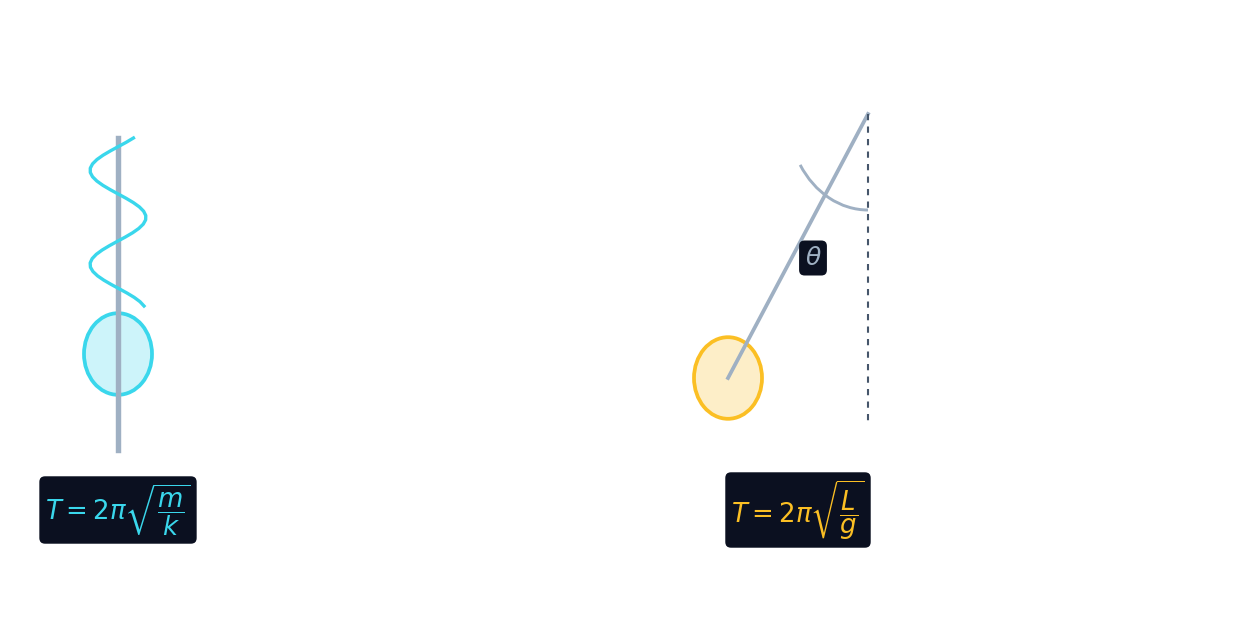
- Mass on a spring: $T = 2\pi\sqrt{\dfrac{m}{k}}$ — heavier mass or softer spring means a slower swing.
- For an ideal simple pendulum at small angles: $T = 2\pi\sqrt{\dfrac{L}{g}}$ — a longer pendulum swings more slowly.
- Notice the pendulum's period does not depend on the mass of the bob.
- Both formulas come straight from the SHM equations.
Length sets the period
Change the pendulum length (and gravity) and watch the period change in the ideal small-angle model, where it is independent of amplitude.
At small angles, the period of an ideal simple pendulum depends on:
Dificuldade 1/5 · Moedas 100 + pequeno bônus na primeira conclusão hoje
$T = 2\pi\sqrt{L/g}$ — only length and gravity, not the bob's mass.
At small angles and fixed g, you lengthen an ideal simple pendulum. Its period:
Dificuldade 1/5 · Moedas 100 + pequeno bônus na primeira conclusão hoje
$T = 2\pi\sqrt{L/g}$: a larger $L$ gives a larger $T$ — a slower swing.
Select todos quantities that change the period of a mass–spring oscillator.
Dificuldade 2/5 · Moedas 140 + pequeno bônus na primeira conclusão hoje
$T = 2\pi\sqrt{m/k}$ depends on $m$ e $k$, not amplitude or colour.
Amplitude does not matter
- For ideal SHM, the period does not depend on amplitude (how far it swings); for pendulums this is a small-angle approximation.
- A wide swing travels farther but also moves faster, so the time is the same.
- This is why pendulum clocks keep good time even as the swing slowly shrinks.
- We call this property isochronous — "equal time".
For SHM, swinging with a larger amplitude makes the period longer.
Dificuldade 1/5 · Moedas 100 + pequeno bônus na primeira conclusão hoje
The period of SHM is independent of amplitude — a wider swing is also faster, so the time is unchanged.
For SHM, the period is independent of amplitude — swinging wider does not take longer. And a pendulum's period does not depend on the mass of the bob, only on its length and $g$. These surprising facts trip up many students.
A $0.5\ \text{kg}$ mass hangs on a spring with $k = 200\ \tfrac{\text{N}}{\text{m}}$. Find the period. (Use $\pi \approx 3.14$.)
- $T = 2\pi\sqrt{\dfrac{m}{k}} = 2\pi\sqrt{\dfrac{0.5}{200}} = 2\pi\sqrt{0.0025} = 2\pi(0.05) \approx 0.31\ \text{s}$.
Its frequency is $f = 1/T \approx 3.2\ \text{Hz}$.
The period $T$ is the time for one cycle; the frequency $f = 1/T$ (in hertz) is cycles per second. A mass–spring has $T = 2\pi\sqrt{m/k}$; a small-angle simple pendulum has $T = 2\pi\sqrt{L/g}$. The period is independent of amplitude (isochronous).
Write from the data: find the frequency
- An oscillator has a period of 0.20 s.
- Find the frequency. A pendulum's period does not depend on the bob's mass.
An oscillator has a period of 0.20 s. What is its frequency, in hertz? Does a heavier bob, at the same length, change a simple pendulum's period?
Frequency is the reciprocal of period: $f=1/T=1/(0.20\ \text{s})=5\ \text{Hz}$. For an ideal simple pendulum at small angles, $T=2\pi\sqrt{L/g}$ has no bob-mass term, so a heavier bob at the same length and g does not change its period.
An oscillator has a period of 0.20 s. What is its frequency?
Dificuldade 1/5 · Moedas 100 + pequeno bônus na primeira conclusão hoje
Frequency is the reciprocal of period: $f=1/T=1/(0.20\ \text{s})=5\ \text{Hz}$. For an ideal simple pendulum at small angles, $T=2\pi\sqrt{L/g}$ has no bob-mass term, so a heavier bob at the same length and g does not change its period.