Public and Private Goods
Introduzido| English | Significado |
|---|---|
| rivalry/ˈraɪvəlri/ | rivalidade |
| excludability/eksˌkluːdəˈbɪlɪti/ | exclusividade |
| private good/ˈpraɪvət ɡʊd/ | bem privado |
| public good/ˈpʌblɪk ɡʊd/ | bem público |
| common resource/ˈkɒmən rɪˈzɔːs/ | recurso comum |
| club good/klʌb ɡʊd/ | bem de clube |
| free-rider problem/friː ˈraɪdə ˈprɒbləm/ | problema do passageiro gratuito |
| government/ˈɡʌvənmənt/ | governo |
| tragedy of the commons/ˈtrædʒədi ɒvðə ˈkɒmənz/ | tragedia dos comuns |
Two questions sort every good
- A sandwich, national defence, ocean fish, a streaming service — all "goods", yet wildly different.
- Two simple yes/no questions sort them all.
- The answers decide whether a market can supply the good well, or fails to.
- Get this grid, and market failure suddenly makes sense.
Rivalry and excludability
- Rivalry 竞争性: does one person's use use it up for others?
- Excludability 排他性: can non-payers be kept out?
- Crossing them gives four types: a private good 私人物品 (rival + excludable), a public good 公共物品 (neither), a common resource 公共资源 (rival, not excludable), and a club good 俱乐部物品 (excludable, not rival).
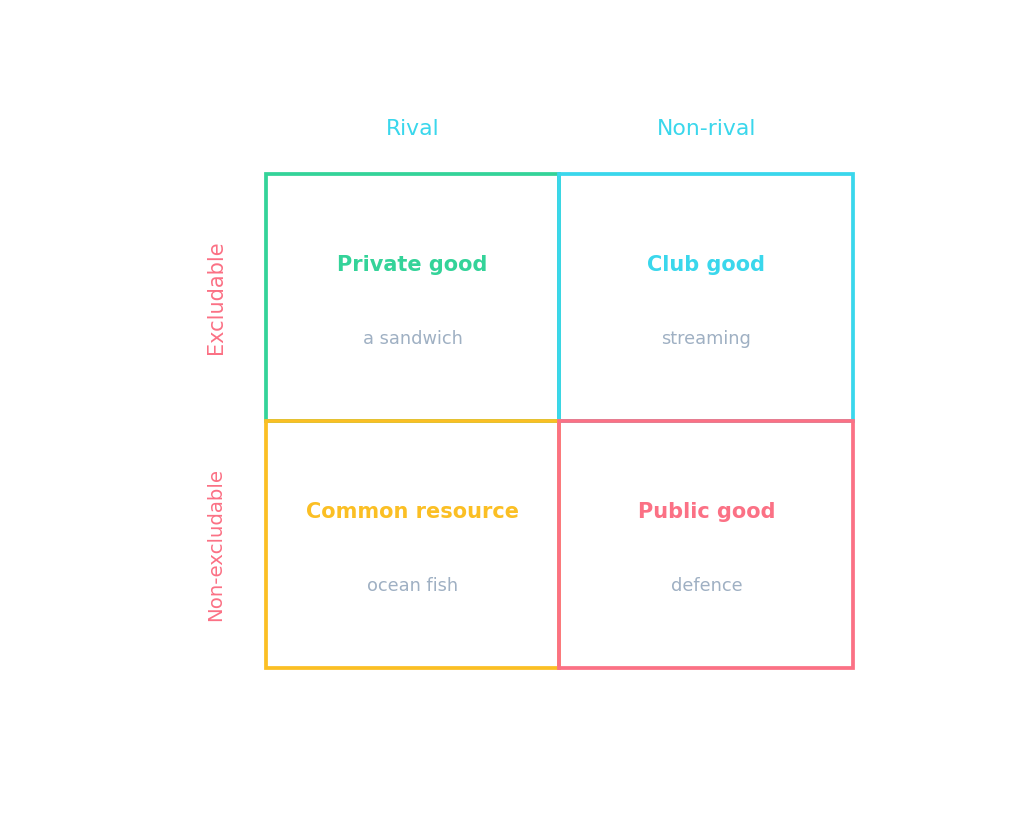
Which type of good?
Rivalry (does use it up?) and excludability (can non-payers be kept out?) sort goods into private, public, common resource, and club goods.
A good is "rival" when:
Dificuldade 1/5 · Moedas 100 + pequeno bônus na primeira conclusão hoje
Rivalry is about using it up; excludability is about keeping non-payers out.
A public good, like national defence, is:
Dificuldade 1/5 · Moedas 100 + pequeno bônus na primeira conclusão hoje
Everyone can use it at once (non-rival) and no one can be shut out (non-excludable).
Match each good to its type.
Dificuldade 2/5 · Moedas 140 + pequeno bônus na primeira conclusão hoje
Rivalry and excludability place each good in one of the four boxes.
The free-rider problem
- Because non-payers can't be excluded from a public good, everyone waits for someone else to pay.
- This is the free-rider problem 搭便车问题, and it makes the market underproduce public goods.
- It is why the government 政府 provides things like defence, funded by taxes.
When everyone waits for someone else to pay for a public good, it is the ______-rider problem.
Dificuldade 1/5 · Moedas 100 + pequeno bônus na primeira conclusão hoje
The free-rider problem leaves public goods underprovided, so the government steps in.
The tragedy of the commons
- A common resource is rival but open to all, so each user grabs as much as they can before others do.
- The result is the tragedy of the commons 公地悲剧: the resource is overused and depleted.
- Fixing it means adding excludability (fencing, licences) or setting a quota.
The tragedy of the commons happens because a common resource is rival but open to all.
Dificuldade 1/5 · Moedas 100 + pequeno bônus na primeira conclusão hoje
Each user grabs as much as they can, so the resource is overused and depleted.
A good way to prevent the tragedy of the commons is to:
Dificuldade 1/5 · Moedas 100 + pequeno bônus na primeira conclusão hoje
Limiting access (quota, fence, licence) stops the overuse that depletes the resource.
Worked example: classifying four goods
Classify each and say whether the market provides it well: (a) a sandwich; (b) a lighthouse; (c) fish in the open ocean; (d) a streaming service.
- (a) Private good: rival and excludable, so markets work well. (b) Public good: non-rival (one ship seeing it does not stop another) and non-excludable, so free riders mean the market under-provides it: governments usually fund it.
- (c) Common resource: rival but non-excludable, so it is overused (the tragedy of the commons); quotas or permits help. (d) Club good: excludable but non-rival (until the servers are full), so a subscription works.
Which is the best example of a public good?
Dificuldade 1/5 · Moedas 100 + pequeno bônus na primeira conclusão hoje
It is non-rival and non-excludable.
Common resources tend to be overused because no one can be excluded but each use reduces what is left.
Dificuldade 1/5 · Moedas 100 + pequeno bônus na primeira conclusão hoje
This is the tragedy of the commons.
Two properties — rivalry and excludability — sort goods into private, public, common resource, and club goods. Public goods suffer the free-rider problem (underprovided, so government steps in); common resources suffer the tragedy of the commons (overused).
Write from the data given
- A lake can sustain 15 boats. 40 boats are fishing.
- Name the overuse and the type of resource.
A lake can sustain 15 fishing boats, but 40 boats are out. How many boats are excess, and what kind of resource is the fish stock?
40 minus 15 is 25.
How many boats are above the sustainable number?
Dificuldade 1/5 · Moedas 100 + pequeno bônus na primeira conclusão hoje
40 minus 15 is 25 extra boats. Other options — 40 (the boats currently fishing); 15 (the sustainable fleet).