Maximização de Lucro
Introduzido| English | Significado |
|---|---|
| total revenue/ˈtəʊtl ˈrevənjuː/ | receita total |
| average revenue/ˈævrɪdʒ ˈrevənjuː/ | Receita média |
| marginal revenue/ˈmɑːdʒɪnl ˈrevənjuː/ | Receita marginal |
| profit-maximizing rule/ˈprɒfɪt ˈmæksɪmaɪzɪŋ ruːl/ | Regra de maximização do lucro |
The one rule every firm follows
- Make too little and you leave easy money on the table.
- Make too much and the last units cost more than they earn.
- Somewhere in between sits the quantity with the biggest profit.
- One simple rule finds it every time.
Three revenue ideas
- Total revenue 总收入 (TR) is all the money from sales: $TR = P \times Q$.
- Average revenue 平均收入 (AR) is revenue per unit: $AR = \tfrac{TR}{Q}$ — this always equals the price.
- Marginal revenue 边际收入 (MR) is the extra revenue from one more unit: $MR = \tfrac{\Delta TR}{\Delta Q}$.
Receita marginal é:
Dificuldade 1/5 · Moedas 100 + pequeno bônus na primeira conclusão hoje
MR = ΔTR/ΔQ — a mudança na receita total de mais uma unidade vendida.
A receita média sempre é igual ao preço do bem.
Dificuldade 1/5 · Moedas 100 + pequeno bônus na primeira conclusão hoje
AR = TR/Q = (P × Q)/Q = P.
Produce where MR = MC
- The profit-maximizing rule 利润最大化法则: make the quantity where marginal revenue equals marginal cost.
- If $MR > MC$, the next unit earns more than it costs — keep going.
- If $MR < MC$, the next unit costs more than it earns — make less.
- Only at $MR = MC$ can profit no longer improve.
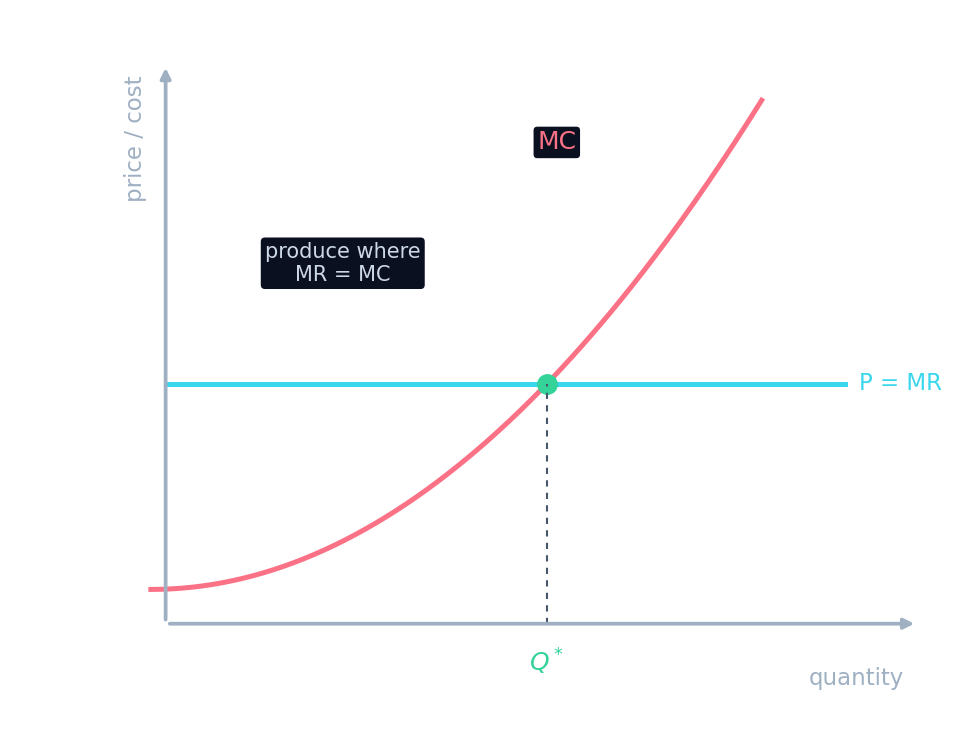
Curvas de custo e a melhor quantidade
Uma empresa maximiza lucro onde a receita marginal encontra o custo marginal. Explore como a curva de custo marginal define essa melhor quantidade.
Uma empresa maximiza lucro produzindo a quantidade onde:
Dificuldade 1/5 · Moedas 100 + pequeno bônus na primeira conclusão hoje
Em MR = MC, o lucro não pode melhorar mais — a regra de maximização de lucro.
Na produção atual, REm é maior que CM. A empresa deve:
Dificuldade 1/5 · Moedas 100 + pequeno bônus na primeira conclusão hoje
REm > CM significa que a próxima unidade adiciona ao lucro, então continue produzindo até que REm = CM.
Measure the profit
- Once you know the best quantity, measure profit with price and average total cost:
- Economic profit $= (P - ATC) \times Q$.
- If $P > ATC$ there is a profit; if $P = ATC$ the firm breaks even; if $P < ATC$ it makes a loss.
- $MR = MC$ finds the best quantity whether the firm is making a profit or the smallest possible loss.
Na sua melhor quantidade, uma empresa produz Q = 50 unidades, com preço P = 12 e custo médio total CMT = 9. Qual é seu lucro econômico?
Dificuldade 2/5 · Moedas 140 + pequeno bônus na primeira conclusão hoje
Lucro econômico = (P − ATC) × Q = (12 − 9) × 50 = 150.
Lucro econômico na quantidade ótima é igual a (P − ______) × Q.
Dificuldade 1/5 · Moedas 100 + pequeno bônus na primeira conclusão hoje
O lucro por unidade é P − CTMe; multiplique por Q para obter o lucro econômico total.
Worked examples
1. A perfectly competitive firm sells at a price of 20, so $MR = 20$. Marginal cost is 18 for the 4th unit, 20 for the 5th and 24 for the 6th. Produce 5 units, where $MR = MC$; the 6th unit would add 24 to cost but only 20 to revenue.
2. If $ATC = 16$ at $Q = 5$, profit $= (P - ATC) \times Q = (20 - 16) \times 5 = 20$.
Uma empresa produz 20 unidades a preço 15 com custo total médio 11. Qual é seu lucro econômico?
4 vezes 20 é 80.
Qual é o lucro econômico?
Dificuldade 1/5 · Moedas 100 + pequeno bônus na primeira conclusão hoje
A diferença de 4 vezes a quantidade 20 é 80. Outras opções — 150 (o lucro da lição); 4 (a diferença por unidade não multiplicada).
Revenue: TR = P × Q, AR = P, and MR is the extra from one more unit. The profit-maximizing rule is MR = MC. Then measure profit as (P − ATC) × Q — positive if P > ATC, break-even if equal, a loss if below.
Write from the data: find the economic profit
- The best output is 20 units. Price is 15 and average total cost is 11.
- Find economic profit.