Government Intervention in Markets
Introduzido| English | Significado |
|---|---|
| price ceiling/praɪs ˈsiːlɪŋ/ | Teto de preço |
| binding/ˈbaɪndɪŋ/ | Vinculante |
| price floor/praɪs flɔː/ | Piso de preço |
| deadweight loss/ˈdedweɪt lɒs/ | Perda de ineficiência |
| per-unit tax/pɜː ˈjuːnɪt tæks/ | Imposto unitário |
| tax incidence/tæks ˈɪnsɪdəns/ | Repercussão tributária |
When the government sets the price
- Sometimes a government decides the market price is too high or too low.
- So it sets a legal limit, or adds a tax, to change the outcome.
- Each rule moves the market away from its efficient equilibrium.
- And each usually creates a loss that goes to nobody.
A price ceiling causes a shortage
- A price ceiling 价格上限 is a legal maximum price.
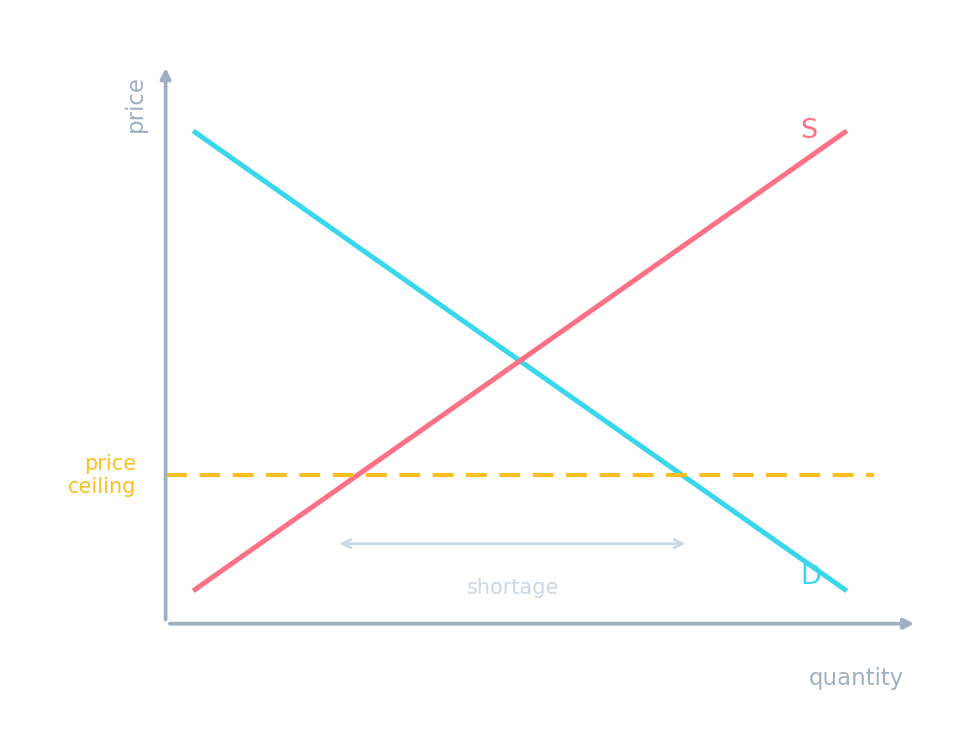
- It only bites when set below equilibrium — then it is binding 有约束力.
- At the low legal price, quantity demanded exceeds quantity supplied — a shortage (think rent control).
Set a price control
A price ceiling below equilibrium creates a shortage; a price floor above it creates a surplus. Drag the control and watch the gap and deadweight loss appear.
A price ceiling causes a shortage
A ceiling of 5 dollars, below the equilibrium of 8, gives quantity demanded 130 and quantity supplied 80: a shortage of 50, with only 80 units traded. Switch to a price floor above 8 and the gap becomes a surplus.
A price ceiling only affects the market (is binding) when it is set:
Dificuldade 1/5 · Moedas 100 + pequeno bônus na primeira conclusão hoje
A ceiling below equilibrium holds the price down and creates a shortage.
Equilibrium is 5 dollars and 100 units. A price ceiling of 3 dollars gives quantity demanded 140 and quantity supplied 70. What is the size of the shortage?
Dificuldade 2/5 · Moedas 140 + pequeno bônus na primeira conclusão hoje
Shortage = quantity demanded − quantity supplied = 140 − 70 = 70.
A price floor causes a surplus
- A price floor 价格下限 is a legal minimum price.
- It only bites when set above equilibrium.
- At the high legal price, quantity supplied exceeds quantity demanded — a surplus (think a minimum wage or farm price supports).
A binding price floor (like a minimum wage) creates a:
Dificuldade 1/5 · Moedas 100 + pequeno bônus na primeira conclusão hoje
A floor above equilibrium keeps the price high, so quantity supplied exceeds quantity demanded.
Match each policy to its effect.
Dificuldade 2/5 · Moedas 140 + pequeno bônus na primeira conclusão hoje
Ceilings cause shortages, floors cause surpluses, and taxes shrink trade with a deadweight loss.
Taxes and deadweight loss
- A per-unit tax 从量税 shifts supply up: buyers pay more, sellers keep less, and the quantity traded shrinks.
- The lost trades create a deadweight loss 无谓损失 — a fall in total surplus that reaches no one.
- Tax incidence 税收归宿: the more inelastic side pays the larger share, because it cannot escape by changing quantity.
A per-unit tax is placed on a good with very inelastic demand. Who bears most of the tax?
Dificuldade 1/5 · Moedas 100 + pequeno bônus na primeira conclusão hoje
The more inelastic side pays the larger share — here, buyers cannot easily escape.
The loss of total surplus from trades that no longer happen is called ______ loss.
Dificuldade 1/5 · Moedas 100 + pequeno bônus na primeira conclusão hoje
A deadweight loss is surplus that a binding control or tax destroys.
Worked example: a binding rent ceiling
In a city, demand for flats is $Q_d = 1000 - P$ and supply is $Q_s = P - 200$ (P is monthly rent in dollars). The city sets a rent ceiling of 500 dollars. Find the equilibrium and the shortage.
- Equilibrium: $1000-P=P-200$, so $P=600$ and $Q=400$ flats. The ceiling of 500 is below 600, so it is binding.
- At a rent of 500 dollars, $Q_d=500$ but $Q_s=300$ flats, a shortage of 200 flats. Only 300 are rented, so 100 trades that would have helped both sides are lost: deadweight loss.
With a price ceiling, quantity demanded is 900 and quantity supplied is 600. What is the shortage?
Dificuldade 2/5 · Moedas 140 + pequeno bônus na primeira conclusão hoje
900 − 600 = 300 units.
A price floor set below the equilibrium price has no effect on the market.
Dificuldade 1/5 · Moedas 100 + pequeno bônus na primeira conclusão hoje
The market price is already above the legal minimum.
A price ceiling (below equilibrium) causes a shortage; a price floor (above equilibrium) causes a surplus. A per-unit tax shrinks trade and creates a deadweight loss, and its burden (tax incidence) falls mostly on the more inelastic side.
Write from the data: find the shortage
- A ceiling of 5 dollars is below the equilibrium price of 8 dollars.
- Quantity demanded is 130 and quantity supplied is 80.
Equilibrium is 8 dollars and 90 units. A price ceiling of 5 dollars gives quantity demanded 130 and quantity supplied 80. What is the shortage?
130 minus 80 is 50.
How large is the shortage?
Dificuldade 1/5 · Moedas 100 + pequeno bônus na primeira conclusão hoje
130 minus 80 is 50. Other options — 70 units (the lesson shortage); 90 units (the old equilibrium quantity).