Market Equilibrium and Surplus
Introduzido| English | Significado |
|---|---|
| equilibrium/ˌiːkwɪˈlɪbrɪəm/ | equilíbrio |
| equilibrium price/ˌiːkwɪˈlɪbrɪəm praɪs/ | preço de equilíbrio |
| equilibrium quantity/ˌiːkwɪˈlɪbrɪəm ˈkwɒntɪti/ | quantidade de equilíbrio |
| producer surplus/prəˈdjuːsə ˈsɜːpləs/ | excedente do produtor |
| consumer surplus/kənˈsuːmə ˈsɜːpləs/ | excedente do consumidor |
| total surplus/ˈtəʊtl ˈsɜːpləs/ | Excedente total |
| allocative efficiency/ˈæləkətɪv ɪˈfɪʃənsi/ | Eficiência alocativa |
| marginal benefit/ˈmɑːdʒɪnl ˈbenɪfɪt/ | benefício marginal |
The price that clears the market
- Buyers want to pay as little as possible; sellers want to charge as much as possible.
- Yet markets settle on one price where their plans match exactly.
- At that price, the amount buyers want equals the amount sellers offer.
- It is the equilibrium 均衡 — and it comes with hidden gains for both sides.
Where demand meets supply
- Equilibrium is where the demand and supply curves cross.
- The equilibrium price 均衡价格 is where quantity demanded equals quantity supplied.
- The equilibrium quantity 均衡数量 is the amount actually bought and sold.
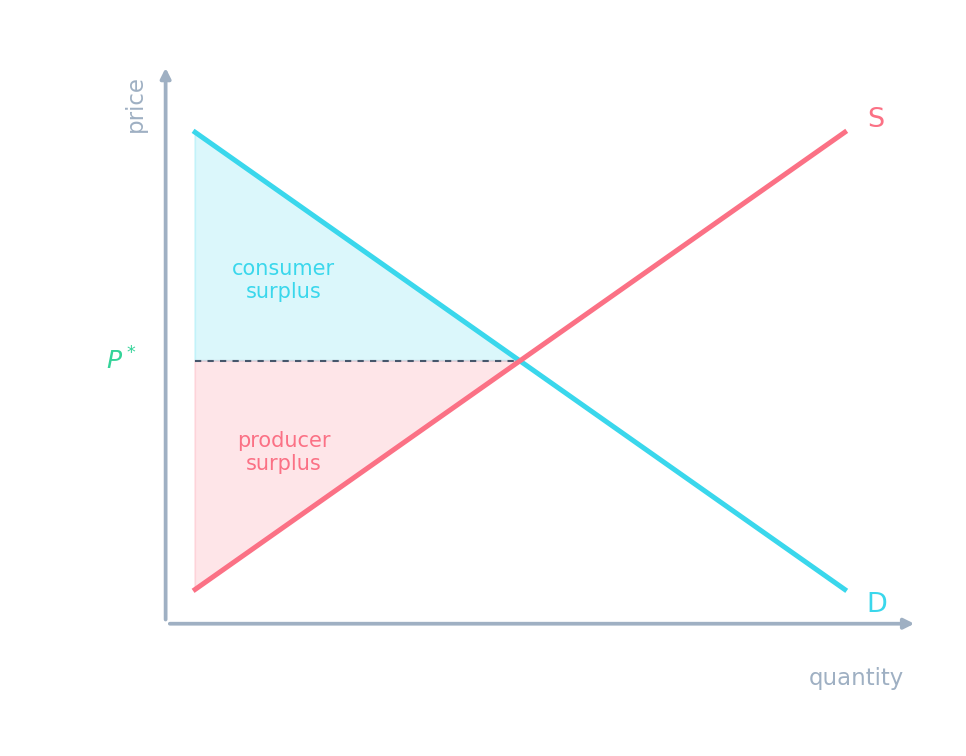
Find the equilibrium
Equilibrium sits where supply crosses demand. Above it there is a surplus; below it a shortage — the price is pushed back to where the two curves meet.
At market equilibrium:
Dificuldade 1/5 · Moedas 100 + pequeno bônus na primeira conclusão hoje
Equilibrium is exactly where the two quantities match and the curves cross.
Consumer and producer surplus
- Consumer surplus 消费者剩余 is the area below the demand curve and above the price — buyers paying less than they were willing to.
- Producer surplus 生产者剩余 is the area above the supply curve and below the price — sellers getting more than they would accept.
- Both are triangles, so each area is $\tfrac{1}{2} \times \text{base} \times \text{height}$.
- Total surplus 总剩余 is consumer surplus plus producer surplus.
Consumer surplus is the area:
Dificuldade 1/5 · Moedas 100 + pequeno bônus na primeira conclusão hoje
Consumer surplus = willingness to pay minus price, summed — below demand, above price.
Consumer surplus plus producer surplus equals ______ surplus.
Dificuldade 1/5 · Moedas 100 + pequeno bônus na primeira conclusão hoje
Total surplus measures the whole gain from trading in the market.
Allocative efficiency
- At the competitive equilibrium, total surplus is as large as it can be.
- This is allocative efficiency 配置效率 — resources go to what society values most.
- It happens exactly where marginal benefit 边际收益 (from the demand curve) equals marginal cost (from the supply curve).
- Make less and MB > MC (a missed gain); make more and MC > MB (a waste).
Allocative efficiency occurs where marginal benefit equals marginal cost.
Dificuldade 1/5 · Moedas 100 + pequeno bônus na primeira conclusão hoje
At MB = MC, total surplus is maximised — the efficient quantity.
Work out the surpluses
- Worked idea. Demand is $P = 20 - Q$; supply is $P = 2 + Q$.
- Set them equal: $20 - Q = 2 + Q$, so $Q = 9$ and $P = 11$.
- Consumer surplus $= \tfrac{1}{2} \times 9 \times (20 - 11) = 40.5$.
- Producer surplus $= \tfrac{1}{2} \times 9 \times (11 - 2) = 40.5$, so total surplus $= 81$.
Demand is P = 20 − Q and supply is P = 2 + Q. What is the equilibrium quantity Q?
Dificuldade 2/5 · Moedas 140 + pequeno bônus na primeira conclusão hoje
Set 20 − Q = 2 + Q, so 18 = 2Q and Q = 9.
With equilibrium at Q = 9 and P = 11, and demand hitting the price axis at 20, what is the consumer surplus? (area of the triangle)
Dificuldade 2/5 · Moedas 140 + pequeno bônus na primeira conclusão hoje
CS = ½ × base × height = ½ × 9 × (20 − 11) = 40.5.
Worked example: surplus from a linear market
Demand is $Q_d = 100 - 10P$ and supply is $Q_s = 10P - 20$ (P in dollars). Find the equilibrium and the consumer and producer surplus.
- Set $100-10P=10P-20$, so $20P=120$, giving $P=6$ and $Q=40$ units. Demand meets the price axis at $P=10$ (where $Q_d=0$), and supply meets it at $P=2$ dollars.
- Consumer surplus = $\tfrac12\times40\times(10-6)=$ 80 dollars. Producer surplus = $\tfrac12\times40\times(6-2)=$ 80 dollars. Total surplus is 160 dollars, the most this market can create.
At equilibrium, quantity is 50 and price is 4 dollars; the demand curve meets the price axis at 10 dollars. What is consumer surplus, in dollars?
Dificuldade 2/5 · Moedas 140 + pequeno bônus na primeira conclusão hoje
½ × 50 × (10 − 4) = 150.
At equilibrium, quantity demanded equals quantity supplied.
Dificuldade 1/5 · Moedas 100 + pequeno bônus na primeira conclusão hoje
That is what defines the market-clearing price.
Equilibrium is where supply meets demand (quantity demanded = quantity supplied). Consumer surplus (below demand, above price) plus producer surplus (above supply, below price) make total surplus, which is largest at the equilibrium — allocative efficiency, where MB = MC.
Write from the data: find the consumer surplus
- Demand is P = 30 minus Q. Supply is P = 6 plus Q.
- Find equilibrium quantity and consumer surplus.
Demand is P = 30 minus Q and supply is P = 6 plus Q. What are the equilibrium quantity and the consumer surplus?
24 divided by 2 is 12. Half of 12 times 12 is 72.
What is the consumer surplus?
Dificuldade 1/5 · Moedas 100 + pequeno bônus na primeira conclusão hoje
The triangle is half of 12 times the gap from 30 down to 18. Other options — 40.5 (the lesson triangle); 12 (the equilibrium quantity).