Financial Assets
Introduzido| English | Significado |
|---|---|
| financial asset/faɪˈnænʃl ˈæset/ | ativo financeiro |
| bond/bɒnd/ | título da dívida |
| interest/ˈɪntrest/ | juros |
| stock/stɒk/ | ação |
| return/rɪˈtɜːn/ | retorno |
| bank deposit/bæŋk dɪˈpɒzɪt/ | depósito bancário |
| bond price/bɒnd praɪs/ | preço do título |
| yield/jiːld/ | rendimento |
| risk/rɪsk/ | risco |
| liquidity/lɪˈkwɪdɪti/ | liquidez |
A claim on future money
- A financial asset 金融资产 is something you own that is a claim on future money.
- Buy one and you are lending or investing, hoping to get more back later.
- Three types anchor the whole financial sector.
- And one surprising rule links a bond's price to interest rates.
Three financial assets
- A stock 股票 is a share of ownership in a company — you hope for rising value and dividends.
- A bond 债券 is a loan to a company or government that pays fixed interest 利息 and returns the amount borrowed at the end.
- A bank deposit 银行存款 is money in a bank — very safe and easy to spend.
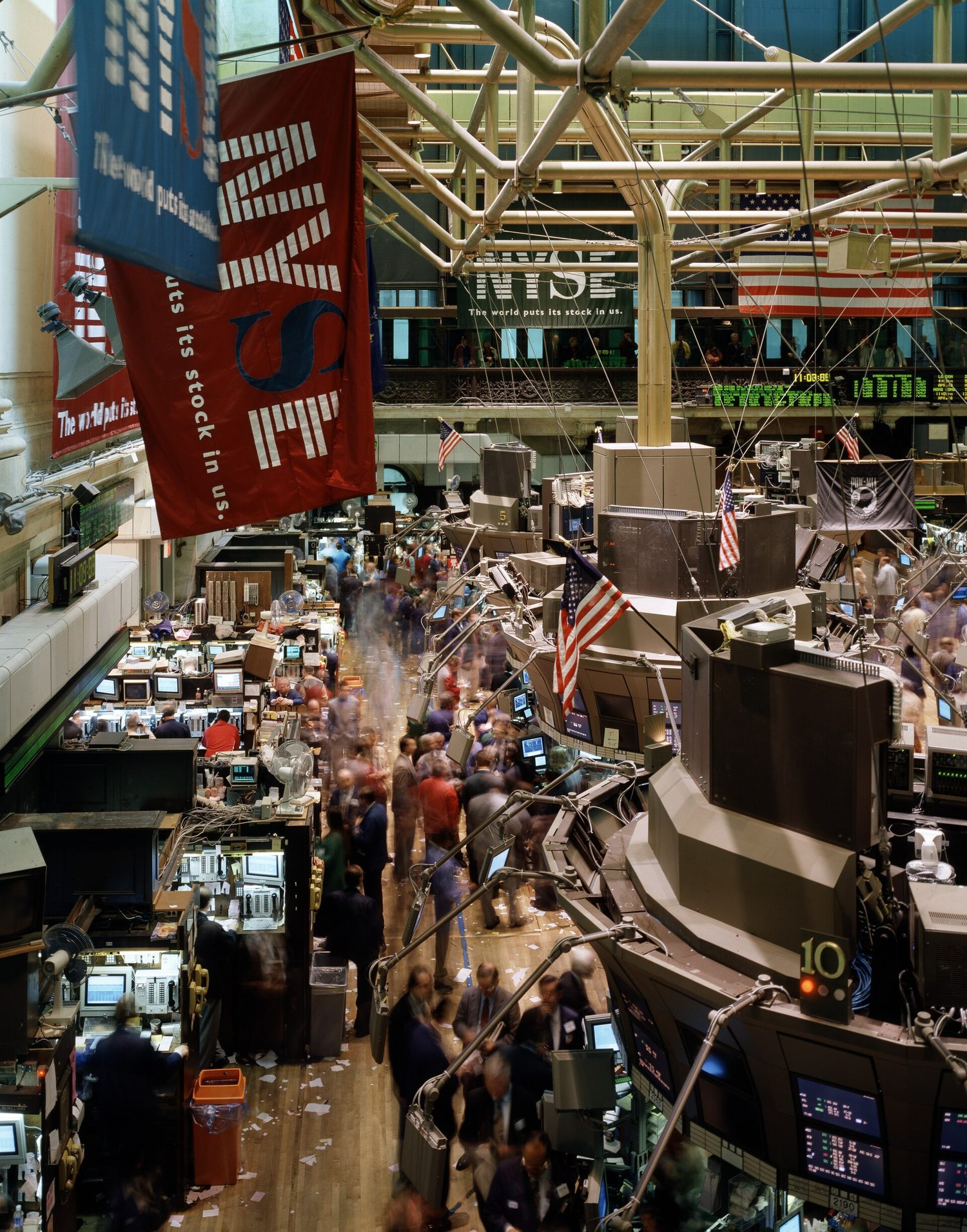
The trading floor of the New York Stock Exchange: financial assets such as shares and bonds are bought and sold here, channelling people's savings into investment
Which financial asset?
A stock is ownership, a bond is a loan paying fixed interest, and a bank deposit is safe, liquid money. Each trades off risk, return, and liquidity.
A bond is:
Dificuldade 1/5 · Moedas 100 + pequeno bônus na primeira conclusão hoje
A bond is a loan; a stock is ownership; a deposit is money in a bank.
Bond prices and yields move opposite
- A bond pays a fixed number of dollars a year, so its bond price 债券价格 and its yield 收益率 move in opposite directions.
- If the price falls, that fixed payment is a bigger percentage — a higher yield.
- Worked idea. A bond pays 50 a year. At a price of 1,000 its yield is $50/1000 = 5\%$; if fear pushes the price to 500, the yield rises to $50/500 = 10\%$.
- This is why bond prices drop when interest rates in the economy climb.
When a bond's market price falls, its yield:
Dificuldade 1/5 · Moedas 100 + pequeno bônus na primeira conclusão hoje
The fixed payment is a bigger percentage of a lower price — price and yield move opposite.
A bond pays 50 a year and its price falls to 500. What is its yield, in percent?
Dificuldade 2/5 · Moedas 140 + pequeno bônus na primeira conclusão hoje
Yield = 50 ÷ 500 × 100 = 10%.
Risk, return, and liquidity
- Risk 风险: the chance the return is worse than expected.
- Return 回报: how much the asset earns.
- Liquidity 流动性: how quickly it turns into spendable cash without losing value.
- Higher risk must offer a higher return to attract buyers; the most liquid assets (like cash) pay the least.
How quickly an asset turns into spendable cash without losing value is its ______.
Dificuldade 1/5 · Moedas 100 + pequeno bônus na primeira conclusão hoje
Cash is the most liquid asset; it also pays the least return.
To attract buyers, a higher-risk asset must offer a higher return.
Dificuldade 1/5 · Moedas 100 + pequeno bônus na primeira conclusão hoje
Buyers demand extra return to bear extra risk.
Select todos three features every asset trades off.
Dificuldade 2/5 · Moedas 140 + pequeno bônus na primeira conclusão hoje
Every asset balances risk, return and liquidity against each other.
Worked example: rates rise, old bonds fall
Maria bought a bond for 1,000 that pays 40 a year (4%). Market interest rates then rise to 8% on new bonds. What happens to the price of Maria's bond, and why?
- No buyer will pay 1,000 for 40 a year when new bonds pay 80. Her bond's price falls until its yield matches the market: $40 \div P = 0.08$, so $P = 500$.
- Bond prices and interest rates move in opposite directions. If she must sell now, she takes a loss; if she holds to maturity, she still gets 1,000 back. A bank deposit would have been more liquid but earned less.
A bond pays 60 a year and now sells for 1,200. What is its yield, in %?
Dificuldade 2/5 · Moedas 140 + pequeno bônus na primeira conclusão hoje
60 ÷ 1,200 × 100 = 5%.
Which asset is the most liquid?
Dificuldade 1/5 · Moedas 100 + pequeno bônus na primeira conclusão hoje
It can be spent at once without losing value.
A financial asset is a claim on future money: a stock (ownership), a bond (a loan paying interest), or a bank deposit. A bond's price and yield move opposite. Every asset trades off risk, return, and liquidity — higher risk needs higher return.
Write from the data: find the bond yield
- A bond pays 40 a year. Its price falls to 800.
- Find the yield.
A bond pays 40 a year and its market price falls to 800. What is the yield, in percent?
40 is 5 percent of 800.
What is the yield?
Dificuldade 1/5 · Moedas 100 + pequeno bônus na primeira conclusão hoje
40 divided by the price 800 is 5 percent. Other options — 10 percent (the lesson yield); 40 percent (the yearly payment used as the yield).