The Size and Distribution of Cities
Introduzido| English | Significado |
|---|---|
| rank-size rule/ræŋk saɪz ruːl/ | Regra de rank-size |
| primate city/ˈpraɪmeɪt ˈsɪti/ | Cidade primata |
| central place theory/ˈsentrəl pleɪs ˈθɪəri/ | Teoria dos Lugares Centrais |
Why is Bangkok so much bigger than Chiang Mai?
- About 11 million people live in the Bangkok region, roughly ten times as many as in any other Thai city. In the United States, by contrast, New York (about 8.3 million in the city itself) is followed by Los Angeles (about 3.9 million), Chicago (about 2.7 million) and Houston (about 2.3 million): a smooth fall in size.
- Geographers describe these two patterns with the rank-size rule 位序规模法则 and the primate city 首位城市, and explain the spacing of towns with central place theory 中心地理论.
The rank-size rule
- The rule says the city ranked n has 1/n the population of the largest city. If the largest city has 8 million people, the 2nd should have 4 million, the 3rd about 2.7 million and the 4th 2 million.
- The US numbers above fit closely (8.3, 3.9, 2.7, 2.3). A rank-size pattern usually means a large, developed country with many cities sharing economic and political functions.
The largest city in a country has 6 million people. Under the rank-size rule, how many million should live in the 3rd city?
Dificuldade 2/5 · Moedas 140 + pequeno bônus na primeira conclusão hoje
6 ÷ 3 = 2 million.
Primate cities
- A primate city is more than twice the size of the second city, and usually dominates the country's economy, government and culture. Examples: Bangkok (Thailand), Paris (France), Lima (Peru), London (UK).
- Primate cities often grew as colonial capitals or the only major port, so investment and migrants kept arriving there. The effects: crowding and housing shortages in the primate city, and fewer jobs and services in the rest of the country.
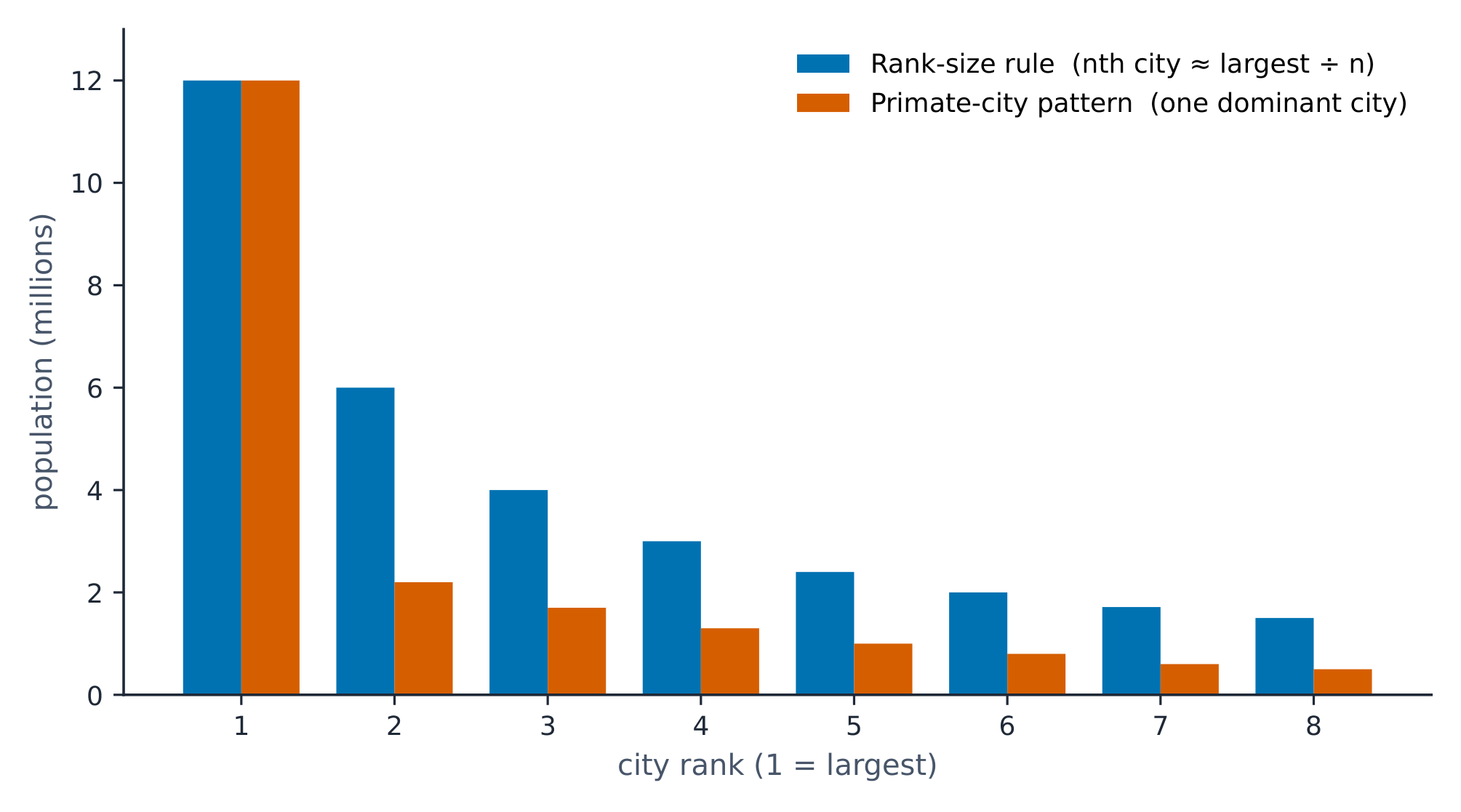
Rank-size or primate?
Sort each urban system as rank-size or primate.
The largest city has 8 million people and the second 1.5 million. What does this show?
Dificuldade 1/5 · Moedas 100 + pequeno bônus na primeira conclusão hoje
The largest city is more than twice (here over five times) the size of the second.
Central place theory
- Walter Christaller (1933) asked why towns are spaced as they are. Each central place sells goods and services to its surrounding market area, drawn as a hexagon so that the areas fit together with no gaps.
- Two ideas decide a service's location: the threshold (the minimum number of customers it needs to stay in business) and the range (the maximum distance people will travel for it). A hospital has a high threshold and a long range; a corner shop has a low threshold and a short range.
Match each term to its meaning.
Dificuldade 2/5 · Moedas 140 + pequeno bônus na primeira conclusão hoje
These decide where services locate.
Hierarchy of places
| Level | How many | Spacing | Typical services |
|---|---|---|---|
| Hamlet or village | many | close together | low-order: bakery, petrol station |
| Town | fewer | further apart | supermarket, secondary school |
| City | few | far apart | high-order: hospital, university, airport |
- Larger places offer every lower-order service too, so a city also has bakeries.
In central place theory, high-order services such as hospitals are found in many small, closely spaced villages.
Dificuldade 1/5 · Moedas 100 + pequeno bônus na primeira conclusão hoje
High-order services need large thresholds, so they are in a few large, widely spaced cities.
The gravity model
- The gravity model predicts that interaction (trade, migration, travel) between two places grows with their populations and falls with the distance between them: interaction ∝ (population A × population B) ÷ distance².
- So two large cities close together (Beijing and Tianjin) interact far more than two small, distant towns. Planners use it to decide where to build roads, rail lines and shopping centres.
According to the gravity model, which pair of places will interact most?
Dificuldade 1/5 · Moedas 100 + pequeno bônus na primeira conclusão hoje
Interaction grows with population and falls with distance.
Worked FRQ answer
Data: In Country X, the largest city has 8 million people and the second city 1.5 million.
(A) Identify the urban pattern shown. A primate city: the largest city is more than five times the size of the second, far more than the double expected by the rank-size rule (4 million).
(B) Explain ONE reason a primate city develops. It was the colonial capital and main port, so government offices, trade and investment were concentrated there, and migrants moved to it for jobs, making it grow even faster.
(C) Explain ONE consequence for the rest of the country. Investment and skilled workers move to the primate city, so other regions have fewer jobs and services, which increases regional inequality.
- Why it scores: (A) uses the numbers against the rule; (B) and (C) each give a process, not just a label.
Rank-size and primate patterns are opposites. Compare the second city with the first: about half suggests rank-size; much less than half means a primate city.
Rank-size rule: the nth city is 1/n the size of the largest. A primate city is more than twice the second city and dominates the country. Central place theory: places serve hexagonal market areas, set by threshold and range, in a hierarchy. The gravity model: interaction rises with population and falls with distance.
FRQ practice. (A) Define the range of a good or service. (B) Explain why a village has a bakery but no hospital. (C) Explain ONE limitation of central place theory.
Threshold and range explain every location in the model.