Internal Boundaries
Introduzido| English | Significado |
|---|---|
| gerrymandering/ˈdʒerɪmændərɪŋ/ | manipulação eleitoral |
| electoral districts/ɪˈlektərəl ˈdɪstrɪkts/ | distritos eleitorais |
| redistricting/ˌriːˈdɪstrɪktɪŋ/ | redistritamento |
A district shaped like a salamander, 1812
- In 1812 Massachusetts Governor Elbridge Gerry signed a law redrawing the state's senate districts to help his party. One district north of Boston twisted so strangely that a newspaper cartoon added claws and wings and called it the "Gerry-mander". His party won more seats than its share of votes.
- Gerrymandering 选区划分不公 is drawing electoral districts 选区 to benefit one group.
Where does the word "gerrymander" come from?
Dificuldade 1/5 · Moedas 100 + pequeno bônus na primeira conclusão hoje
Elbridge Gerry, 1812.
Why districts are redrawn
- In the United States, seats in the House of Representatives are reapportioned among states after each ten-year census. States then redraw district lines — redistricting 重新划分选区 — so each district has about the same population.
- Whoever draws the lines can influence who wins.
Fair redistricting or gerrymandering?
Sort each action as fair redistricting or unfair gerrymandering.
How many years apart are US censuses that trigger redistricting?
Dificuldade 2/5 · Moedas 140 + pequeno bônus na primeira conclusão hoje
Every decade.
Packing and cracking
- Packing: crowd the other party's voters into a few districts, where they win by huge, "wasted" margins.
- Cracking: split the other party's voters across many districts so they are a minority in each.
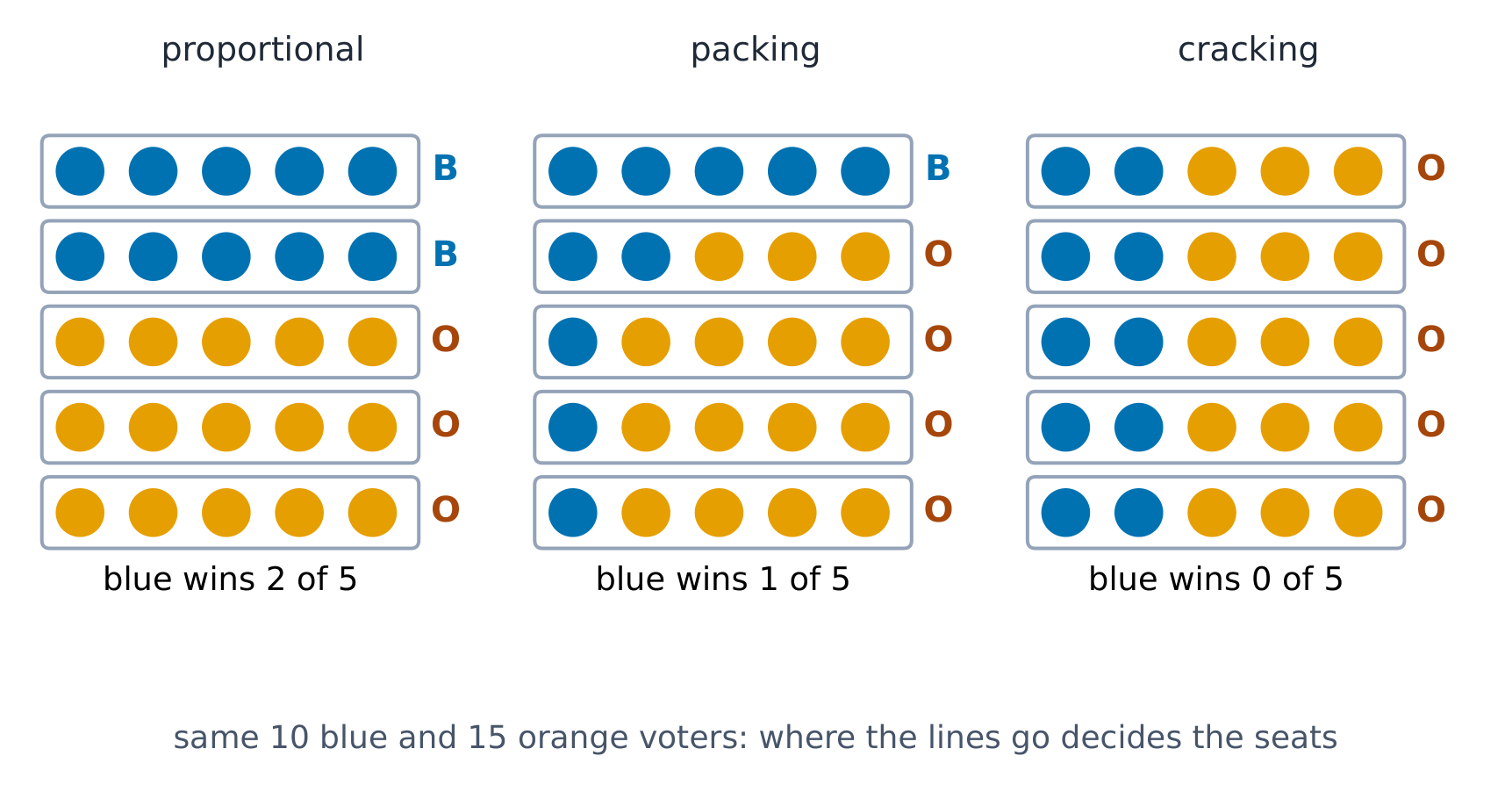
Match each technique to its description.
Dificuldade 2/5 · Moedas 140 + pequeno bônus na primeira conclusão hoje
Two ways to gerrymander.
Who draws the lines
- In many states the legislature draws them, so the party in power has an advantage. Some states use independent commissions to reduce gerrymandering.
- Courts can strike down districts drawn to weaken racial minority votes, under the Voting Rights Act.
Some states use independent commissions to draw districts.
Dificuldade 1/5 · Moedas 100 + pequeno bônus na primeira conclusão hoje
To reduce partisan advantage.
Worked example: 50 voters, 5 districts
A state has 50 voters: 30 Green and 20 Orange. It must draw 5 districts of 10.
- Proportional: 3 Green districts, 2 Orange → matches the 60 : 40 split.
- Cracked for Green: each district has 6 Green and 4 Orange → Green wins all 5.
- Packed to help Orange: put 20 Green voters into two all-Green districts; split the other 30 (20 Orange, 10 Green) as 7–3, 7–3 and 6–4 for Orange → Orange wins 3 of 5 seats with only 40% of the votes.
30 Green and 20 Orange voters are split into 5 districts of 6 Green and 4 Orange. How many districts does Green win?
Dificuldade 2/5 · Moedas 140 + pequeno bônus na primeira conclusão hoje
Green is the majority in each.
In the packed map, what percentage of the seats does Orange win?
Dificuldade 2/5 · Moedas 140 + pequeno bônus na primeira conclusão hoje
3 of 5 seats with 40% of the votes.
Other internal boundaries
- Internal boundaries also divide states into counties, cities, school districts and special zones; they decide which taxes people pay and which schools children attend.
- Boundaries can be consequent (following cultural lines), antecedent, subsequent or geometric (straight lines).
Equal populations do not guarantee fair districts. Every gerrymandered map above has five districts of exactly 10 voters; the shape, not the size, decides the result.
Districts with equal populations are always fair.
Dificuldade 1/5 · Moedas 100 + pequeno bônus na primeira conclusão hoje
Shapes decide results.
After each census, US districts are redrawn to equalise population. Gerrymandering — packing and cracking — can turn the same votes into very different seat totals; independent commissions and courts try to limit it.
Explain how a party with fewer than half the votes can win most seats, using packing and cracking.
Gerrymandering mechanics.