Art Turns, Three Times
Introduzido| English | Significado |
|---|---|
| Neoclassicism | A style of art and architecture from the late 1700s that copied ancient Greece and Rome. |
| Realism | A nineteenth-century style in art and literature that showed ordinary people and everyday life as they really were. |
| Cubism | An early twentieth-century art style that broke objects and figures into geometric shapes, begun by Picasso and Braque. |
A critic names a movement by mistake, 1874
- In April 1874, a group of painters refused by the official Paris Salon held their own exhibition. One picture by Claude Monet showed the harbour at Le Havre in quick brushstrokes and was called Impression, Sunrise. The critic Louis Leroy mocked the whole group as "Impressionists". The painters adopted the name.
- Between 1780 and 1914, European art changed direction three times — and each time, older styles continued.
How did Impressionism get its name?
Dificuldade 1/5 · Moedas 100 + pequeno bônus na primeira conclusão hoje
Louis Leroy, 1874.
From Neoclassicism to Romanticism
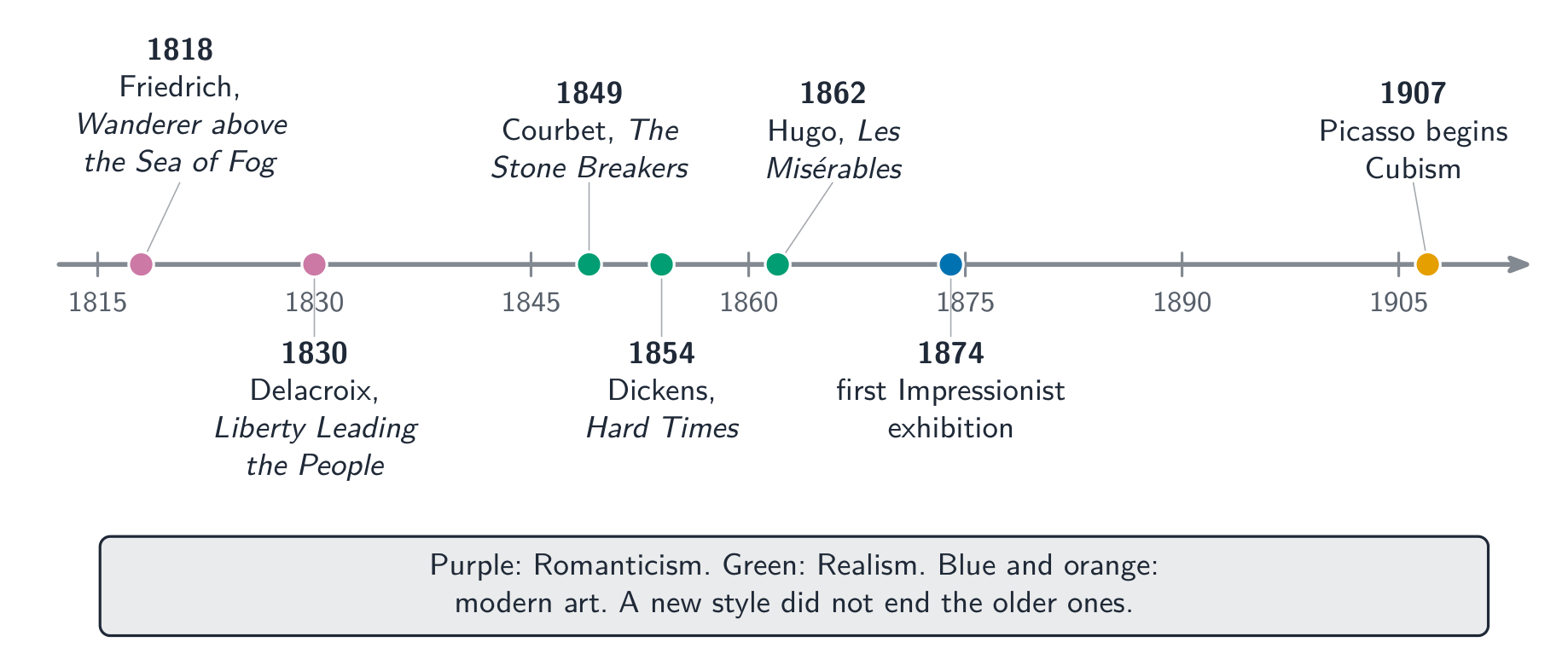
- Neoclassicism 新古典主义 copied ancient Greece and Rome with clear lines and moral stories, as in Jacques-Louis David's Oath of the Horatii (1784).
- Romantic painters, such as Delacroix and Turner, used strong colour, movement and emotion, and painted storms, battles and wild nature.
Writers respond to two revolutions
- After the French and Industrial Revolutions, writers described the poor and the cities. Victor Hugo's Les Misérables (1862) and Charles Dickens's Hard Times (1854) showed poverty and injustice.
- Novels became a way to criticize society.
Romanticism, Realism, or Modern art?
Sort each artistic development.
Worked example: Realism
- Subject: Gustave Courbet's The Stone Breakers (1849) showed two poor labourers breaking rocks at life size — a size usually kept for kings and gods.
- Aim: Realism 现实主义 showed ordinary people and everyday work as they really were, without idealizing them.
- Literature: Flaubert's Madame Bovary (1857) and Zola's novels of miners and workers did the same in writing.
Match each work to its style.
Dificuldade 2/5 · Moedas 140 + pequeno bônus na primeira conclusão hoje
Three turns.
What did Realism aim to show?
Dificuldade 1/5 · Moedas 100 + pequeno bônus na primeira conclusão hoje
Courbet, Flaubert, Zola.
Modern art moves past representation
- Impressionists painted light and moments rather than exact detail. Van Gogh and Cézanne used colour and form to express feeling and structure.
- Picasso's Les Demoiselles d'Avignon (1907) broke figures into geometric shapes — the start of Cubism 立体主义.
Put these works in order.
Dificuldade 3/5 · Moedas 200 + pequeno bônus na primeira conclusão hoje
1784, 1849, 1872, 1907.
Continuities
- The official Salon kept showing traditional academic art throughout the century.
- Photography (from 1839) pushed painters to do what the camera could not.
Photography pushed painters to do what the camera could not.
Dificuldade 1/5 · Moedas 100 + pequeno bônus na primeira conclusão hoje
From 1839.
A new style did not end the older ones. Neoclassical and academic art continued alongside Romanticism, Realism and Impressionism. Describe overlapping changes, not one style replacing another.
Impressionism ended academic art in the nineteenth century.
Dificuldade 1/5 · Moedas 100 + pequeno bônus na primeira conclusão hoje
The Salon continued.
Art moved from Neoclassicism to Romanticism's emotion, then to Realism's ordinary lives and the novels of Hugo, Dickens and Zola, and finally to Impressionism and Cubism, which moved beyond exact representation. Older styles continued alongside each change.
Explain how and why the subjects of European art changed between 1780 and 1914.
Change and continuity.