Empire's Two Effects
Introduzido| English | Significado |
|---|---|
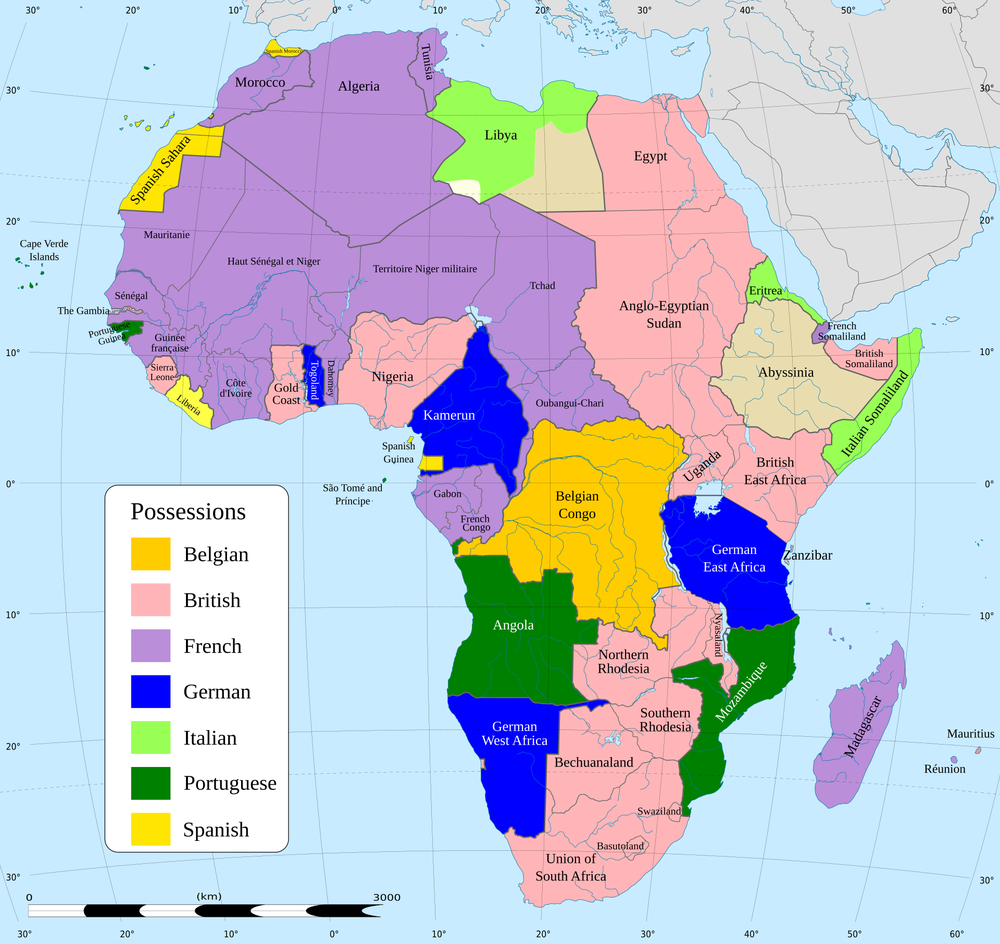
| Scramble for Africa | The rapid division of almost all of Africa among European powers between about 1880 and 1914. |
| imperialism/ɪmˈpɪərɪəlɪzəm/ | The policy of extending a country's power by taking control of other lands and peoples. |
Victory at Adwa, 1896
- On 1 March 1896, an Ethiopian army of about 100 000 under Emperor Menelik II, armed with modern rifles, defeated an Italian invasion force at Adwa. Around 7000 Italian soldiers were killed in one day. Ethiopia remained independent — one of only two African states not ruled by Europeans by 1914.
- Empire changed both the colonized societies and Europe itself.
What happened at Adwa in 1896?
Dificuldade 1/5 · Moedas 100 + pequeno bônus na primeira conclusão hoje
Ethiopia stayed independent.
The Scramble for Africa
- In the Scramble for Africa 瓜分非洲 after 1880, Britain, France, Germany, Belgium, Italy and Portugal claimed almost the whole continent.
- In the Congo, ruled personally by King Leopold II of Belgium, forced rubber collection and brutal punishments killed millions.
Forced rubber collection in Leopold II's Congo killed millions of people.
Dificuldade 1/5 · Moedas 100 + pequeno bônus na primeira conclusão hoje
One of the worst colonial regimes.
Effects in Europe
- Society: new jobs in shipping, trade and colonial government; tea, cocoa, rubber and palm oil became everyday goods.
- Culture: writers such as Rudyard Kipling ("The White Man's Burden", 1899) presented imperialism 帝国主义 as a civilizing duty; exhibitions displayed colonized peoples as curiosities.
Which were effects of empire inside Europe?
Dificuldade 2/5 · Moedas 140 + pequeno bônus na primeira conclusão hoje
Rivalries grew.
Worked example: empire and European diplomacy
- Fashoda (1898): British and French forces met on the Upper Nile; France backed down, and the two powers later settled their rivalry in the Entente Cordiale (1904).
- Morocco (1905 and 1911): Germany challenged French control of Morocco, but Britain backed France both times.
- Effect: colonial disputes pushed Britain and France together and isolated Germany — part of the alliance system that went to war in 1914.
Which effect of empire?
Sort each consequence of imperial endeavours.
Put these events in order.
Dificuldade 3/5 · Moedas 200 + pequeno bônus na primeira conclusão hoje
1898, 1904, 1905, 1911.
Resistance abroad
- In India, the 1857 rebellion against the East India Company was crushed, but the Indian National Congress (1885) began organized nationalism.
- In German East Africa, the Maji Maji rising (1905–07) was crushed; in South West Africa, Germany's war against the Herero and Nama (1904–08) killed most of both peoples. China's Boxer Uprising (1899–1901) attacked foreigners and was put down by an eight-nation force.
Match each act of resistance to its place.
Dificuldade 2/5 · Moedas 140 + pequeno bônus na primeira conclusão hoje
Resistance abroad.
Two societies changed
- Colonized societies lost land, labour and self-rule, but also gained new ideas — including European nationalism, which they turned against their rulers.
- Europe gained wealth and prestige, but also new rivalries and racial ideas that hardened at home.
Colonized peoples were not passive. They resisted by war (Adwa, Maji Maji), revolt (the Boxers) and political organization (the Indian National Congress). Write about both societies, not only the Europeans.
Colonized peoples accepted European rule without resistance.
Dificuldade 1/5 · Moedas 100 + pequeno bônus na primeira conclusão hoje
They fought and organized.
The Scramble for Africa and imperial rule in Asia brought new jobs, goods and ideas of racial superiority to Europe, and colonial disputes shaped its alliances. Colonized peoples resisted in war and politics, and some, like Ethiopia at Adwa, kept their independence.
Explain how imperialism affected relations between European powers between 1898 and 1914.
Causation.