Governments Respond
Introduzido| English | Significado |
|---|---|
| laissez-faire/ˈleɪsez feə/ | An approach in which government largely leaves economic decisions to individuals and businesses with minimal intervention. |
| public health/ˈpʌblɪk helθ/ | Measures, such as sewers and clean water, that protect a population's health. |
| social insurance | A state scheme that pays people when they are sick, injured or old, funded by contributions from workers, employers and the state. |
The Great Stink, 1858
- In the hot summer of 1858, the River Thames in London smelled so bad from untreated sewage that Parliament soaked its curtains in chemicals and thought of leaving the city. Within weeks, MPs approved Joseph Bazalgette's plan for over 2000 kilometres of sewers. Cholera, which had killed tens of thousands of Londoners, soon stopped returning.
- In the later 1800s, governments took on new responsibilities for their people.
Liberalism changes
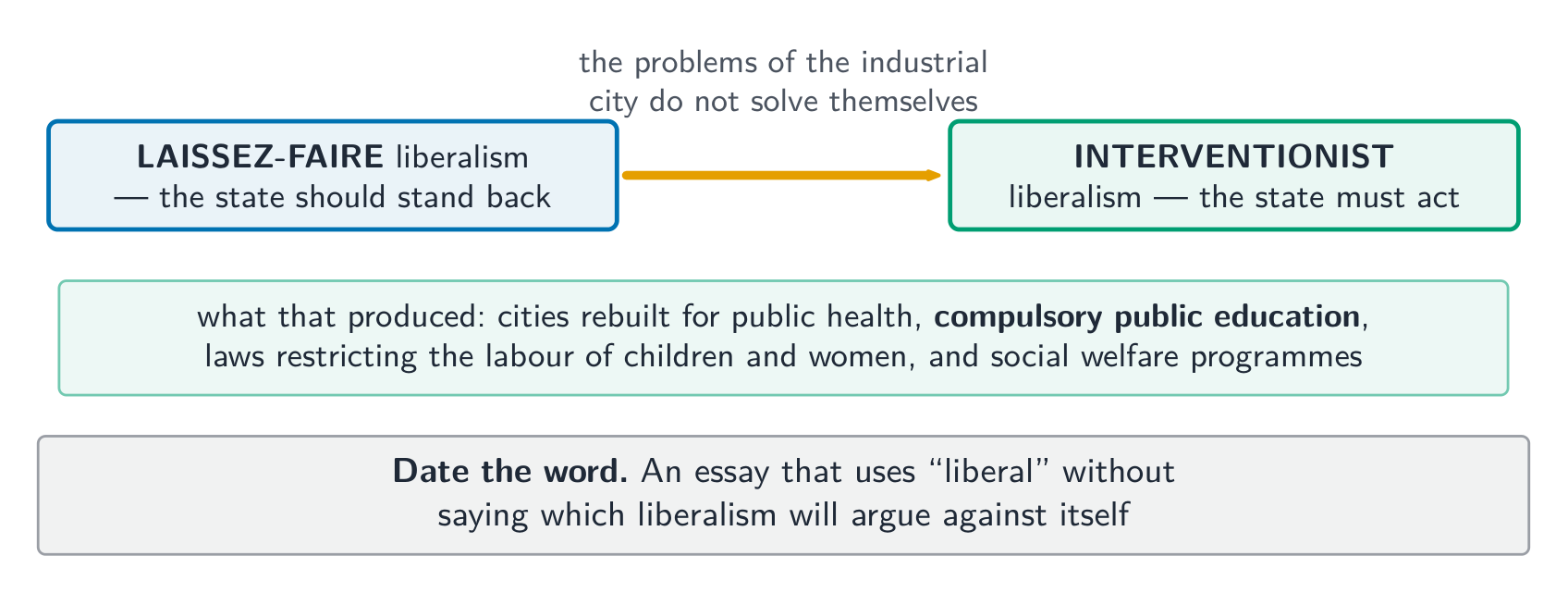
- Early liberals favoured laissez-faire 自由放任: the state should leave the economy alone.
- By 1900, many liberals argued the state must act to give people a fair chance — through laws on factories, health and education.
What does laissez-faire mean?
Dificuldade 1/5 · Moedas 100 + pequeno bônus na primeira conclusão hoje
Early liberal belief.
Rebuilding cities
- Public health 公共卫生 laws (Britain 1848 and 1875) required clean water, drains and inspectors.
- In Paris, Baron Haussmann (1853–70) demolished crowded medieval streets for wide boulevards, parks, sewers and new apartment blocks — also making it harder to build barricades.
Match each reform to its place.
Dificuldade 2/5 · Moedas 140 + pequeno bônus na primeira conclusão hoje
Urban and social reform.
Worked example: why Bismarck created social insurance
- The measures: Germany created social insurance 社会保险 for health (1883), accidents (1884) and old age (1889), the first national schemes of their kind.
- The motive: Bismarck, a conservative, wanted to win workers away from the growing Social Democratic Party, which he had banned in 1878.
- The lesson: governments reformed not only from kindness but to keep order and loyalty — reform as a way to prevent revolution.
Watch liberalism change sides
'Liberal' in 1830 and in 1900 recommend contradictory things — date the word.
Why did Bismarck introduce social insurance?
Dificuldade 1/5 · Moedas 100 + pequeno bônus na primeira conclusão hoje
Reform to prevent revolution.
Mass education
- Britain's Education Act (1870) set up state schools; France's Ferry laws (1881–82) made primary schooling free, compulsory and secular.
- Goals: a literate workforce, loyal citizens who shared one national language and history, and less Church influence.
What were the goals of mass education?
Dificuldade 2/5 · Moedas 140 + pequeno bônus na primeira conclusão hoje
Literacy and loyalty.
France's Ferry laws made primary schooling free, compulsory and secular.
Dificuldade 1/5 · Moedas 100 + pequeno bônus na primeira conclusão hoje
1881–82.
Who pushed governments
- Reformers and doctors gathered evidence: Edwin Chadwick's 1842 report linked disease to filthy housing.
- Workers who gained the vote — British men in 1867 and 1884, German men in 1871 — pressed for reforms.
"Liberal" changed meaning in the nineteenth century. An 1830 liberal wanted the state to stay out of the economy; an 1900 liberal often wanted the state to act. Date the term in your answer.
Liberals held the same view of the state throughout the nineteenth century.
Dificuldade 1/5 · Moedas 100 + pequeno bônus na primeira conclusão hoje
Many moved from laissez-faire to intervention.
Governments moved from laissez-faire to active reform: sewers and public health laws, rebuilt cities, social insurance in Germany and free mass education. Reformers, voters and fear of socialism all pushed them to act.
Explain why European governments took on new social responsibilities in the late nineteenth century.
Causation.