The Congress of Vienna
Introduzido| English | Significado |
|---|---|
| balance of power/ˈbæləns ɒv ˈpaʊə/ | A diplomacy that stops any one state from dominating the others. |
| legitimacy/ləˈdʒɪtɪməsi/ | The principle of the Congress of Vienna that rightful hereditary monarchs should be restored to their thrones. |
| Concert of Europe/ˈkɒnsət ɒv ˈjʊərəp/ | The post-1815 cooperation of great powers to prevent revolution and war. |
"The Congress dances", 1814–15
- From September 1814, emperors, kings and diplomats met in Vienna to rebuild Europe after Napoleon. There were so many balls that an old prince joked, "The Congress dances, but it does not advance." Then, in March 1815, Napoleon escaped from Elba and returned to France. The diplomats moved fast — and signed their treaty nine days before Waterloo.
- The Congress of Vienna tried to make a peace that would prevent both French expansion and revolution.
Who decided
- The four great powers — Austria (Metternich), Britain (Castlereagh), Russia (Tsar Alexander I) and Prussia — led the Congress. France's Talleyrand cleverly won France a seat.
- Their aims: stop France from dominating Europe again and stop revolution from spreading.
Match each diplomat to their country.
Dificuldade 2/5 · Moedas 140 + pequeno bônus na primeira conclusão hoje
The Congress's leaders.
What were the aims of the Congress?
Dificuldade 2/5 · Moedas 140 + pequeno bônus na primeira conclusão hoje
German unity was not an aim.
Balance of power, again
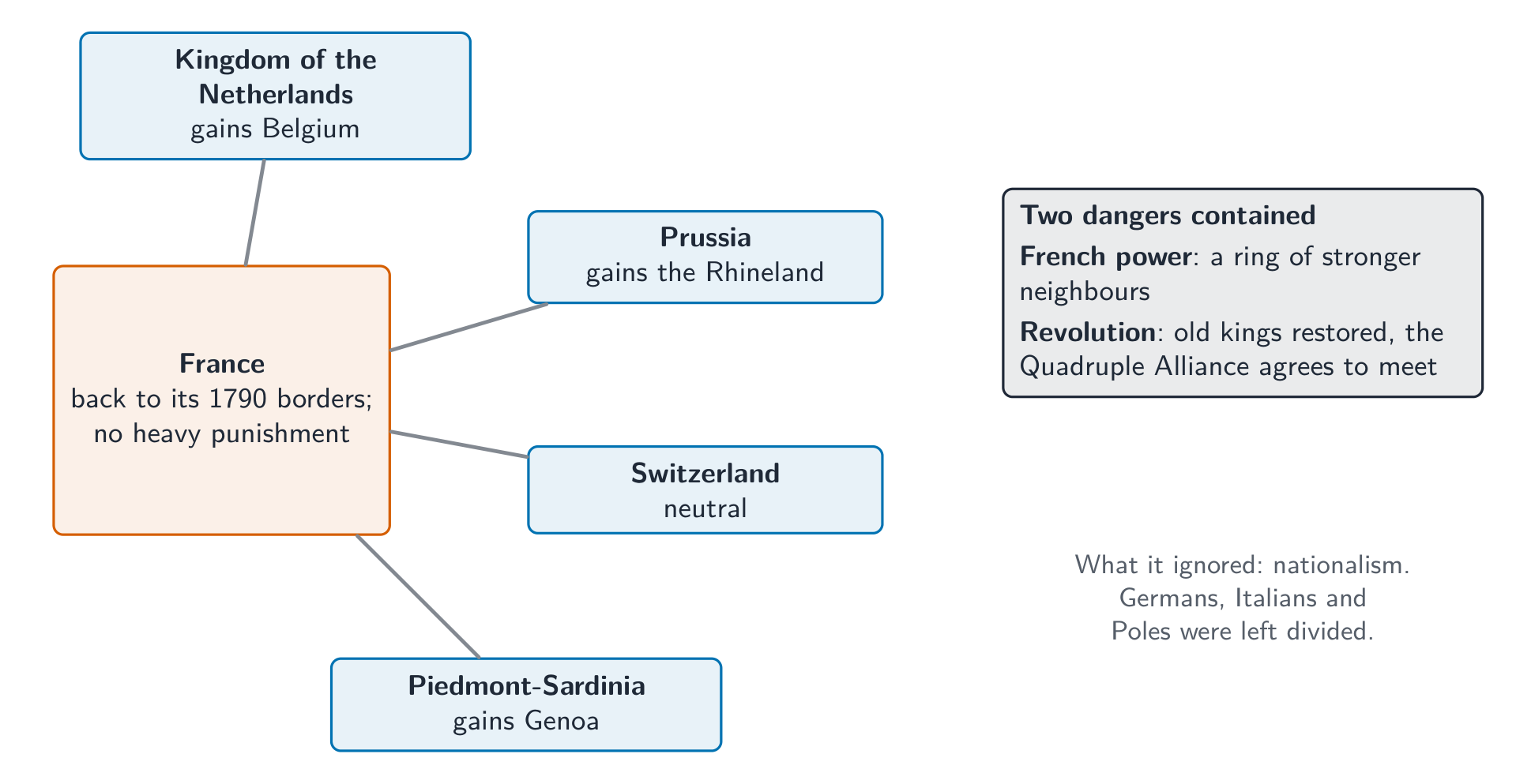
- France was surrounded by stronger neighbours: the Netherlands gained Belgium, Prussia gained land on the Rhine, and Piedmont-Sardinia gained Genoa.
- France itself was treated mildly, keeping its 1790 borders, so it would not seek revenge.
An aim, a named danger, or a later consequence?
Sort each element of the Vienna settlement.
Why did the Netherlands gain Belgium?
Dificuldade 1/5 · Moedas 100 + pequeno bônus na primeira conclusão hoje
A buffer state.
Worked example: two dangers contained
- Danger 1 — French expansion: buffer states around France and a restored balance of power 均势.
- Danger 2 — revolution: the principle of legitimacy 正统原则 restored "rightful" monarchs, such as the Bourbons in France and Spain.
- The system: the Concert of Europe 欧洲协调 — great powers meeting to settle problems — and Metternich's Carlsbad Decrees (1819), which censored German universities and newspapers.
What was the principle of legitimacy?
Dificuldade 1/5 · Moedas 100 + pequeno bônus na primeira conclusão hoje
Against revolution.
How long it lasted
- No war involved all the great powers until 1914 — nearly a century.
- But revolts broke out in 1820, 1830 and 1848, and the Concert weakened after the Crimean War (1853–56).
How many years passed between 1815 and 1914?
Dificuldade 2/5 · Moedas 140 + pequeno bônus na primeira conclusão hoje
Nearly a century without a general war.
What it ignored
- The Congress ignored nationalism: Germans and Italians stayed divided, and Poles were ruled by Russia.
- These ignored peoples drove the revolutions and unifications of the next decades.
The Congress gave the Italians and Germans national unity.
Dificuldade 1/5 · Moedas 100 + pequeno bônus na primeira conclusão hoje
It ignored nationalism.
The Congress of Vienna did not restore Europe exactly as it was before 1789. It redrew borders, kept many changes and created a new system of great-power meetings.
The Congress of Vienna (1814–15) contained France with buffer states and a balance of power, restored legitimate monarchs, and created the Concert of Europe to fight revolution. It prevented a general war for nearly a century but ignored nationalism, which fuelled later revolts.
Explain how the Congress of Vienna tried to prevent future revolution and war.
Purpose and effect.