Romanticism and Revival
Introduzido| English | Significado |
|---|---|
| Romanticism/rəʊˈmæntɪsɪzəm/ | An artistic movement that prized emotion, nature, and the individual imagination. |
| nationalism/ˈnæʃənəlɪzəm/ | The belief that a people sharing language and culture should have its own state. |
A novel that made young men weep, 1774
- In 1774, the 24-year-old Johann Wolfgang von Goethe published The Sorrows of Young Werther, a novel about a sensitive young man who kills himself for love. Young men across Europe copied Werther's yellow waistcoat and blue coat, and some cities banned the book. Readers were moved not by argument but by feeling.
- From the late eighteenth century, Romanticism challenged the Enlightenment's trust in reason.
Why was Werther important for Romanticism?
Dificuldade 1/5 · Moedas 100 + pequeno bônus na primeira conclusão hoje
Emotion over reason.
Rousseau opens the door
- Rousseau had argued that feeling and nature were as important as reason, and that society corrupted people.
- Romanticism 浪漫主义 valued emotion, imagination, nature and the individual's inner life.
What did Romanticism value?
Dificuldade 2/5 · Moedas 140 + pequeno bônus na primeira conclusão hoje
Feeling and imagination.
The Romantic challenge
- Wordsworth and Coleridge's Lyrical Ballads (1798) used ordinary speech to write about nature and feeling. Caspar David Friedrich painted lone figures before mountains and seas.
- Romantics admired the past, especially the Middle Ages, and the culture of ordinary people, rather than ancient Greece and Rome.
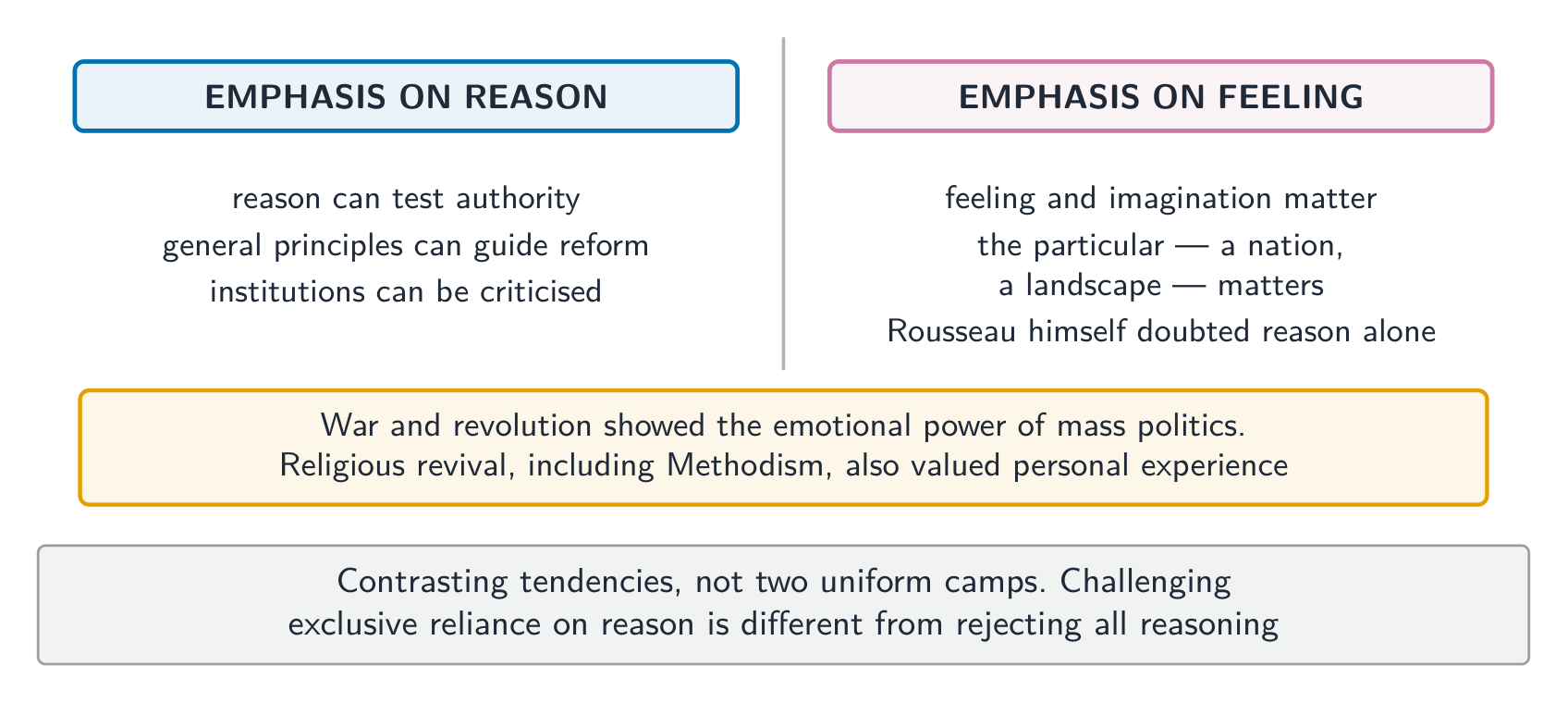
Rousseau, the movements, or the evidence?
Sort each element of the challenge to reason.
Worked example: Romanticism and the nation
- Idea: the German writer Herder argued that each people has its own spirit, shown in its language, songs and stories.
- Action: the Brothers Grimm collected German folk tales (1812) to preserve a national culture.
- Politics: Lord Byron died in 1824 while helping the Greeks fight for independence from the Ottomans. Romantic feeling gave nationalism 民族主义 emotional power.
Match each person to their work.
Dificuldade 2/5 · Moedas 140 + pequeno bônus na primeira conclusão hoje
Romantic works.
How did Romanticism support nationalism?
Dificuldade 1/5 · Moedas 100 + pequeno bônus na primeira conclusão hoje
Herder's idea of a people's spirit.
Religious revival
- After the Revolution's attacks on the Church, many Europeans returned to faith. Chateaubriand's The Genius of Christianity (1802) praised Catholicism for its beauty and emotion.
- In Britain and Germany, Protestant revivals stressed personal, emotional faith.
Romanticism was accompanied by a religious revival.
Dificuldade 1/5 · Moedas 100 + pequeno bônus na primeira conclusão hoje
Chateaubriand, Protestant revivals.
Emotion in politics
- Romantic art could inspire revolution: Delacroix's Liberty Leading the People (1830) celebrated Paris's July Revolution.
- Movements appealed to people's hearts as well as their reason.
Romantics did not reject reason completely. They argued that reason alone was not enough, and that feeling, faith and history also mattered.
Romantics rejected reason completely.
Dificuldade 1/5 · Moedas 100 + pequeno bônus na primeira conclusão hoje
Reason alone was not enough.
Romanticism, from Goethe and Rousseau to Wordsworth and Friedrich, valued feeling, nature, the past and the culture of ordinary people. It fed a religious revival and gave nationalism and revolution emotional power.
Explain how Romanticism challenged Enlightenment ideas.
Change.