Britain and France
Introduzido| English | Significado |
|---|---|
| Seven Years' War/ˈsevən jɪəz wɔː/ | The 1756–1763 global war in which Britain beat France for colonial dominance. |
| national debt/ˈnæʃənl det/ | The total amount of money a government owes to its lenders. |
The Plains of Abraham, 1759
- Before dawn on 13 September 1759, British soldiers under General Wolfe climbed the cliffs below Quebec, the capital of French Canada. In a battle of about fifteen minutes, they defeated the French; both commanders were killed. By 1763, France had lost almost all of Canada and most of its power in India to Britain.
- Britain and France competed for empire and trade around the world in the eighteenth century — and how each paid for war shaped its future.
What did France lose by 1763?
Dificuldade 1/5 · Moedas 100 + pequeno bônus na primeira conclusão hoje
The Treaty of Paris.
A rivalry on several continents
- The two powers fought in Europe, North America, the Caribbean and India: in the War of the Austrian Succession (1740–48) and the Seven Years' War 七年战争 (1756–63).
- At Plassey (1757), the British East India Company defeated the ruler of Bengal and began to control India's richest province.
Credit as a weapon
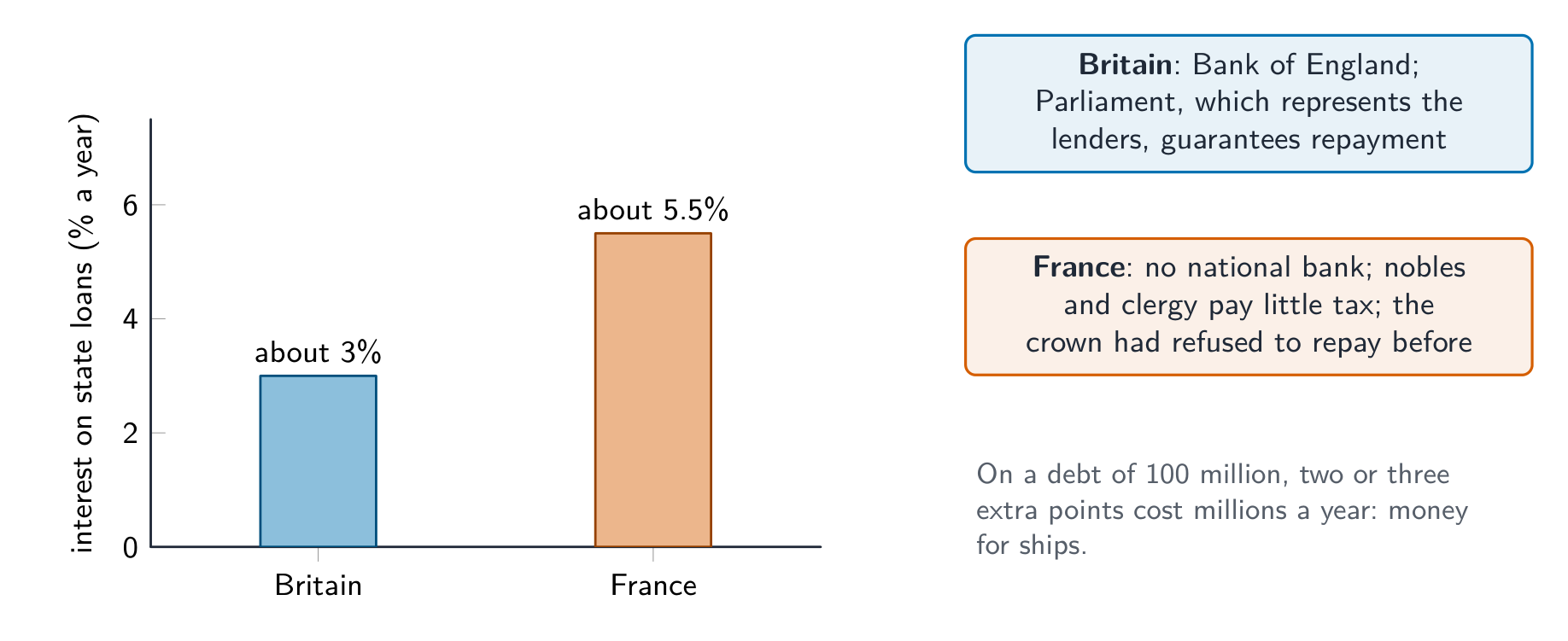
- Britain borrowed through the Bank of England, and Parliament guaranteed repayment, so lenders accepted low interest — about 3%.
- France had no national bank, and many nobles and clergy paid little tax, so it borrowed at higher rates and struggled to collect money.
Military, economic, or the political outcome?
Sort each element of the Anglo-French rivalry.
Why could Britain borrow more cheaply than France?
Dificuldade 1/5 · Moedas 100 + pequeno bônus na primeira conclusão hoje
Trusted credit.
About what interest rate did British government loans pay?
Dificuldade 2/5 · Moedas 140 + pequeno bônus na primeira conclusão hoje
About 3%.
Worked example: the consequences
- Economic: Britain gained Canada, Florida and power in India in the Treaty of Paris (1763), and its Atlantic trade grew. Both states were left with large national debts 国债.
- Political (Britain): to pay its debt, Britain taxed its American colonies, which led to the American Revolution (1775–83).
- Political (France): France helped the Americans to weaken Britain, spending over a billion livres; this new debt pushed the monarchy into the crisis of 1789.
Match each consequence to its result.
Dificuldade 2/5 · Moedas 140 + pequeno bônus na primeira conclusão hoje
Economic and political consequences.
Put these events in order.
Dificuldade 3/5 · Moedas 200 + pequeno bônus na primeira conclusão hoje
1757, 1759, 1763, 1783.
Why the two states differed
- In Britain, Parliament controlled taxes and was trusted by lenders. In France, the king could not tax the privileged without their consent.
- Britain's navy, the largest in the world, protected its trade and colonies.
A pattern
- The state that could raise money most reliably usually won the wars. Britain's financial system was its secret weapon.
- France's victory in America (1783) was a financial disaster.
France won the American war but lost the money. Winning a war does not always make a state stronger. Link the debt to the causes of the French Revolution.
France's victory in the American war strengthened its finances.
Dificuldade 1/5 · Moedas 100 + pequeno bônus na primeira conclusão hoje
It deepened the debt.
Britain and France fought for empire in Europe, North America and India. Britain's trusted credit and navy helped it win the Seven Years' War, but war debts led Britain to tax its colonies and France into the financial crisis that opened the Revolution of 1789.
Explain how the Anglo-French rivalry contributed to the French Revolution.
Causation.