The French Revolution
Introduzido| English | Significado |
|---|---|
| Declaration of the Rights of Man and of the Citizen | The 1789 French statement of natural rights, equality before the law and popular sovereignty. |
| constitutional monarchy/ˌkɒnstɪˈtjuːʃənl ˈmɒnəki/ | A system in which a monarch rules under a constitution and shares power with an elected parliament. |
| levée en masse | The French order of August 1793 calling all unmarried men aged 18 to 25 into the army. |
| mass conscription/mæs kɒnˈskrɪpʃn/ | mass conscription: Recrutamento em massa |
The Tennis Court Oath, 20 June 1789
- On 20 June 1789, the deputies of the Third Estate — representing about 97% of the French people — found themselves locked out of their meeting hall at Versailles. They gathered in a nearby indoor tennis court and swore not to separate until they had given France a constitution. They called themselves the National Assembly.
- The French Revolution moved from reform to radical republic in five years, and changed Europe.
Long-term causes, short-term trigger
- Long-term: the nobles and clergy were largely exempt from taxes; the middle class resented privilege; and Enlightenment ideas questioned absolute monarchy.
- Short-term: by 1788, about half the state's spending went on debt payments. A bad harvest that year doubled the price of bread.
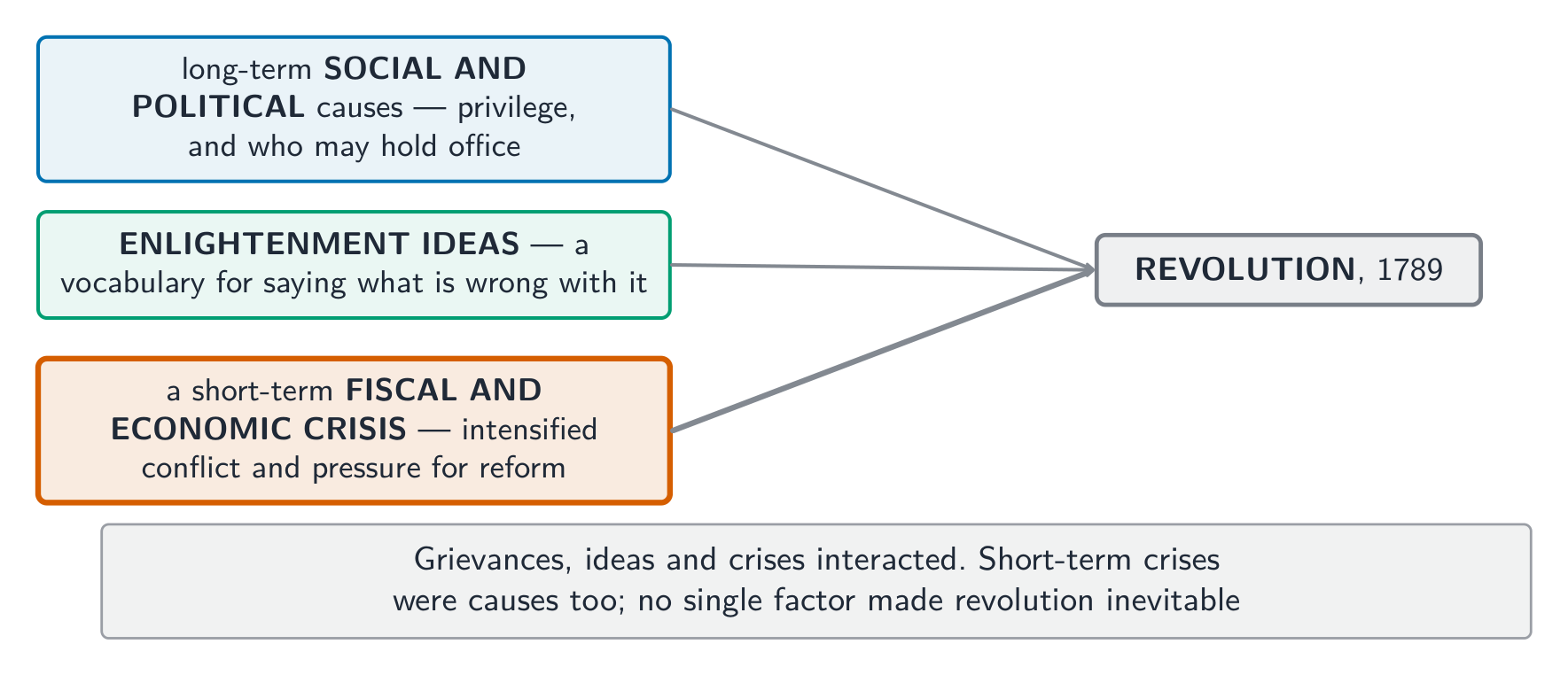
Match each cause to its type.
Dificuldade 2/5 · Moedas 140 + pequeno bônus na primeira conclusão hoje
Causes interacted.
About what percentage of French state spending went on debt payments by 1788?
Dificuldade 2/5 · Moedas 140 + pequeno bônus na primeira conclusão hoje
About half.
The liberal phase, 1789–91
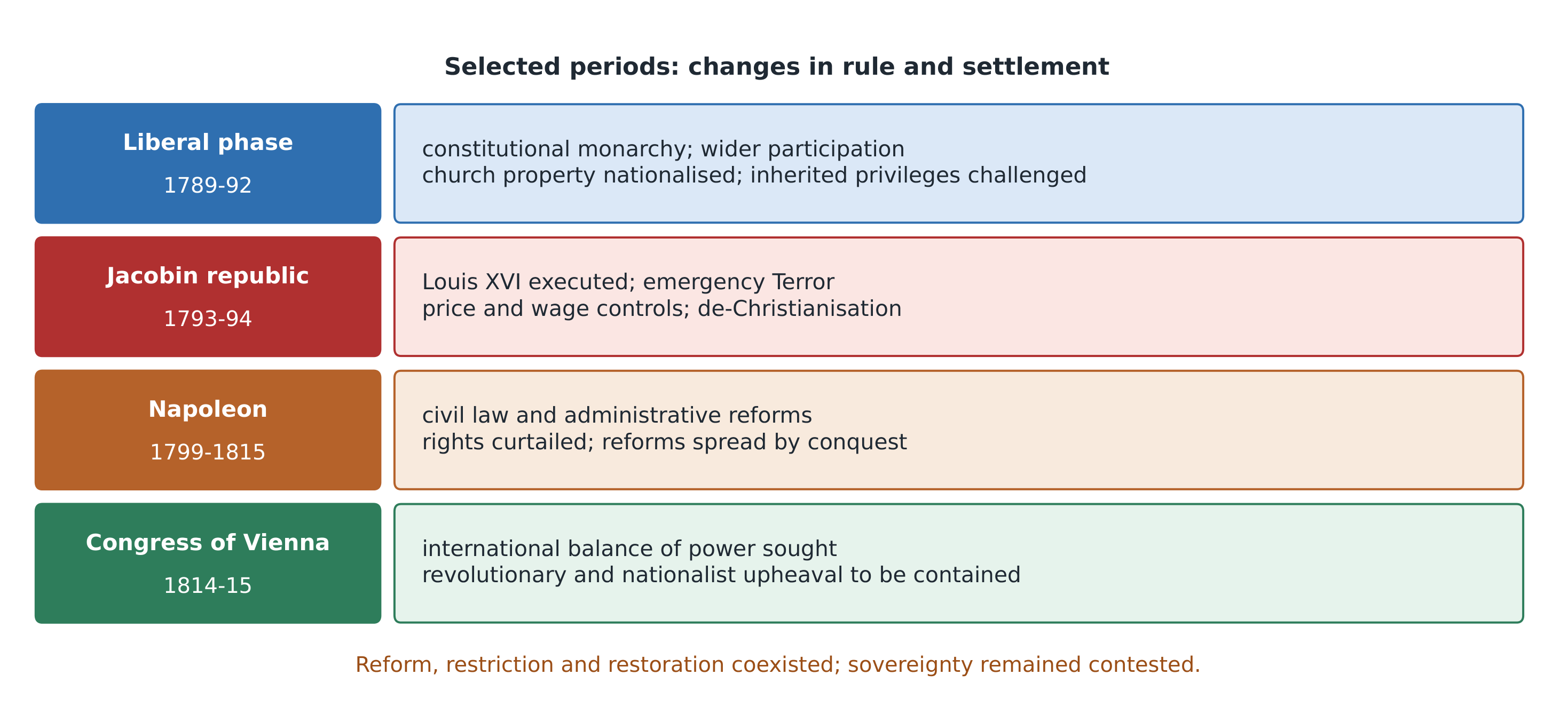
- On 14 July 1789, Parisians stormed the Bastille. In August, the Assembly abolished feudal privileges and issued the Declaration of the Rights of Man and of the Citizen 人权和公民权宣言.
- The Assembly took over Church lands and made France a constitutional monarchy 君主立宪制 in 1791.
Separate the conditions from the trigger
The CED distinguishes long-term causes and Enlightenment ideas from the short-term crises that exacerbated them.
Which belongs to the liberal phase?
Dificuldade 1/5 · Moedas 100 + pequeno bônus na primeira conclusão hoje
August 1789.
Worked example: the radical phase, 1792–94
- Republic: in September 1792, France became a republic; Louis XVI was executed in January 1793.
- War: facing Austria, Prussia and Britain, the government ordered the levée en masse 全民征兵 (August 1793) — mass conscription 大规模征兵 of all unmarried men aged 18–25.
- Terror: Robespierre's Committee of Public Safety executed about 17 000 people after trials, and many more died in prison or civil war. In July 1794, Robespierre himself was executed.
Put these events in order.
Dificuldade 3/5 · Moedas 200 + pequeno bônus na primeira conclusão hoje
June 1789, July 1789, January 1793, July 1794.
Exporting the Revolution
- French armies, fed by conscription, defeated their enemies and spread revolutionary laws into the Netherlands, Germany and Italy.
- Nationalism — loyalty to the nation — became a powerful force.
Women and the Revolution
- In October 1789, thousands of Parisian women marched to Versailles over bread prices and brought the royal family to Paris.
- But women did not get the vote. Olympe de Gouges, who demanded women's rights, was executed in 1793, and women's political clubs were banned.
The Revolution gave French women the right to vote.
Dificuldade 1/5 · Moedas 100 + pequeno bônus na primeira conclusão hoje
Women's clubs were banned in 1793.
The Revolution was not one event. Distinguish the liberal phase (1789–91), which created a constitutional monarchy, from the radical phase (1792–94), with the republic, war and Terror.
France became a republic in 1792.
Dificuldade 1/5 · Moedas 100 + pequeno bônus na primeira conclusão hoje
September 1792.
Privilege, Enlightenment ideas, debt and bread prices caused the Revolution of 1789. A liberal phase abolished feudal privileges and created a constitutional monarchy; a radical phase brought the republic, mass conscription and the Terror. Women took part but were denied political rights.
Explain why the French Revolution became more radical after 1791.
Causation.