A Worldwide Network
Introduzido| English | Significado |
|---|---|
| triangular trade | The Atlantic trade linking Europe, West Africa and the Americas: goods to Africa, enslaved people to the Americas, plantation crops to Europe. |
| consumer revolution/kənˈsuːmə ˌrevəˈluːʃn/ | revolução do consumo |
London's coffeehouses, 1700
- By 1700, London had several hundred coffeehouses. Merchants drank coffee from Yemen and Java, sweetened with sugar grown by enslaved Africans in the Caribbean, while they read newspapers and traded insurance — Lloyd's of London began in one in 1688. A single cup connected three continents.
- In the eighteenth century, European trade became a worldwide network, and it changed farming, industry and what people bought.
How did a cup of coffee in London connect three continents?
Dificuldade 1/5 · Moedas 100 + pequeno bônus na primeira conclusão hoje
A worldwide network.
The network
- Ships carried manufactured goods to Africa, enslaved people to the Americas, and sugar, tobacco and cotton back to Europe — the Atlantic triangular trade 三角贸易.
- Britain's and the Netherlands' East India Companies traded tea, spices, silk and cotton cloth from Asia.
Put the triangular trade in order, starting from Europe.
Dificuldade 3/5 · Moedas 200 + pequeno bônus na primeira conclusão hoje
Three sides.
Effects on farming
- Growing towns and markets gave farmers a reason to produce more for sale — encouraging the Agricultural Revolution.
- New American crops, such as potatoes and maize, fed more people in Europe.
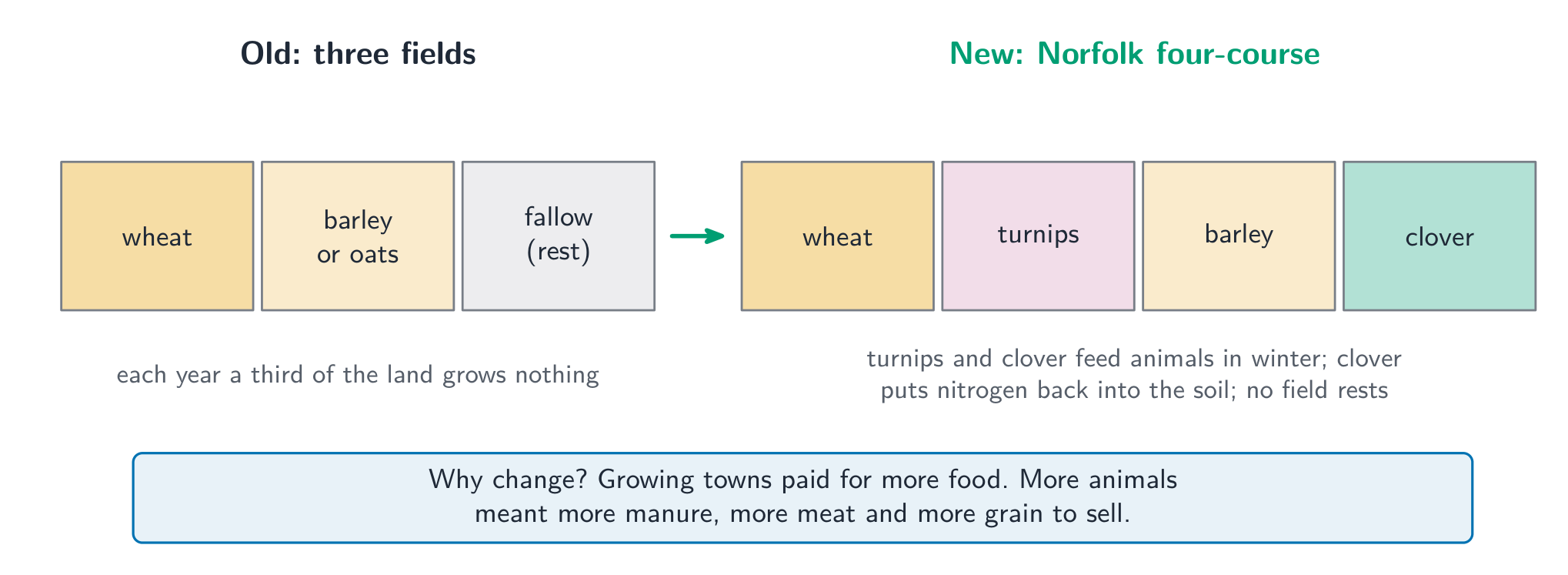
Which of the three revolutions?
Sort each contribution of the worldwide network.
Worked example: the consumer revolution
- What changed: ordinary families in England and the Netherlands began to buy tea, sugar, cotton clothes, china cups and printed books.
- Evidence: British sugar use rose from about 2 kg per person a year in 1700 to about 9 kg by 1800.
- The term: this rise in buying is called the consumer revolution 消费革命. People worked longer and harder to earn money for goods.
British sugar use rose from about 2 kg to about 9 kg per person a year. By how many kilograms did it rise?
Dificuldade 2/5 · Moedas 140 + pequeno bônus na primeira conclusão hoje
9 − 2.
Effects on industry
- Demand for cotton cloth, first imported from India, led British makers to look for cheaper ways to produce it.
- The search for faster production helped start the Industrial Revolution after 1760.
Match each effect to its area.
Dificuldade 2/5 · Moedas 140 + pequeno bônus na primeira conclusão hoje
Three revolutions.
Continuities
- Most Europeans were still peasants, and most goods were still made by hand.
- The network depended on slavery: about 6 million Africans were transported across the Atlantic in the eighteenth century.
By 1800, most Europeans worked in factories.
Dificuldade 1/5 · Moedas 100 + pequeno bônus na primeira conclusão hoje
Most were still peasants.
The consumer revolution was built on slavery. Sugar, tobacco and cotton were grown by enslaved people. Include this when you explain European prosperity.
The consumer revolution depended partly on slavery.
Dificuldade 1/5 · Moedas 100 + pequeno bônus na primeira conclusão hoje
Sugar, tobacco and cotton.
In the eighteenth century, the Atlantic triangular trade and Asian trade made a worldwide network. Growing markets encouraged agricultural change, a consumer revolution in tea, sugar and cotton, and the search for new machines — all resting partly on slavery.
Explain how the worldwide trade network contributed to the consumer revolution.
Causation.