The Dutch Republic
Introduzido| English | Significado |
|---|---|
| stadtholder | The leader of the army and a leading official in the Dutch Republic, usually from the House of Orange. |
| oligarchy/ˈɒlɪɡɑːki/ | oligarquia |
| religious toleration | Allowing people of other faiths to worship without punishment, without necessarily giving them equal rights. |
A tiny republic with the world's ships, 1650
- By about 1650, the Dutch Republic, with fewer than 2 million people, owned perhaps half of all Europe's merchant ships. Amsterdam's exchange traded goods and shares from Japan to Brazil, and Dutch painters such as Rembrandt sold pictures to ordinary merchants. A small state of merchants had become Europe's richest.
- The Dutch Republic was a different kind of state: run by merchants, not by a king.
Born in revolt
- From 1566, the northern Netherlands revolted against Philip II of Spain over taxes, religious persecution of Protestants and lost local rights.
- The seven northern provinces declared independence in 1581; Spain recognized it only in 1648.
Why did the Netherlands revolt against Spain?
Dificuldade 2/5 · Moedas 140 + pequeno bônus na primeira conclusão hoje
From 1566.
How it was governed
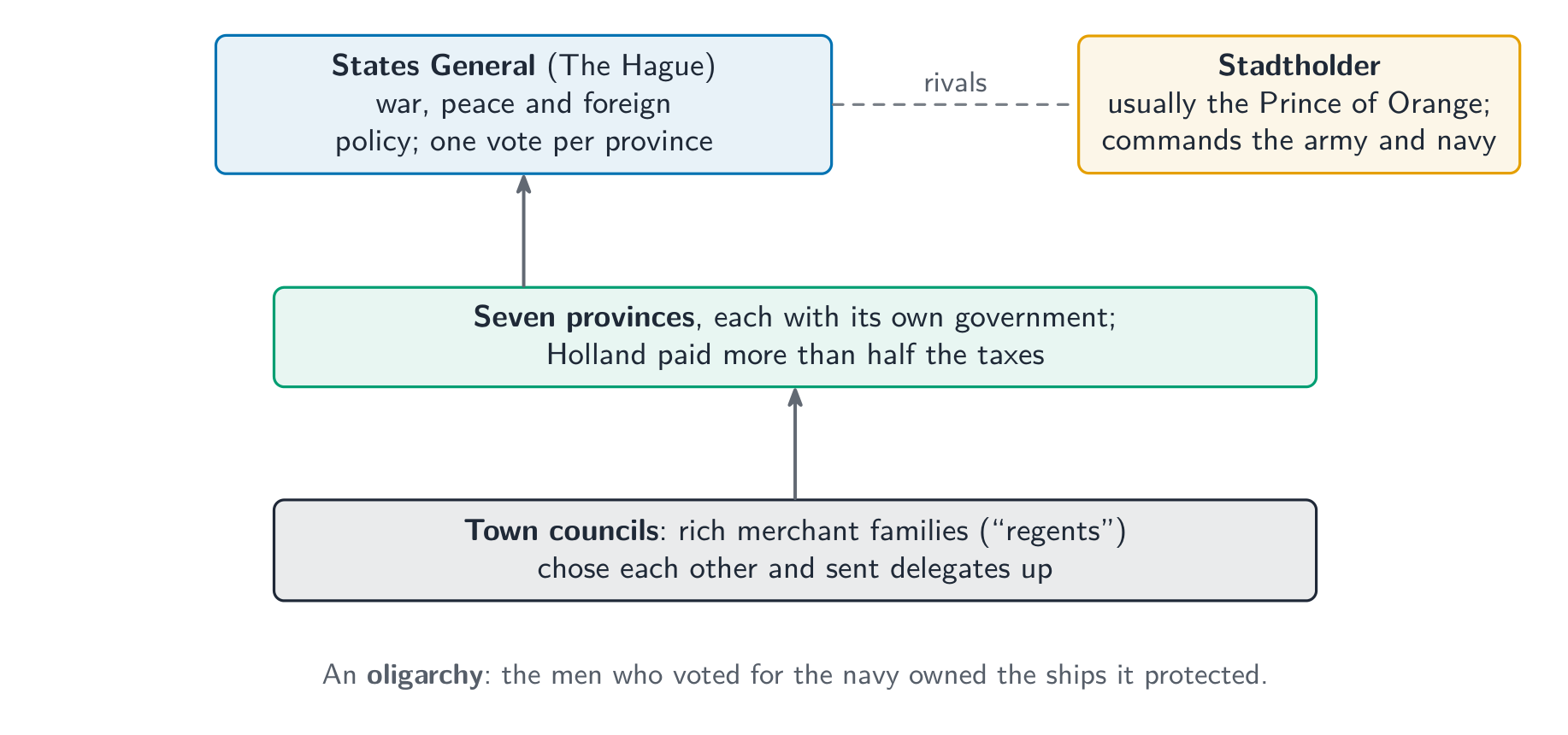
- Each province kept its own government, and the States General met to decide war and foreign policy. A stadtholder 执政, usually from the House of Orange, led the army.
- Real power lay with rich merchant families in the towns — an oligarchy 寡头政治, rule by a few.
Origin, form, or purpose?
Sort each element of the CED's sentence on the Dutch Republic.
Match each part of government to its role.
Dificuldade 2/5 · Moedas 140 + pequeno bônus na primeira conclusão hoje
A federation.
What is an oligarchy?
Dificuldade 1/5 · Moedas 100 + pequeno bônus na primeira conclusão hoje
Merchant families.
Worked example: a state built for trade
- Company: the Dutch East India Company (VOC, 1602) had the right to make war and treaties in Asia, and paid investors dividends.
- Finance: the Bank of Amsterdam (1609) gave merchants a safe, stable currency.
- Toleration: Jews, Catholics and refugees could live and trade in Amsterdam; religious toleration 宗教宽容 attracted skilled people and their money.
Religious toleration attracted skilled people and money to Amsterdam.
Dificuldade 1/5 · Moedas 100 + pequeno bônus na primeira conclusão hoje
Jews, Catholics and refugees.
Put these events in order.
Dificuldade 3/5 · Moedas 200 + pequeno bônus na primeira conclusão hoje
1566, 1581, 1602, 1648.
A home for books and ideas
- With less censorship than elsewhere, Dutch printers published books banned in other countries, including works by Descartes and Locke.
- The philosopher Spinoza lived and wrote in the Republic.
Old rights, not new ones
- The Dutch rebels fought to defend traditional local rights and privileges, not modern democracy.
- Only wealthy men had a say in government; most people did not.
The Dutch Republic was not a democracy. It was governed by a small group of wealthy merchant families. Its freedoms were real, but limited.
The Dutch Republic was a democracy in which most people voted.
Dificuldade 1/5 · Moedas 100 + pequeno bônus na primeira conclusão hoje
An oligarchy of rich merchants.
Born from revolt against Spain, the Dutch Republic was a federation run by a merchant oligarchy. Its government, the VOC, the Bank of Amsterdam and religious toleration made it a leader in trade and printing — but not a democracy.
Explain why the Dutch Republic became a leading trading power.
Causation.