Luther, Calvin and the Responses
Introduzido| English | Significado |
|---|---|
| indulgence | A Church grant reducing punishment for sin, which by Luther's time was often sold for money. |
| predestination | Calvin's teaching that God has already chosen who will be saved. |
| Anabaptists/ˈænəbæptɪsts/ | Anabaptistas |
Ninety-five theses, 1517
- In October 1517, the monk Martin Luther sent his Ninety-Five Theses attacking the sale of indulgences 赎罪券 — certificates said to reduce punishment for sins after death. Printers turned his arguments into cheap pamphlets, and within a few years hundreds of thousands of copies of his writings were circulating in Germany.
- A dispute about doctrine became a challenge to the whole Church.
What practice did Luther's Ninety-Five Theses attack?
Dificuldade 1/5 · Moedas 100 + pequeno bônus na primeira conclusão hoje
Paying to reduce punishment for sin.
Luther's ideas
- Salvation came through faith alone, not through good works or buying indulgences.
- The Bible alone was the authority, not the Pope; Luther translated the New Testament into German (1522) so ordinary people could read it.
Which were Luther's teachings?
Dificuldade 2/5 · Moedas 140 + pequeno bônus na primeira conclusão hoje
He rejected papal authority.
From doctrine to politics
- At the Diet of Worms (1521), Luther refused to take back his views and was declared an outlaw. The Elector of Saxony protected him.
- German princes who became Lutheran gained control of church lands and independence from the Pope and the Catholic emperor, Charles V.
Why did many German princes support Lutheranism?
Dificuldade 1/5 · Moedas 100 + pequeno bônus na primeira conclusão hoje
Political gain.
Worked example: Luther and Calvin compared
- Similarity: both taught salvation by faith, the authority of the Bible, and rejected the Pope.
- Difference: John Calvin, in Geneva from 1541, taught predestination 预定论 — God had already chosen who would be saved. Geneva's church council strictly controlled behaviour.
- Spread: Calvinism spread to France (Huguenots), the Netherlands, Scotland and England's Puritans, often among people resisting their rulers; Lutheranism spread mainly where princes adopted it.
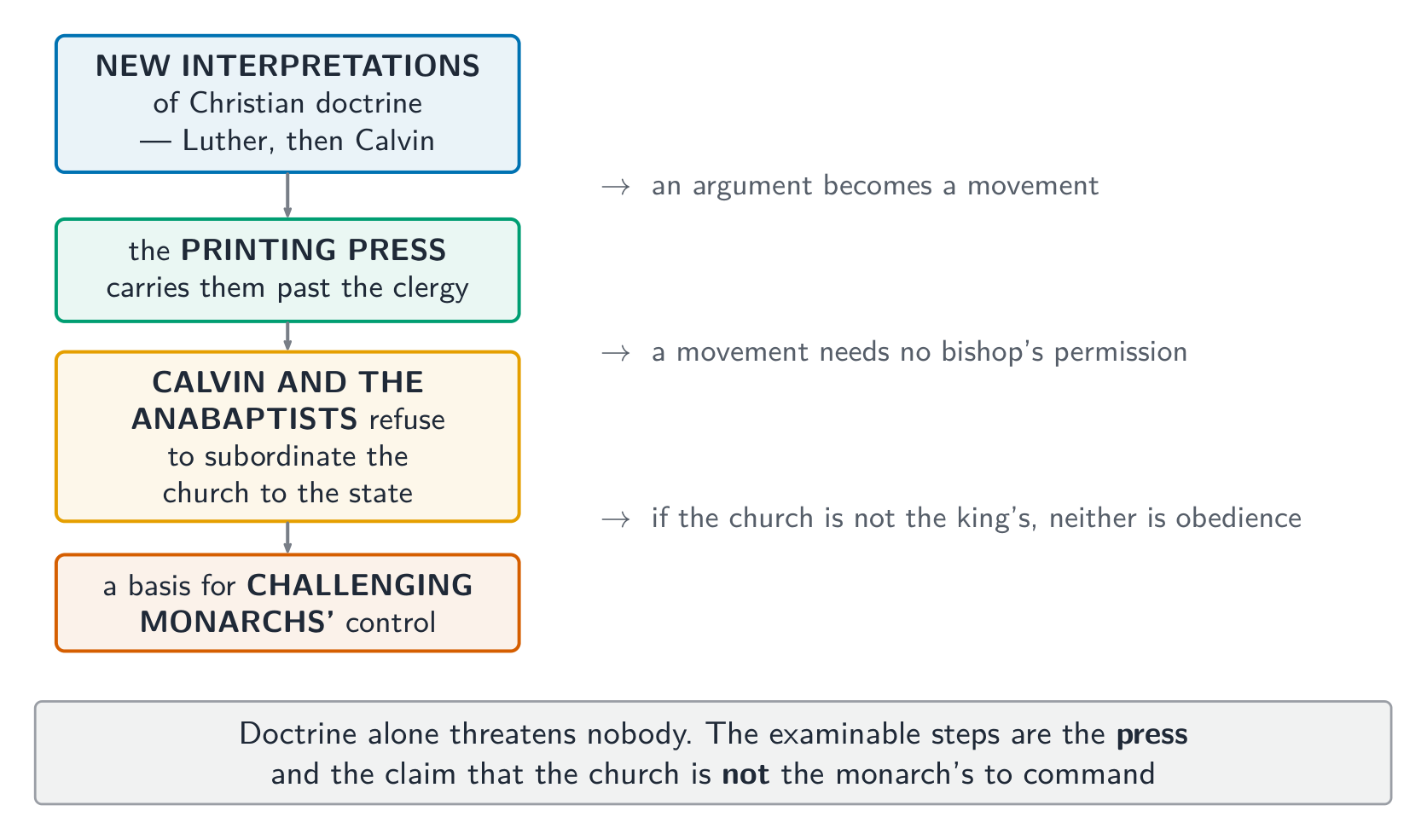
Follow doctrine into a political threat
Doctrine alone threatens nobody — the press and the church's independence are the examinable steps.
Match each idea or place to the reformer.
Dificuldade 2/5 · Moedas 140 + pequeno bônus na primeira conclusão hoje
Two reformers.
Radical reformers
- Anabaptists 再洗礼派 baptized only adults and some wanted to separate church from state. In 1534–35 radicals seized the city of Münster; Catholics and Lutherans together crushed them.
- In the German Peasants' War (1524–25), peasants used Luther's ideas to demand rights; Luther urged the princes to crush them, and about 100 000 died.
A settlement in Germany
- The Peace of Augsburg (1555) let each German prince choose Lutheranism or Catholicism for his territory: "whose realm, his religion".
- Calvinists and Anabaptists were not included.
The Peace of Augsburg (1555) allowed each German prince to choose Lutheranism or Catholicism.
Dificuldade 1/5 · Moedas 100 + pequeno bônus na primeira conclusão hoje
Calvinists were excluded.
The Reformation was not only about religion. The printing press spread it, and princes supported it because it gave them church land and independence from Pope and emperor. Explain religious and political causes together.
The Reformation spread only because of religious belief.
Dificuldade 1/5 · Moedas 100 + pequeno bônus na primeira conclusão hoje
Printing and politics mattered too.
Luther's attack on indulgences, spread by the printing press, led to new Protestant doctrines and a break with Rome. Princes backed reform for political gain; Calvin's predestination spread among resisters; radicals were crushed. The Peace of Augsburg let German princes choose their territory's religion.
Explain why the Protestant Reformation spread so quickly in Germany after 1517.
Causation.