Why and How Europeans Sailed
Introduzido| English | Significado |
|---|---|
| caravel/ˈkærævl/ | A small, fast Portuguese sailing ship of the 1400s whose mixed sails let it sail against the wind. |
| cartography/kɑːˈtɒɡrəfi/ | Cartografia |
| mercantilism/ˈmɜːkæntəlɪzəm/ | A policy of seeking national wealth through a favourable trade balance and state control. |
Pepper from Calicut, 1498
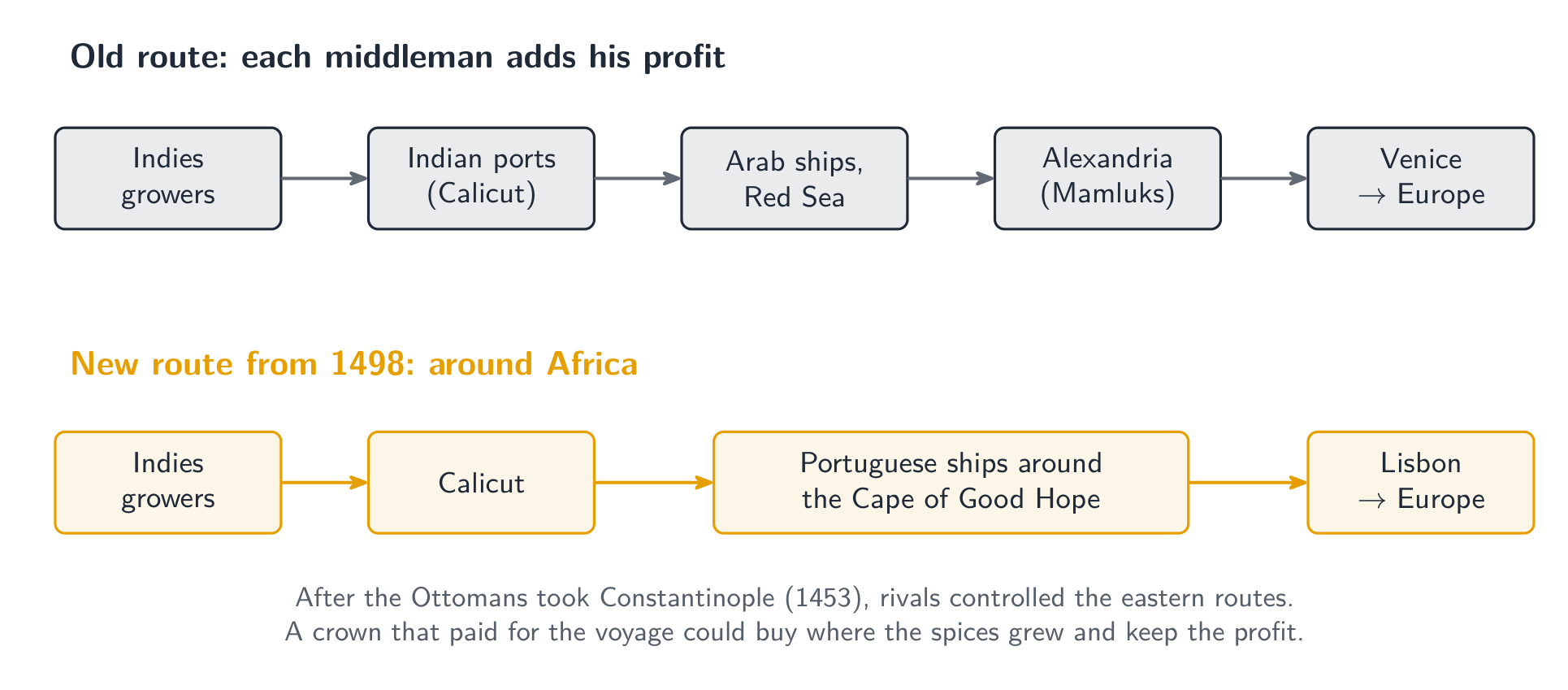
- In May 1498, the Portuguese captain Vasco da Gama reached Calicut in India after sailing around Africa. He came home with pepper and spices worth many times the cost of the voyage, although he lost two of his four ships and more than half his crew. A sea route to Asia now bypassed the Venetian and Ottoman middlemen.
- Why did Europeans sail out onto the oceans, and how were they able to?
How: new technology
- Ships: the Portuguese caravel 卡拉维尔帆船 combined square and triangular sails, so it could sail against the wind and explore coasts.
- Navigation: the magnetic compass and the astrolabe found direction and latitude, and cartography 制图学 — the making of maps and sea charts — improved with every voyage. Mercator's 1569 world map helped sailors steer straight courses.
Match each tool to what it did.
Dificuldade 2/5 · Moedas 140 + pequeno bônus na primeira conclusão hoje
The technology of exploration.
Why: wealth and state power
- After the Ottomans took Constantinople in 1453, eastern trade routes were controlled by rivals. Spices, silk and gold could make a kingdom rich.
- Rulers such as Portugal's Prince Henry "the Navigator" and Spain's Ferdinand and Isabella paid for voyages to strengthen their states against rivals.
Why did the fall of Constantinople in 1453 encourage sea exploration?
Dificuldade 1/5 · Moedas 100 + pequeno bônus na primeira conclusão hoje
Europeans sought another route.
Worked example: from 1453 to 1498
- Problem: Ottoman and Venetian control of eastern trade made Asian goods expensive for Portugal and Spain.
- Means: caravels, compasses and better charts made long ocean voyages possible; the crown paid the cost.
- Result: Dias rounded the Cape of Good Hope (1488), Columbus crossed the Atlantic (1492) and da Gama reached India (1498). Motive, means and money together produced the voyages.
Follow Europeans out onto the ocean
Advances in navigation, cartography and military technology give the capability; the motives are older.
Put these voyages in order.
Dificuldade 3/5 · Moedas 200 + pequeno bônus na primeira conclusão hoje
1488, 1492, 1498.
Mercantilism
- Under mercantilism 重商主义, rulers believed a country's wealth was its stock of gold and silver, and that one state's gain was another's loss.
- Colonies existed to supply raw materials and buy the home country's goods, so states took a direct role in trade and empire.
What did mercantilists believe?
Dificuldade 1/5 · Moedas 100 + pequeno bônus na primeira conclusão hoje
Bullion and zero-sum trade.
Christianity: motive and justification
- Explorers and missionaries sought converts; Spain had just finished the conquest of Muslim Granada in 1492.
- The Pope's Treaty of Tordesillas (1494) divided newly found lands between Spain and Portugal, giving religious approval to conquest.
The Treaty of Tordesillas (1494) divided new lands between Spain and Portugal.
Dificuldade 1/5 · Moedas 100 + pequeno bônus na primeira conclusão hoje
With papal approval.
Technology did not cause the voyages by itself. Caravels and compasses made exploration possible; the desire for wealth, state rivalry and religion made Europeans want to go. Explain both "how" and "why".
Better ships alone explain why Europeans explored the oceans.
Dificuldade 1/5 · Moedas 100 + pequeno bônus na primeira conclusão hoje
Motives mattered too.
New ships, navigational instruments and cartography made ocean voyages possible. The search for wealth, competition between states (organized by mercantilism) and the spread of Christianity made rulers pay for them. Portugal reached India by 1498, Spain the Americas by 1492.
Explain the reasons for, and the means of, European exploration in the fifteenth century.
Causation.