Stratospheric Ozone Depletion
Introduzido| English | Significado |
|---|---|
| ozone layer/ˈəʊzəʊn ˈleɪə/ | camada de ozônio |
| ultraviolet/ˌʊltrəˈvaɪəlɪt/ | ultravioleta |
| CFCs/ˌsiː ef ˈsiːz/ | CFCs |
| chlorine/ˈklɔːriːn/ | cloro |
A hole in Earth's sunscreen
- In 1985, British scientists measuring the air above Antarctica found that every spring, about a third of the ozone overhead was disappearing. Satellites soon showed an "ozone hole" larger than the continent.
- The stratospheric ozone layer 平流层臭氧层 (about 15–35 km up) absorbs most of the Sun's harmful ultraviolet 紫外线 (UV-B and UV-C) radiation. Life on land could only evolve after this layer formed, and it still protects the health and survival of life on Earth.
A ozone layer high in the atmosphere is important because it…
Dificuldade 1/5 · Moedas 100 + pequeno bônus na primeira conclusão hoje
A ozone layer absorbs most of the sun's harmful UV rays, shielding life below.
A thinner ozone layer lets more harmful ____ radiation reach the ground.
Dificuldade 1/5 · Moedas 100 + pequeno bônus na primeira conclusão hoje
Less ozone means more UV reaches us, raising skin cancer and eye damage.
The human cause: CFCs
- Chlorofluorocarbons 氯氟烃 (CFCs) were used in refrigerators, air conditioners, aerosol spray cans and foam. They are stable, non-toxic and non-flammable, which made them seem perfect.
- Because they are so stable, they do not break down in the lower atmosphere. Over several years they drift up into the stratosphere 平流层, where strong UV light finally breaks them apart and releases chlorine 氯 atoms.
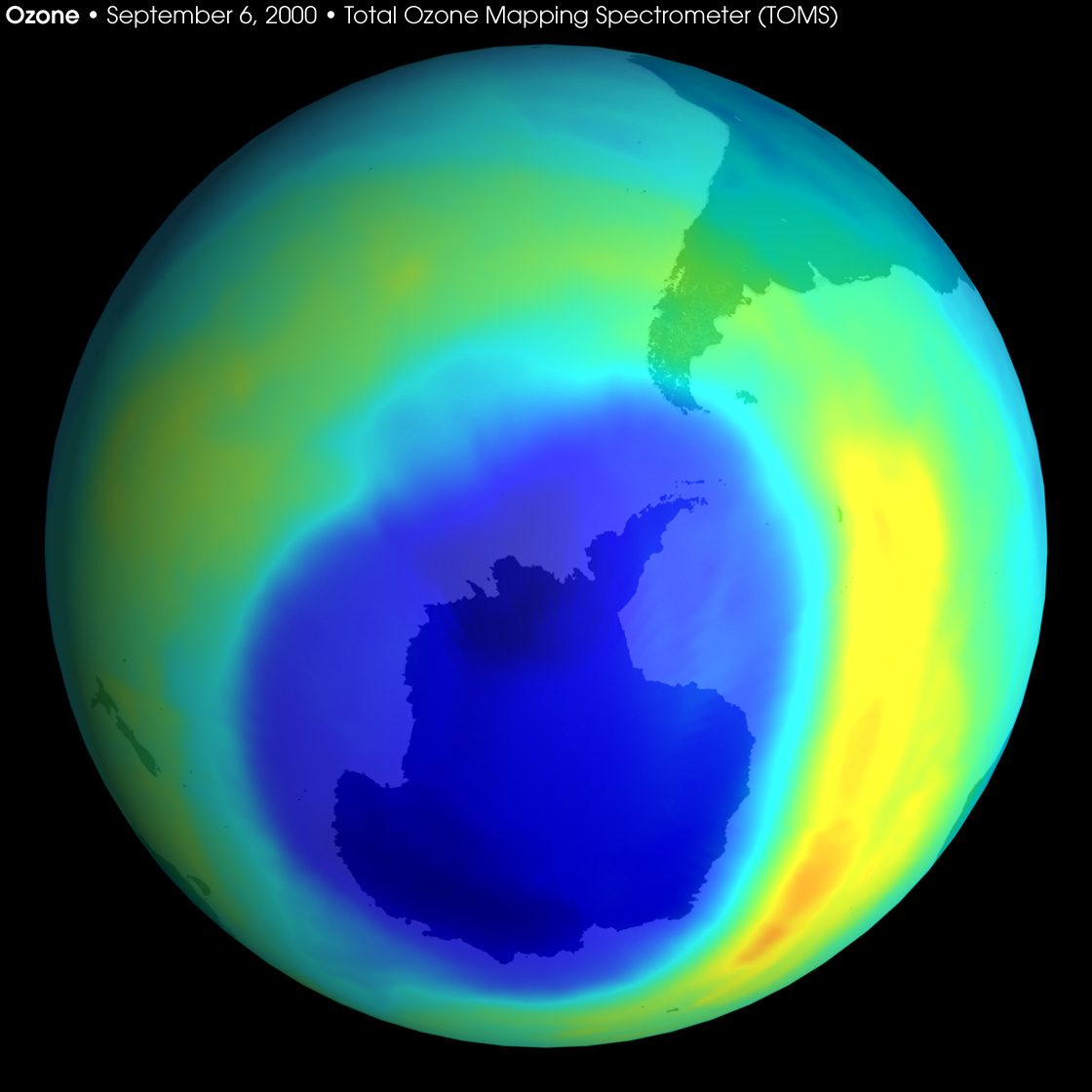
Ozone depletion was caused mainly by CFCs, chemicals once used in…
Dificuldade 1/5 · Moedas 100 + pequeno bônus na primeira conclusão hoje
CFCs (chlorofluorocarbons) were used in cooling and sprays until they were found to destroy ozone.
How one chlorine atom destroys thousands of ozone molecules
- The chlorine atom is not used up: it comes out of the second step unchanged and attacks another ozone molecule. It acts as a catalyst 催化剂. One chlorine atom can destroy about 100 000 ozone molecules before it is removed.
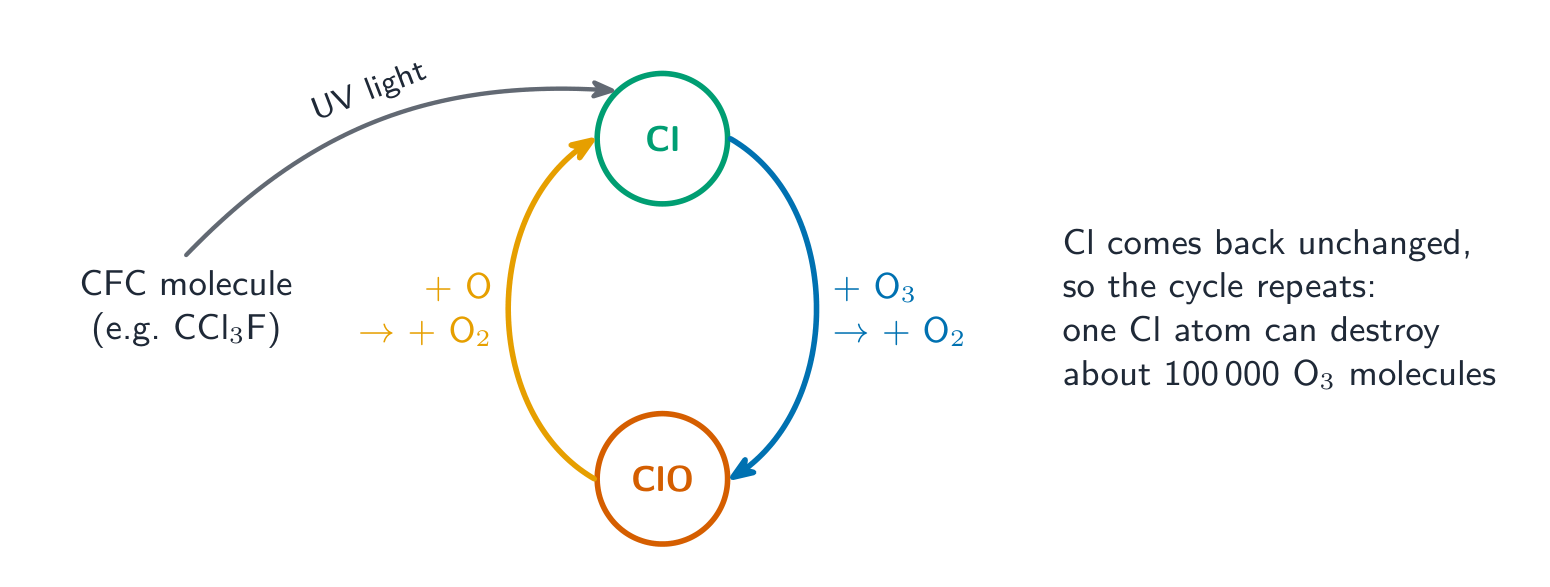
How CFCs destroy the ozone layer
Follow a CFC from a spray can up to the stratosphere, where it destroys ozone.
A single chlorine atom can destroy many thousands of ozone molecules.
Dificuldade 1/5 · Moedas 100 + pequeno bônus na primeira conclusão hoje
Chlorine acts as a catalyst — it destroys ozone again and again without being used up.
Why can a single chlorine atom destroy many thousands of ozone molecules?
Dificuldade 1/5 · Moedas 100 + pequeno bônus na primeira conclusão hoje
Cl + O₃ → ClO + O₂, then ClO + O → Cl + O₂. The Cl atom is free again to repeat the cycle.
Why the hole forms over Antarctica in spring
- In the dark, very cold Antarctic winter, polar stratospheric clouds made of ice crystals form. Chlorine compounds collect on the ice crystals.
- At the start of the Antarctic spring (September–October), sunlight returns and the ice crystals melt, releasing large amounts of chlorine at once. Ozone is destroyed very quickly. This natural factor is why the hole is deepest in the southern spring.
Why is ozone loss over Antarctica greatest in September and October?
Dificuldade 1/5 · Moedas 100 + pequeno bônus na primeira conclusão hoje
Chlorine compounds collect on ice crystals over the dark winter. When the ice melts at the start of spring, chlorine is released in large amounts.
Effects of more UV at the surface
| Who is affected | Effect of more UV |
|---|---|
| humans | skin cancer, cataracts (clouded eye lenses), sunburn, weaker immune system |
| crops and plants | damaged leaves, lower yields |
| phytoplankton | less photosynthesis, so less food at the base of ocean food webs |
- Less stratospheric ozone → more UV reaches Earth's surface. That is the key chain to write in an FRQ.
Select todos harms of a thinner ozone layer.
Dificuldade 2/5 · Moedas 140 + pequeno bônus na primeira conclusão hoje
More UV means more skin cancer, eye damage, and harm to crops and plankton. It does not help bones.
Select todos effects of increased UV radiation reaching Earth's surface.
Dificuldade 2/5 · Moedas 140 + pequeno bônus na primeira conclusão hoje
Warming is caused by greenhouse gases trapping infrared, not by extra UV from ozone loss.
Worked FRQ answer
(A) Identify one human activity that caused stratospheric ozone depletion. Releasing CFCs from old refrigerators, air conditioners and aerosol sprays.
(B) Explain how CFCs reduce stratospheric ozone. UV light in the stratosphere breaks CFC molecules apart and releases chlorine atoms. A chlorine atom reacts with ozone to form ClO and O₂, then ClO reacts with an oxygen atom and frees the chlorine again, so one chlorine atom destroys many ozone molecules.
(C) Describe one human health effect of stratospheric ozone depletion. Thinner ozone lets more UV-B reach the surface, which damages DNA in skin cells and increases the risk of skin cancer.
- Why it scores: (B) gives the mechanism (UV frees Cl; Cl is regenerated). (C) links depletion → more UV → the health effect.
- Ozone depletion is not the greenhouse effect. Depletion lets in more UV (a radiation shield problem); the greenhouse effect traps heat (infrared). Do not say the ozone hole causes global warming.
- Stratospheric ozone is good; ground-level ozone (smog) is harmful.
- Depletion has human causes (CFCs) and a natural factor (ice crystals melting in the Antarctic spring).
The ozone hole is the main cause of global warming.
Dificuldade 1/5 · Moedas 100 + pequeno bônus na primeira conclusão hoje
They are different problems. The ozone hole lets in more UV; global warming comes from greenhouse gases trapping heat.
The stratospheric ozone layer absorbs harmful UV and is essential for life on Earth. CFCs drift into the stratosphere, where UV releases chlorine that destroys ozone in a catalytic cycle. A natural factor, the melting of ice crystals at the start of the Antarctic spring, releases chlorine quickly and creates the ozone hole. Less ozone → more UV at the surface → skin cancer and cataracts, and harm to crops and plankton.