Perspectives That Change and Disagree
Introduzido| English | Significado |
|---|---|
| perspective/pəˈspektɪv/ | A particular viewpoint from which an issue or experience is understood. |
| dramatic irony | when the audience knows something that a character does not |
"Honest Iago", c. 1603
- In Shakespeare's Othello, the general Othello trusts his officer Iago completely. He calls him "A man he is of honesty and trust", and later "O brave Iago, honest and just".
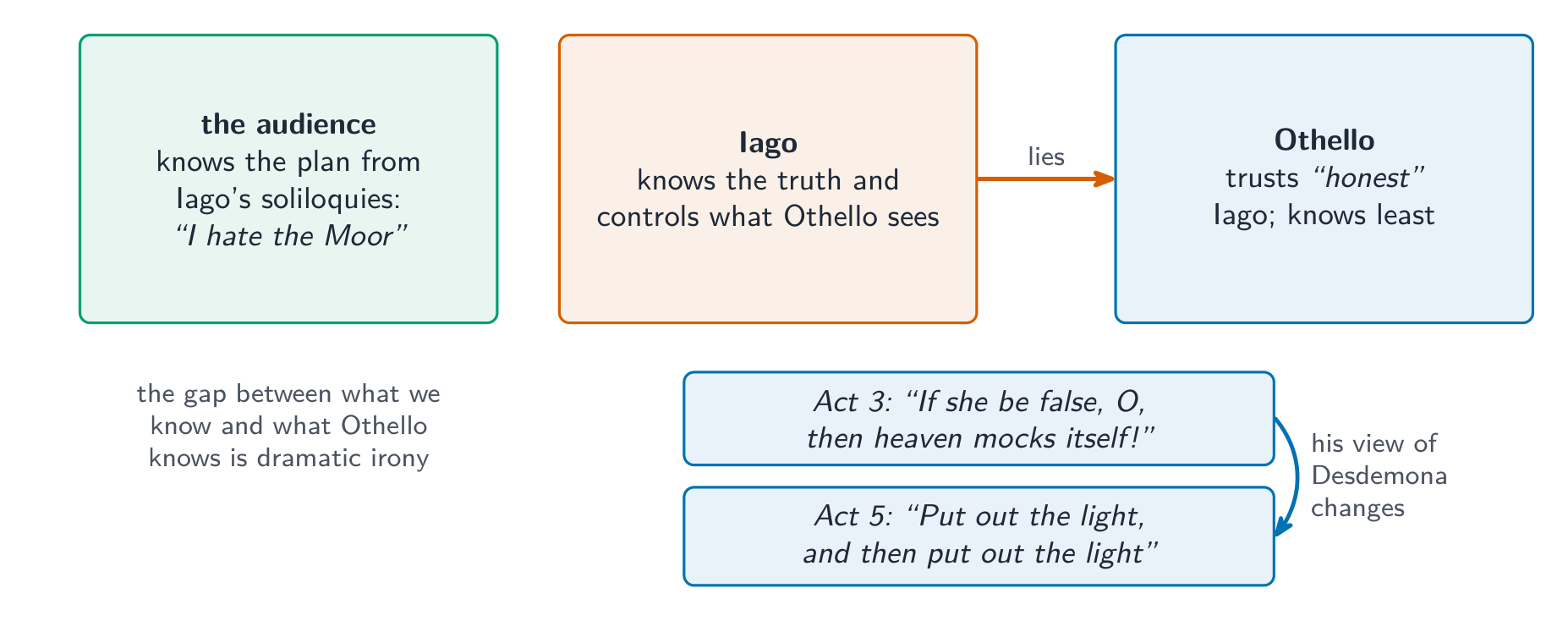
- The audience knows better. In his first soliloquy Iago tells us: "I hate the Moor", and plans to make Othello believe that his wife, Desdemona, is unfaithful.
Which word does Othello keep using about Iago?
Dificuldade 1/5 · Moedas 100 + pequeno bônus na primeira conclusão hoje
"O brave Iago, honest and just".
The audience learns Iago's plan from his soliloquies.
Dificuldade 1/5 · Moedas 100 + pequeno bônus na primeira conclusão hoje
"I hate the Moor".
Perspectives disagree
- A perspective 视角 is the way a character, narrator or audience sees events. In drama, different perspectives often disagree.
- When the audience knows something a character does not, the result is dramatic irony 戏剧反讽: every time Othello says "honest", the word turns against him.
When the audience knows something a character does not, the result is dramatic ____.
Dificuldade 1/5 · Moedas 100 + pequeno bônus na primeira conclusão hoje
Dramatic irony.
A perspective can change
- Othello's perspective on Desdemona changes completely. In Act 3: "If she be false, O, then heaven mocks itself! / I'll not believe't." By Act 5 he stands over her bed: "Put out the light, and then put out the light".
- The play shows each step of the change, and the audience watches it with knowledge Othello lacks.
What is this evidence of?
Sort each observation by the CED's three statements.
Put these lines of Othello's in the order they appear.
Dificuldade 3/5 · Moedas 200 + pequeno bônus na primeira conclusão hoje
His perspective changes completely.
Worked example: one word, two perspectives
- Word: "honest", repeated about Iago again and again.
- Othello's perspective: a sincere description of a loyal friend.
- The audience's perspective: a painful irony, because Iago has told us his plan. The repetition makes the audience feel the gap grow with each scene, so we watch the tragedy coming while Othello cannot.
Map who knows what
- For any key scene, ask: what does each character know? What does the audience know? Where are the gaps?
- The gaps are where irony, suspense and tragedy come from.
Where do irony, suspense and tragedy come from in a scene?
Dificuldade 1/5 · Moedas 100 + pequeno bônus na primeira conclusão hoje
Map who knows what.
Track the change
- When a character's perspective changes, find the step-by-step evidence: what they hear or see, and how their language changes.
- Othello's speech, once calm and grand, breaks into short, angry phrases as Iago works on him.
Do not treat one character's view as the truth. Othello's view of Desdemona in Act 4 is wrong. Say whose perspective a line shows, and how it differs from what the audience knows.
Othello's view of Desdemona in Act 4 is the truth of the play.
Dificuldade 1/5 · Moedas 100 + pequeno bônus na primeira conclusão hoje
Say whose perspective a line shows.
Perspectives can disagree and change. When the audience knows more than a character, words become dramatically ironic. Map who knows what, and track how a perspective changes step by step.
Choose a scene where the audience or reader knows more than a character. Explain the gap and its effect.
Who knows what.