Minor Characters and What They Are For
Introduzido| English | Significado |
|---|---|
| minor character | A character with a small role in a story. |
| foil | a character who shares a situation with another so that their differences stand out |
The blacksmith who stays the same, 1861
- In Great Expectations, Pip leaves the forge to become a London gentleman and grows ashamed of Joe Gargery, the kind blacksmith who raised him. Joe hardly changes: when he visits Pip in London he is awkward in his best clothes, and he tells Pip, "life is made of ever so many partings welded together."
- Joe is a minor character 次要人物, but the novel needs him. Because he stays the same, he shows how far Pip has moved — and in which direction.
Why does Great Expectations need Joe Gargery?
Dificuldade 1/5 · Moedas 100 + pequeno bônus na primeira conclusão hoje
A static minor character measures change.
What minor characters are for
- Minor characters can measure a main character's change, act as a foil 衬托人物 (a contrast that highlights traits), carry a theme, or move the plot.
- Ask: what would the work lose without this character?
Which are functions of minor characters?
Dificuldade 2/5 · Moedas 140 + pequeno bônus na primeira conclusão hoje
Writers rarely include characters without a function.
A static character measures change
- A minor character who stays the same can show change without the narrator stating it.
- In Great Expectations, Joe Gargery is the same kind blacksmith from first to last. Pip is ashamed of him in London, and when Joe nurses him and pays his debt, Joe's steadiness shows how far Pip has moved and how he comes back.
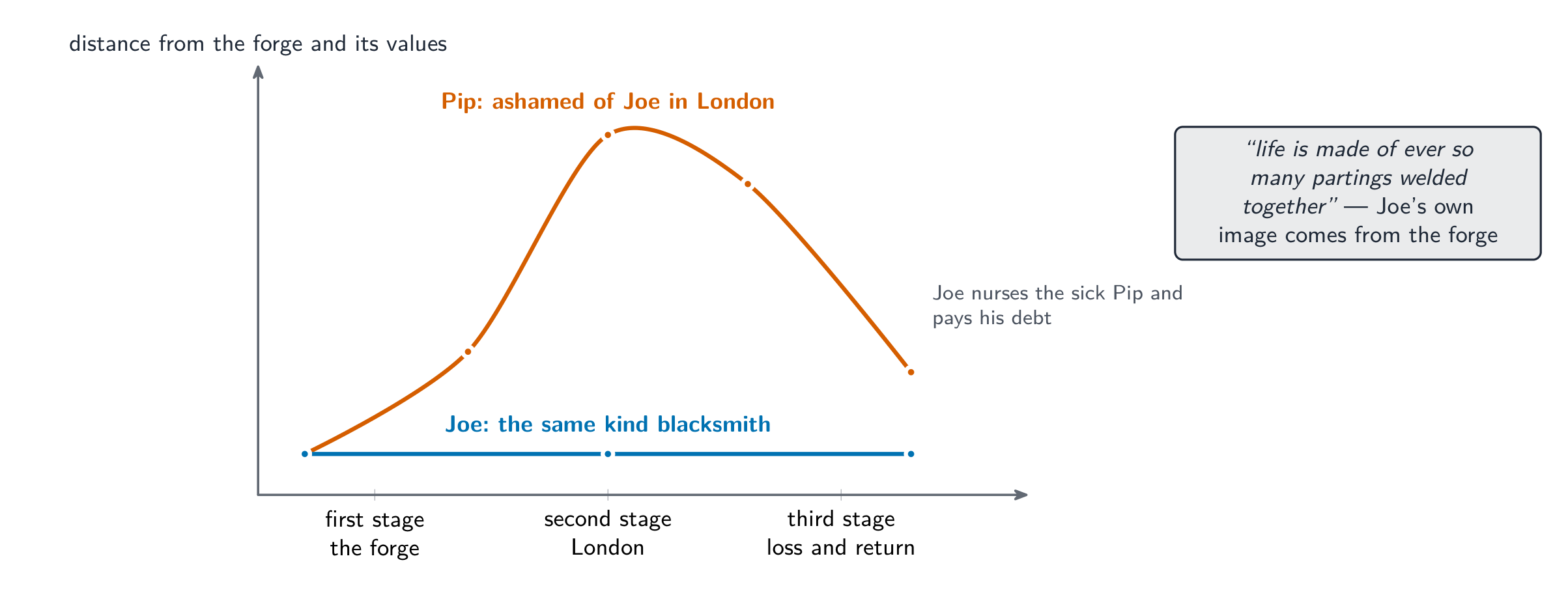
What is this minor character doing?
Sort each case by the function it serves.
What does the unchanged question "Will you be staying, then?" reveal at the end?
Dificuldade 1/5 · Moedas 100 + pequeno bônus na primeira conclusão hoje
A constant question measures change.
Worked example: Joe as a measure
- Joe's constancy: he remains loyal and gentle throughout — he even pays Pip's debts and nurses him through a fever without telling him.
- Pip's change: as a boy Pip loves Joe; as a gentleman he dreads Joe's visit; after his fortune collapses he begs forgiveness.
- Interpretation: Dickens uses Joe to measure Pip's moral journey, not his social rise. Pip rises in class but falls in goodness, and only returns to goodness by seeing Joe's unchanged love — the minor character holds the novel's values.
In the worked example, what kind of journey does Joe measure?
Dificuldade 1/5 · Moedas 100 + pequeno bônus na primeira conclusão hoje
Pip rises in class but falls in goodness.
Foils
- A foil shares something with the main character so that the difference stands out. Herbert Pocket, also a young gentleman, is cheerful and honest about money, which sharpens Pip's anxious pride.
- Name the shared feature first, then the difference.
What should you name first when analysing a foil?
Dificuldade 1/5 · Moedas 100 + pequeno bônus na primeira conclusão hoje
The difference stands out against what is shared.
Herbert Pocket's honesty about money sharpens Pip's anxious pride.
Dificuldade 1/5 · Moedas 100 + pequeno bônus na primeira conclusão hoje
Herbert is a foil for Pip.
Writing about minor characters
- Explain the function: measure, foil, theme, plot. Support it with the minor character's key moments and the main character's response.
- Link the function to the work's meaning.
Do not dismiss minor characters as background. Writers rarely include a character for no reason. Ask what the character measures, contrasts or carries.
Minor characters are usually just background with no function.
Dificuldade 1/5 · Moedas 100 + pequeno bônus na primeira conclusão hoje
Ask what they measure, contrast or carry.
Minor characters measure change, act as foils, carry themes or move the plot. A static minor character can show a main character's change without the narrator stating it. Name the shared feature before the difference, and link the character's function to the work's meaning.
Choose a minor character from a work you know and explain their function with evidence.
Function, evidence, meaning.