Pacing
Introduzido| English | Significado |
|---|---|
| pacing/ˈpeɪsɪŋ/ | The relation between story time and page time. |
| summary/ˈsʌməri/ | A short statement of the main points. |
| scene | A unit of action in one place and time. |
| frequency/ˈfriːkwənsi/ | The number of complete cycles per unit time. |
Ten years in a bracket, 1927
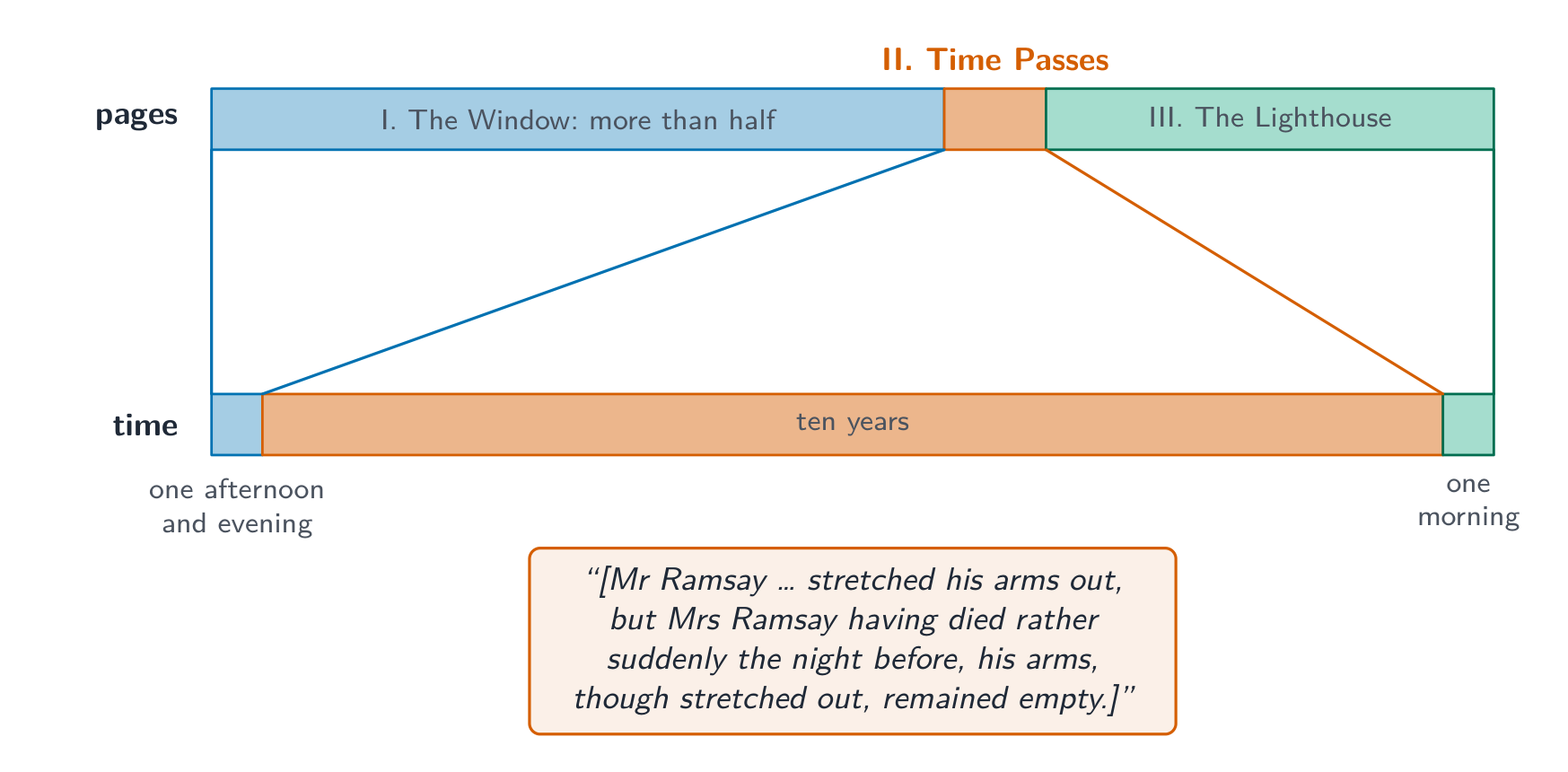
- In Virginia Woolf's To the Lighthouse (1927), the first section follows a single afternoon and evening over more than half the novel. The middle section, "Time Passes", covers ten years in a few pages.
- A death is given in brackets: "[Mr Ramsay, stumbling along a passage one dark morning, stretched his arms out, but Mrs Ramsay having died rather suddenly the night before, his arms, though stretched out, remained empty.]" Pacing 节奏 — how fast time moves on the page — makes that sentence devastating.
How much time does "Time Passes" cover?
Dificuldade 1/5 · Moedas 100 + pequeno bônus na primeira conclusão hoje
The first section covers a single day.
Mrs Ramsay's death is given in brackets.
Dificuldade 1/5 · Moedas 100 + pequeno bônus na primeira conclusão hoje
The pacing makes it devastating.
Story time and page time
- Story time is how long events take; page time is how much text they get. A page can hold four minutes or forty years.
- Summary 概述 speeds up; scene 场景 and detail slow down.
Which technique speeds narrative up?
Dificuldade 1/5 · Moedas 100 + pequeno bônus na primeira conclusão hoje
Scene and detail slow it down.
Factors that shape pace
- Scene versus summary, dialogue, description, flashback and gaps, and shifts in tense all change speed.
- Ask where time is stretched and where it is skipped.
Feel a passage change pace
Pacing is produced by sentence length, detail density and scene-versus-summary — all observable.
Which factors shape pace?
Dificuldade 2/5 · Moedas 140 + pequeno bônus na primeira conclusão hoje
Ask where time is stretched or skipped.
Syntax is a pacing device
- Long sentences with many clauses slow reading; short sentences speed it or stop it dead.
- Woolf's bracket is a short, almost parenthetical sentence inside a long, slow passage about an empty house.
Long sentences with many clauses tend to slow reading.
Dificuldade 1/5 · Moedas 100 + pequeno bônus na primeira conclusão hoje
Short sentences speed or stop it.
Worked example: Woolf's brackets
- Pace: "Time Passes" moves through years of weather, darkness and decay in long, flowing sentences.
- Interruption: human events — Mrs Ramsay's death, Prue's death in childbirth, Andrew's death in France — appear in brackets, in a sentence or two each.
- Interpretation: "Woolf reverses expected proportion: the empty house gets pages, the deaths get brackets. The pacing makes the reader feel how time and war sweep through a family without pause."
How does Woolf reverse expected proportion?
Dificuldade 1/5 · Moedas 100 + pequeno bônus na primeira conclusão hoje
Time sweeps through the family.
Frequency and tempo
- Frequency 频率 is how often an event is told; tempo is how fast. A memory told three times weighs more than one told once.
- Both are deliberate choices.
Frequency is how often an event is told.
Dificuldade 1/5 · Moedas 100 + pequeno bônus na primeira conclusão hoje
Tempo is how fast.
"The pace is fast" is not analysis. Say what mechanism makes it fast — summary, short sentences, a gap — and what effect the speed has at that moment.
Pacing is the relation between story time and page time. Scene, summary, dialogue, description, gaps, tense shifts and sentence length change it. Quote the mechanism, and explain why the text speeds up or slows down there.
Analyse how pacing works in a passage you know.
Mechanism, where, effect.