When a Setting Changes
Introduzido| English | Significado |
|---|---|
| setting/ˈsetɪŋ/ | The time and place in which a story happens. |
"There warn't no home like a raft", 1884
- In Mark Twain's Adventures of Huckleberry Finn, Huck and Jim, an enslaved man escaping to freedom, travel down the Mississippi on a raft. Again and again they go ashore, and each time something goes wrong.
- After a bloody family feud on shore, Huck says: "We said there warn't no home like a raft, after all. Other places do seem so cramped up and smothery, but a raft don't."
How does Huck describe the raft after the feud?
Dificuldade 1/5 · Moedas 100 + pequeno bônus na primeira conclusão hoje
Other places are "cramped up and smothery".
When the setting changes
- A change of setting 背景 is a change of rules: what characters can say, do and be. Ask what the new place allows and what it forbids.
- On the raft, Huck and Jim are equals and friends. On shore, the laws and customs of slavery return.
A change of setting can change what characters are allowed to say and do.
Dificuldade 1/5 · Moedas 100 + pequeno bônus na primeira conclusão hoje
A change of setting is a change of rules.
A pattern of changes
- Twain moves between river and shore many times. The pattern itself makes an argument: freedom lives on the river; danger, violence and lies live in the towns.
- Each return to the raft feels like coming home, as Huck says: "You feel mighty free and easy and comfortable on a raft."
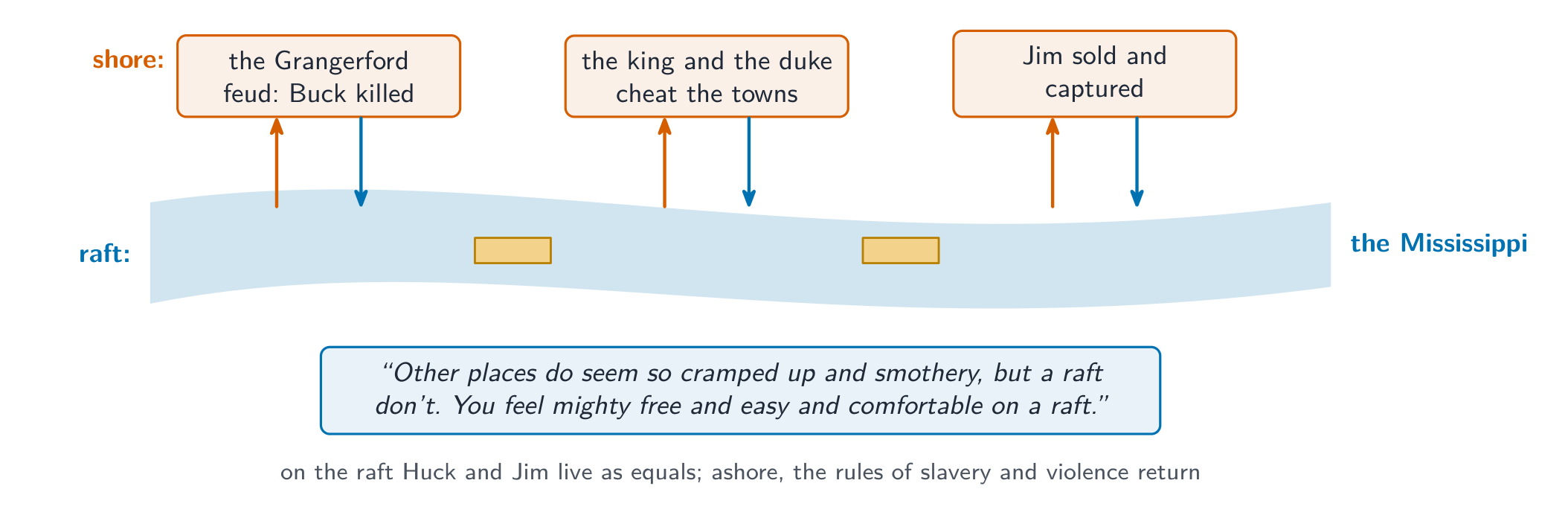
What kind of setting change is this?
Sort each shift by its type.
Match each place to what it allows.
Dificuldade 2/5 · Moedas 140 + pequeno bônus na primeira conclusão hoje
The pattern makes an argument.
Worked example: after the feud
- Shore: Huck lives with the Grangerfords, a polite, churchgoing family locked in a deadly feud. He watches his friend Buck killed.
- Change: he runs back to the river and finds Jim and the raft.
- Interpretation: the "civilised" house was the violent place, and the raft, home to a runaway and a boy, is the safe one. The change of setting turns the reader's expectations of civilisation upside down.
What does the Grangerford episode suggest?
Dificuldade 1/5 · Moedas 100 + pequeno bônus na primeira conclusão hoje
It turns expectations of civilisation upside down.
Characters change with the place
- Notice how a character behaves differently after a change of setting. Huck lies constantly on shore and speaks honestly with Jim on the raft.
- The difference shows what each place does to people.
Huck behaves the same way on shore and on the raft.
Dificuldade 1/5 · Moedas 100 + pequeno bônus na primeira conclusão hoje
He lies on shore and speaks honestly with Jim on the raft.
The last change
- The final change of setting often carries the most weight. Huck ends by planning to "light out for the Territory", away from the towns altogether.
- Ask what the last move says about the whole pattern.
Do not just list where the story goes. "First they are on the raft, then at the Grangerfords'" is a route. Say what each change of setting allows or forbids, and what the pattern argues.
Listing the places a story goes is an analysis of setting.
Dificuldade 1/5 · Moedas 100 + pequeno bônus na primeira conclusão hoje
Say what each change allows or forbids.
A change of setting is a change of rules. Ask what each place allows and forbids, how characters change with it, and what the pattern of changes argues across the work.
Choose a change of setting in a text you know. Say what the new place allows or forbids and what the change shows.
Place as rules.