Sufficient Evidence Across a Whole Work
Introduzido| English | Significado |
|---|---|
| Sufficient | enough to convince a reader |
"To be, or not to be", c. 1600
- In Shakespeare's Hamlet, the prince learns in Act 1 that his uncle murdered his father. He promises revenge, then waits until the last scene of Act 5.
- Many essays argue that Hamlet delays because he thinks too much. The claim is about the whole play, so it needs evidence from the whole play.
When does Hamlet finally kill his uncle?
Dificuldade 1/5 · Moedas 100 + pequeno bônus na primeira conclusão hoje
He waits through the whole play.
What sufficient means
- Sufficient 充分的 evidence is enough to convince a reader that the claim holds for the whole work. One famous speech is not sufficient for a claim about five acts.
- Evidence should come from different parts of the work, and show how the idea develops.
One famous speech is sufficient evidence for a claim about a whole five-act play.
Dificuldade 1/5 · Moedas 100 + pequeno bônus na primeira conclusão hoje
Evidence must come from different parts.
Evidence across five acts
- Act 1: "O, that this too too solid flesh would melt". Act 2: "O, what a rogue and peasant slave am I!" Act 3: "Thus conscience does make cowards of us all". Act 4: "How all occasions do inform against me".
- Act 5 shows the change: "the readiness is all". He stops planning and accepts what comes.
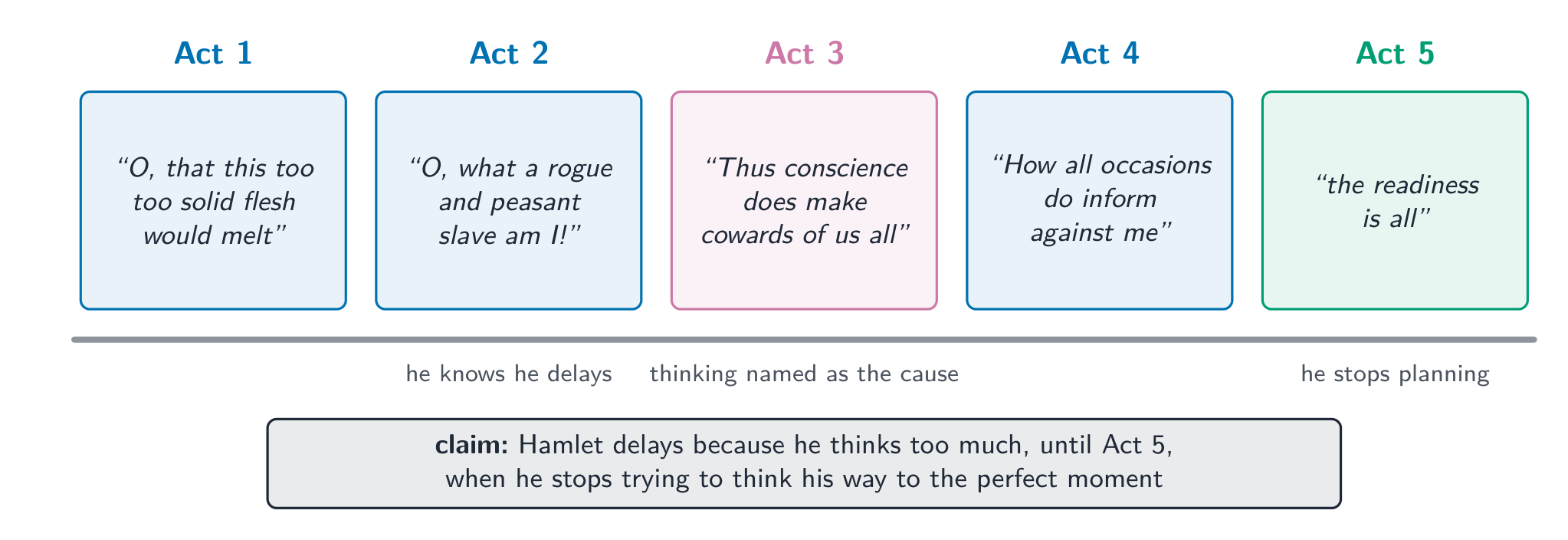
Match each line to its act.
Dificuldade 2/5 · Moedas 140 + pequeno bônus na primeira conclusão hoje
Evidence across the play.
Worked example: three moments, one development
- Act 2: after watching an actor weep for a fictional queen, Hamlet calls himself "a rogue and peasant slave" for doing nothing. He knows he is delaying.
- Act 3: "Thus conscience does make cowards of us all": he names thinking itself as the cause.
- Act 5: "the readiness is all": he stops trying to think his way to the perfect moment. The three moments show the claim developing, from guilt about delay, to an explanation of it, to its end.
Does this evidence set support a whole-work claim?
Sort each set by what it can prove.
What does "the readiness is all" show in Act 5?
Dificuldade 1/5 · Moedas 100 + pequeno bônus na primeira conclusão hoje
The development ends in acceptance.
How much is enough?
- For a whole-work claim, three or four moments from different parts are usually sufficient, if each is explained.
- Add more only if each new moment adds a new step to the argument.
You should add more evidence only if each new moment adds a new step to the argument.
Dificuldade 1/5 · Moedas 100 + pequeno bônus na primeira conclusão hoje
Quality, not quantity.
Watch for counter-evidence
- Hamlet sometimes acts fast: he stabs Polonius through a curtain without thinking. Sufficient evidence also means you have looked for moments that complicate your claim.
- Mention one and explain it: his quick action goes wrong, which supports the idea that the play makes action and thought both dangerous.
Which moment complicates the claim that Hamlet always delays?
Dificuldade 1/5 · Moedas 100 + pequeno bônus na primeira conclusão hoje
Explain it rather than ignore it.
Do not rely on one famous speech. "To be, or not to be" alone cannot prove a claim about the whole of Hamlet. Spread the evidence and explain each part.
Sufficient evidence for a whole-work claim comes from several parts of the work, shows development, and takes account of moments that complicate the claim. Three or four well-explained moments usually convince.
For a claim about a whole work you know, name three moments from different parts and one moment that complicates the claim.
Spread, develop, test.