Contrast as Complication
Introduzido| English | Significado |
|---|---|
| contrast/ˈkɒntræst/ | A clear difference between movement ideas, qualities or sections. |
Kind to Africa, blind to her children, 1852
- In Charles Dickens's Bleak House (1852–53), Mrs Jellyby devotes every hour to a charity project in Africa while her own house is filthy and her children fall down the stairs unnoticed. Her eyes, Dickens writes, seem to see nothing nearer than Africa — he calls it "telescopic philanthropy".
- She is generous and neglectful at once. A contrast 对比 inside one character complicates our judgement — and a strong essay keeps both sides.
What does Dickens call Mrs Jellyby's kind of charity?
Dificuldade 1/5 · Moedas 100 + pequeno bônus na primeira conclusão hoje
Her eyes see nothing nearer than Africa.
Contrast as complication
- A contrast inside a character makes them harder to judge, and more interesting. Dickens's Mrs Jellyby works for a faraway mission at Borrioboola-Gha while her own children are dirty and neglected.
- The essay's task is to explain how the two traits connect, not to decide which is "the real" person.
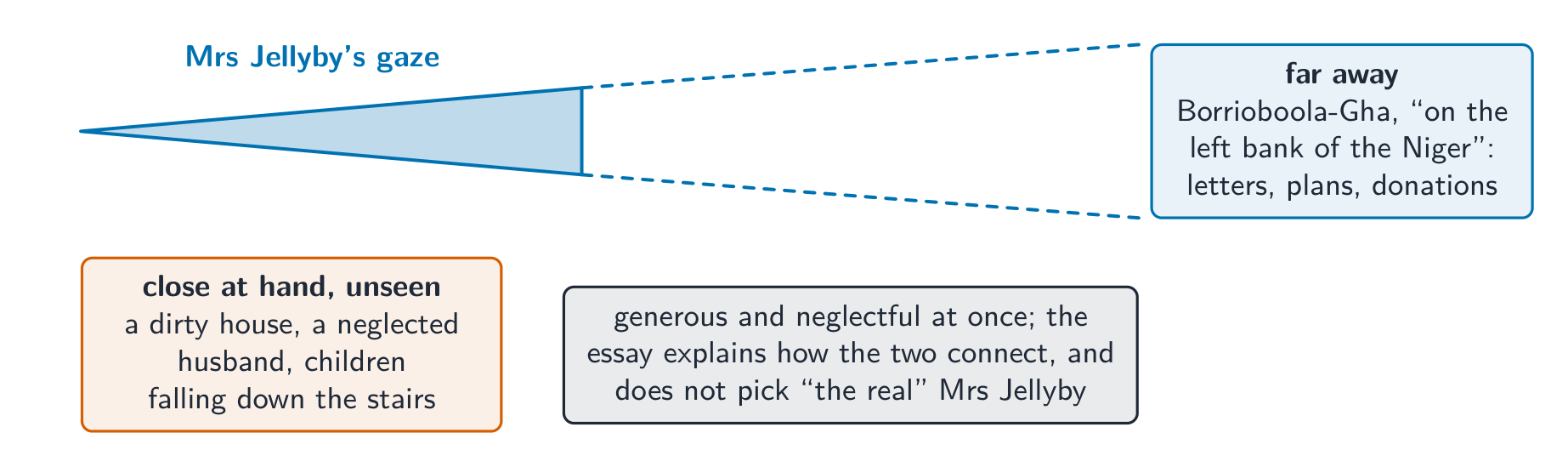
A contrast inside a character makes them harder to judge.
Dificuldade 1/5 · Moedas 100 + pequeno bônus na primeira conclusão hoje
That is why it complicates.
How the traits connect
- Ask: does one trait cause the other? Do they come from the same value? Does the work use them to criticise something larger?
- Mrs Jellyby's charity and her neglect come from the same habit — attention fixed on distant causes that bring her praise.
Nuance, ambiguity, or contradiction?
Sort each result by how far it unsettles the text.
How can two contrasting traits connect?
Dificuldade 2/5 · Moedas 140 + pequeno bônus na primeira conclusão hoje
Explain the connection.
Worked example: reading Mrs Jellyby
- Trait 1: she writes letters all day for her African mission, surrounded by papers, and speaks warmly of the people she will help.
- Trait 2: her daughter Caddy is ink-stained and miserable; a younger son has his head stuck in the railings; dinner is barely cooked.
- Connection: Dickens makes the two traits one failure: charity that looks far away avoids the duty that is close and unglamorous. Interpretation: the contrast satirises a Victorian kind of public goodness that ignored poverty at home — Mrs Jellyby is not a hypocrite who secretly does not care, but a woman whose caring is aimed at the wrong distance.
Match the evidence to the trait.
Dificuldade 2/5 · Moedas 140 + pequeno bônus na primeira conclusão hoje
Evidence for both sides.
What does the worked example conclude about Mrs Jellyby?
Dificuldade 1/5 · Moedas 100 + pequeno bônus na primeira conclusão hoje
Both traits come from one habit.
Keeping the tension
- Use phrases that hold both sides: at the same time, even as, while, yet.
- Let the conclusion explain what the contrast shows, not resolve it into one trait.
Which phrases help hold both sides of a contrast?
Dificuldade 2/5 · Moedas 140 + pequeno bônus na primeira conclusão hoje
Keep the tension.
Writing about a contrast
- Give evidence for each side, then a paragraph on how they connect and what the work gains.
- Consider the narrator's attitude: is the contrast comic, tragic, critical?
Do not make the essay tidy by choosing one trait. "Deep down, she is selfish" throws away the evidence of her real effort. Explain how both traits exist together and what that reveals.
A strong essay decides which trait is the real character.
Dificuldade 1/5 · Moedas 100 + pequeno bônus na primeira conclusão hoje
Keep both and explain the link.
A contrast inside a character complicates our judgement. Give evidence for both traits, explain how they connect — cause, shared value or larger criticism — keep the tension with linking phrases, and say what the contrast reveals rather than resolving it.
Analyse a character with two contrasting traits and explain how they connect.
Two traits, link, meaning.