Different Perspectives, Different Texts
Introduzido| English | Significado |
|---|---|
| perspective/pəˈspektɪv/ | A particular viewpoint from which an issue or experience is understood. |
| attitude/ˈætɪtjuːd/ | A person's viewpoint, feeling or disposition towards someone or something. |
Three narrators, one story, 1818
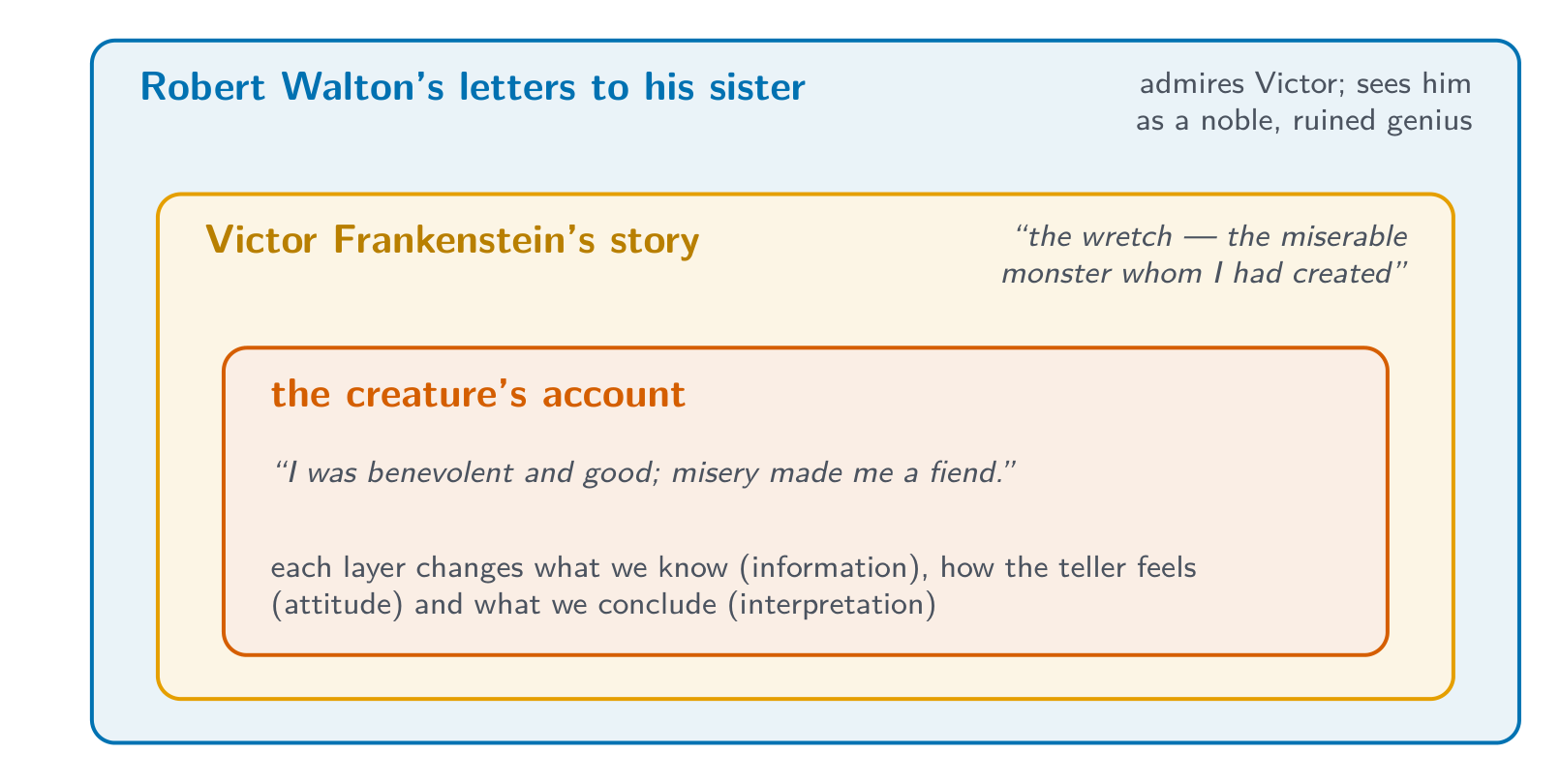
- Mary Shelley's Frankenstein (1818) is told by three voices. The explorer Robert Walton writes letters to his sister; inside them, Victor Frankenstein tells his story; inside that, the creature tells his.
- Victor calls him "the wretch — the miserable monster whom I had created". The creature says: "I was benevolent and good; misery made me a fiend." Each perspective 视角 changes what we know, how we feel and what we conclude.
Who is the outer narrator of Frankenstein?
Dificuldade 1/5 · Moedas 100 + pequeno bônus na primeira conclusão hoje
Victor's story and the creature's sit inside his letters.
How does the creature explain becoming evil?
Dificuldade 1/5 · Moedas 100 + pequeno bônus na primeira conclusão hoje
"I was benevolent and good".
Different information
- Each narrator knows different things. Only the creature can tell us about his months watching the De Lacey family and learning to read.
- What one narrator cannot know, another can supply.
Only the creature can tell us about his months watching the De Lacey family.
Dificuldade 1/5 · Moedas 100 + pequeno bônus na primeira conclusão hoje
Each narrator knows different things.
Different attitudes
- Victor's attitude 态度 is horror and guilt; the creature's is longing turned to rage; Walton's is admiration for Victor.
- Attitude shows in diction: "daemon", "wretch" against "benevolent", "misery".
Information, attitude, or interpretation?
Sort each observation by which of the three effects it shows.
Which words show Victor's attitude to the creature?
Dificuldade 2/5 · Moedas 140 + pequeno bônus na primeira conclusão hoje
Attitude shows in diction.
Different interpretations
- Victor interprets the creature as evil by nature; the creature interprets himself as made evil by rejection.
- The novel leaves the reader to weigh both.
Victor and the creature interpret the creature's evil in the same way.
Dificuldade 1/5 · Moedas 100 + pequeno bônus na primeira conclusão hoje
Nature against rejection.
Worked example: the nested frame
- Information: the creature's narrative reveals that he saved a drowning girl and was shot for it — facts Victor never knew.
- Attitude: Victor's words for him are "daemon" and "fiend"; the creature's own words are about loneliness: "I am alone and miserable".
- Interpretation: "By placing the creature's voice at the centre of Victor's story, Shelley lets the reader hear what Victor refuses to: that his creation's crimes grew from abandonment. The frame makes us judges of Victor as much as of the creature."
What does the creature's narrative reveal that Victor never knew?
Dificuldade 1/5 · Moedas 100 + pequeno bônus na primeira conclusão hoje
The frame makes us judges of Victor.
Writing about perspective
- Make three separate claims: what this perspective lets us know, what attitude it carries, and how it shapes interpretation.
- Compare perspectives where a text offers more than one.
Do not merge author and narrator. "Shelley thinks the creature is a fiend" confuses Victor's view with the novel's. Say whose perspective a judgement belongs to.
A narrator's judgement is always the author's view.
Dificuldade 1/5 · Moedas 100 + pequeno bônus na primeira conclusão hoje
Say whose perspective it is.
A perspective changes three things: the information we receive, the attitude towards it, and the interpretation it invites. Make each a separate claim, compare perspectives, and keep narrator and author apart.
Analyse how one perspective shapes information, attitude and interpretation in a text you know.
Information, attitude, interpretation.