A Thesis About a Whole Poem
Introduzido| English | Significado |
|---|---|
| tension/ˈtenʃn/ | A pulling force transmitted through a stretched string, cable or similar object. |
A polite ride with Death, published 1890
- Emily Dickinson's poem "Because I could not stop for Death" (written about 1862, published 1890) begins: "Because I could not stop for Death – / He kindly stopped for me – / The Carriage held but just Ourselves – / And Immortality." Death is a courteous gentleman taking the speaker for a drive.
- The calm, polite tone sits against a terrifying subject. A thesis about the whole poem should claim this kind of tension 张力, not list devices.
How is Death presented at the start of Dickinson's poem?
Dificuldade 1/5 · Moedas 100 + pequeno bônus na primeira conclusão hoje
The polite tone creates tension with the subject.
Claim a tension
- A tension is a pull between two things in the poem — tone and subject, past and present, what is said and what is felt.
- "Through imagery, structure and diction, the poem explores death" names devices and a topic. "Dickinson's speaker describes her own death as a pleasant outing, and the calm hides a growing shock" is a claim.
Which is a thesis that claims a tension?
Dificuldade 1/5 · Moedas 100 + pequeno bônus na primeira conclusão hoje
It names a pull between tone and subject.
The whole poem, not one line
- A thesis about the whole poem must account for its movement: how the tension develops from start to end.
- Read the ending carefully; it often changes the meaning of the opening.
Does this thesis survive the deletion test?
Sort each thesis by what remains once literary terms are removed.
A thesis about a whole poem must account for its movement to the ending.
Dificuldade 1/5 · Moedas 100 + pequeno bônus na primeira conclusão hoje
The ending often changes the opening.
Worked example: building the thesis
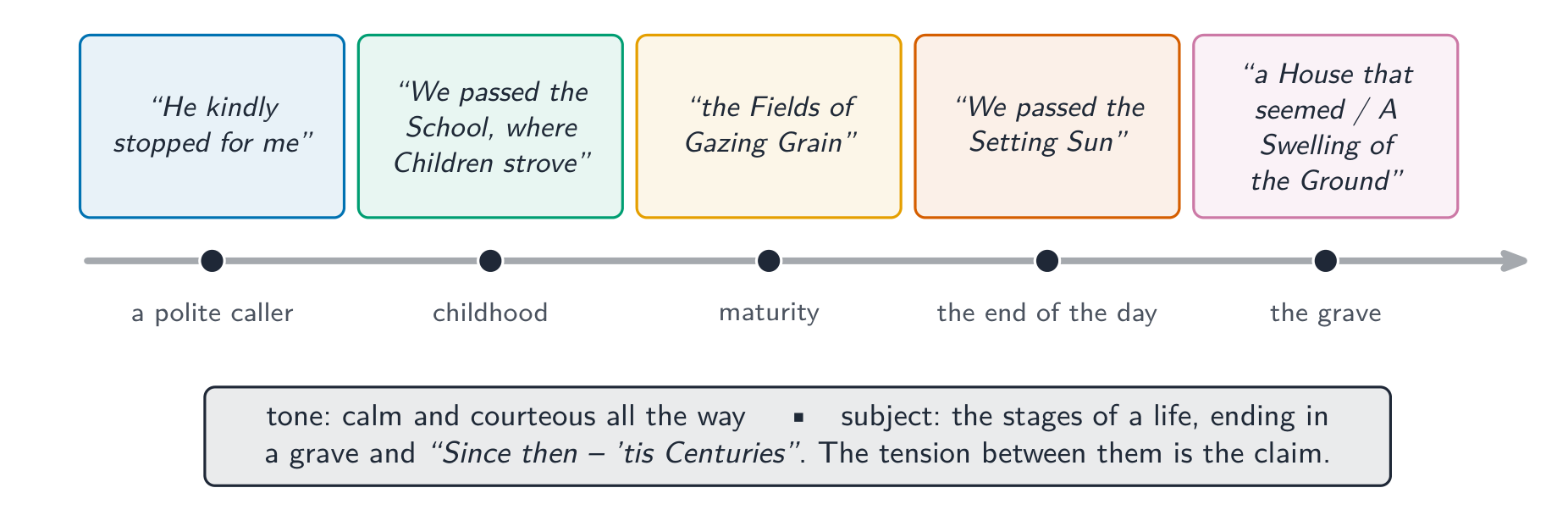
- Movement: the carriage passes a school, "Fields of Gazing Grain" and "the Setting Sun" — childhood, maturity, end of life. Then the speaker notices the cold: her gown is only "Gossamer". They pause at "a House that seemed / A Swelling of the Ground" — a grave.
- Ending: "Since then – 'tis Centuries – and yet / Feels shorter than the Day / I first surmised the Horses' Heads / Were toward Eternity –". The speaker has been dead for centuries.
- Thesis: "Dickinson's speaker narrates her death as a gentle carriage ride, but the growing chill and the grave disguised as a house reveal that the politeness was a trap — and the final stanza shows that she understood where she was going only after it was too late to stop."
Order what the carriage passes.
Dificuldade 3/5 · Moedas 200 + pequeno bônus na primeira conclusão hoje
Childhood, maturity, end of life, grave.
What is the "House that seemed / A Swelling of the Ground"?
Dificuldade 1/5 · Moedas 100 + pequeno bônus na primeira conclusão hoje
The grave is disguised as a house.
Testing the thesis
- Check it against every stanza: does each one support or develop the tension? If one does not fit, revise the thesis.
- The thesis should be arguable — a careful reader might read Death's kindness as sincere.
A good thesis is one that no careful reader could disagree with.
Dificuldade 1/5 · Moedas 100 + pequeno bônus na primeira conclusão hoje
It should be arguable.
Previewing the argument
- A thesis may preview the movement: "first … then … finally" following the poem's stanzas, not a list of devices.
- Devices appear later as evidence for each step.
A device list is not a thesis. "The poet uses imagery, structure and diction" could describe any poem. Claim a tension specific to this poem and show how it develops to the end.
A list of devices makes a strong thesis.
Dificuldade 1/5 · Moedas 100 + pequeno bônus na primeira conclusão hoje
Claim a specific tension.
A thesis about a whole poem claims a specific tension — between tone and subject, or what is said and what is felt — and accounts for the poem's movement to its ending. Test it against every stanza, keep it arguable, and let devices serve as evidence.
Write a tension-based thesis for a poem you know that accounts for its ending.
Tension, movement, ending.