Images and Imagery
Introduzido| English | Significado |
|---|---|
| images | words that create pictures or other sense impressions in the reader's mind |
| imagery/ˈɪmɪdʒri/ | The pattern of many images. |
| sensory/ˈsensəri/ | relating to the senses of sight, sound, touch, taste and smell |
Season of mists, 1819
- On 19 September 1819, after a walk near Winchester, John Keats wrote "To Autumn". It opens: "Season of mists and mellow fruitfulness, / Close bosom-friend of the maturing sun". The poem fills with apples bending trees, swelling gourds and bees that think "warm days will never cease".
- Keats builds the season out of things you can see, taste, touch and hear. These images 意象 together make the poem's imagery 意象群 — and they carry its ideas about ripeness and ending.
How does "To Autumn" open?
Dificuldade 1/5 · Moedas 100 + pequeno bônus na primeira conclusão hoje
Keats wrote it in September 1819.
Literal and figurative images
- An image can be literal — "the moss'd cottage-trees" — or a comparison that works through the senses — autumn as a "bosom-friend" of the sun.
- Sensory 感官的 imagery appeals to sight, sound, touch, taste and smell. Descriptive words — adjectives, verbs, adverbs — build it.
Classify each image.
Dificuldade 2/5 · Moedas 140 + pequeno bônus na primeira conclusão hoje
Images can be literal or comparisons.
Match each image to its main sense.
Dificuldade 2/5 · Moedas 140 + pequeno bônus na primeira conclusão hoje
Imagery appeals to the senses.
Imagery is a collection
- Imagery is the pattern of many images. A collection can emphasise an idea across a stanza or the whole poem.
- Ask what the images have in common, and how they change.
One image, a joined group, or an unjoined list?
Sort each set by whether it is imagery in the CED's sense.
Imagery is a pattern of many images that can emphasise an idea.
Dificuldade 1/5 · Moedas 100 + pequeno bônus na primeira conclusão hoje
Ask what the images share.
Worked example: three stanzas, three senses
- Stanza 1 — fullness (touch, taste): "To bend with apples", "fill all fruit with ripeness to the core", cells "o'er-brimm'd" with honey. The verbs load and swell — nature at its peak.
- Stanza 2 — slowing (sight): autumn as a person "sitting careless on a granary floor" or watching "the last oozings hours by hours". The images slow down.
- Stanza 3 — sound and ending: gnats "mourn", lambs bleat, swallows gather in the skies. Interpretation: Keats moves from touch to sight to sound, and from fullness to departure; the imagery accepts ending as part of ripeness — the songs of autumn are its own music, not a lament for spring.
Order the movement of the poem's imagery.
Dificuldade 3/5 · Moedas 200 + pequeno bônus na primeira conclusão hoje
Touch, sight, sound.
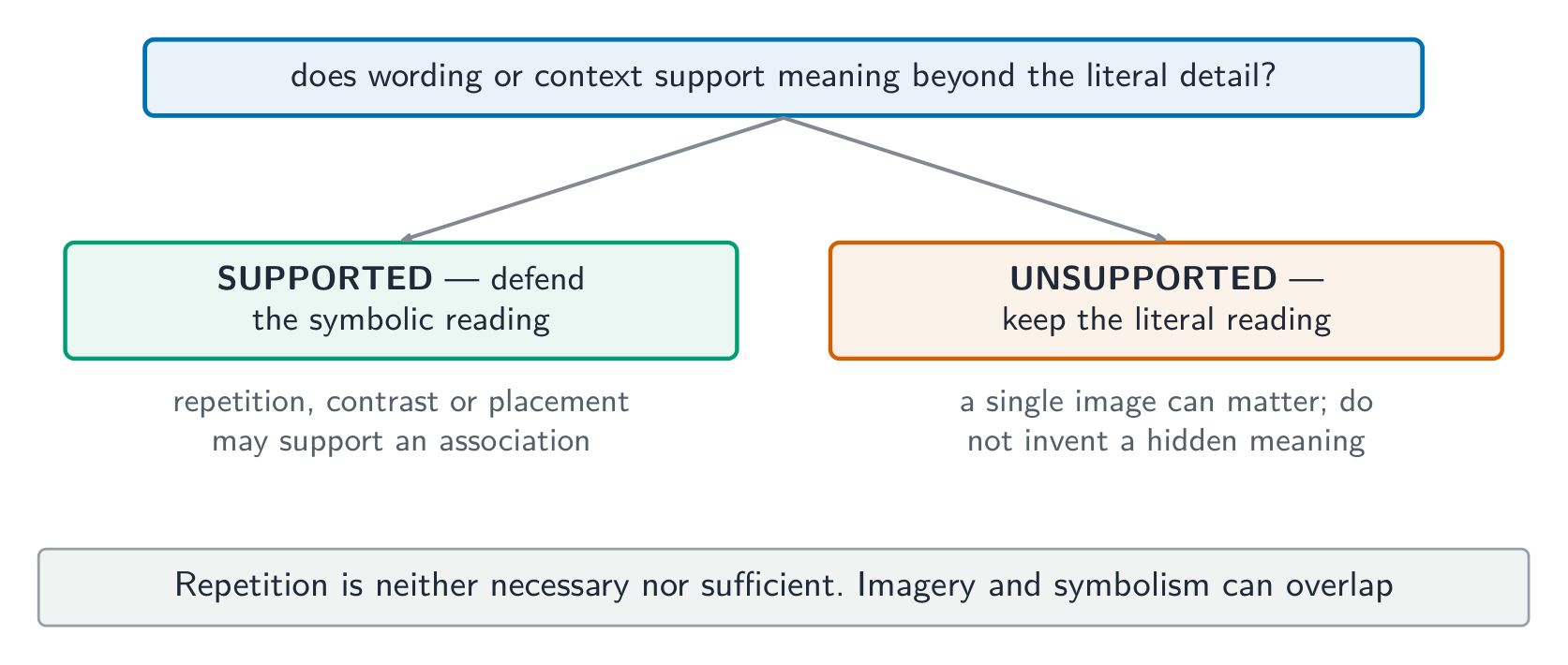
Image or symbol?
- An image becomes symbolic only when the text gives it a meaning beyond itself. The gathering swallows suggest departure because they migrate, and the poem ends with them.
- Use "suggests" for suggestive evidence.
Why do the gathering swallows suggest departure?
Dificuldade 1/5 · Moedas 100 + pequeno bônus na primeira conclusão hoje
The text supports the suggestion.
Writing about imagery
- Quote short images, name the sense, analyse the key words (especially verbs), then link the pattern to the poem's idea.
- Track how the imagery develops from start to end.
"The poet uses lots of imagery to create a vivid picture" says nothing. Name the images, the senses and the words, then explain what idea the pattern builds.
"The poet uses imagery to create a vivid picture" is good analysis.
Dificuldade 1/5 · Moedas 100 + pequeno bônus na primeira conclusão hoje
Name images, senses, words and the idea.
Images can be literal or figurative and appeal to the senses; imagery is the pattern they form. Quote images, name the senses and key words, track how the imagery develops, and link the pattern to the poem's ideas.
Analyse two images from a poem you know, naming the sense and the idea they build.
Image, sense, idea.