Coherence at Three Levels
Introduzido| English | Significado |
|---|---|
| coherence/kəʊˈhɪərəns/ | Of an argument: its ideas fitting together logically. |
Autumn, evening, a dying fire, 1609
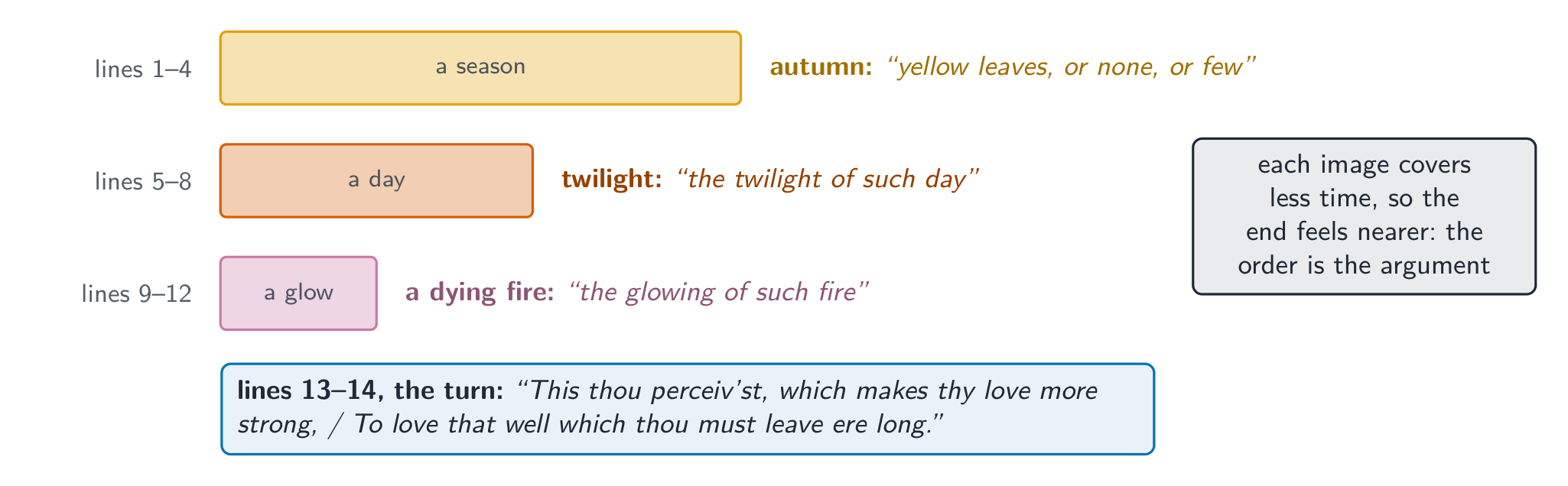
- In Shakespeare's Sonnet 73 (published 1609), the speaker compares himself to three things in turn: autumn trees with "yellow leaves, or none, or few", twilight fading into night, and a fire dying on its own ashes. Each image covers a shorter time — a season, a day, a final glow.
- The final couplet turns to the listener: "This thou perceiv'st, which makes thy love more strong, / To love that well which thou must leave ere long." The arrangement itself builds the argument. That is coherence 连贯性: every part connected to the whole.
Order Sonnet 73's three images.
Dificuldade 3/5 · Moedas 200 + pequeno bônus na primeira conclusão hoje
Each covers a shorter time.
Coherence at three levels
- Sentence level: each sentence connects to the last — through linking words, repeated key terms and logical order.
- Paragraph level: each paragraph develops one step of the argument and links to the thesis. Essay level: the order of paragraphs builds the line of reasoning.
Match each level of coherence to its concern.
Dificuldade 2/5 · Moedas 140 + pequeno bônus na primeira conclusão hoje
Coherence works at three levels.
Arrangement can carry the logic
- Order paragraphs so each step leads to the next, as Shakespeare's quatrains move from long to short time.
- The final step should follow from the earlier ones, not just add another point.
Which level of coherence is being tested?
Sort each check by the level the CED names.
The final paragraph should follow from the earlier ones, not just add another point.
Dificuldade 1/5 · Moedas 100 + pequeno bônus na primeira conclusão hoje
Arrangement carries the logic.
Worked example: a coherent essay plan on Sonnet 73
Thesis: Sonnet 73 shrinks its images of ageing to make the listener feel the speaker's time running out, so that love becomes stronger because it is about to end.
- Paragraph 1: the autumn image — a season, "bare ruin'd choirs" where birds once sang; loss is slow and visible.
- Paragraph 2: twilight, "which by and by black night doth take away" — a single day; the end is faster and closer. Link: "If autumn takes months, twilight takes hours."
- Paragraph 3: the fire "consum'd with that which it was nourish'd by" — minutes; life is destroyed by what fed it. Conclusion: the shrinking time explains the couplet: the listener's love grows "more strong" because the ending is near.
In the worked example, what does the shrinking time explain?
Dificuldade 1/5 · Moedas 100 + pequeno bônus na primeira conclusão hoje
The conclusion follows from the order.
Linking words and repeated terms
- Use linking words that show logic, not just order: because, so, therefore, yet, by contrast rather than also, another point.
- Repeat the thesis's key term (here, "time running out") in each paragraph to hold the essay together.
Which linking words show logic, not just order?
Dificuldade 2/5 · Moedas 140 + pequeno bônus na primeira conclusão hoje
Logical links connect ideas.
Checking coherence
- Read only your topic sentences: do they make a logical argument on their own?
- If two paragraphs could swap places without loss, the order is not yet carrying the logic.
If two paragraphs could swap places without loss, the order is carrying the logic.
Dificuldade 1/5 · Moedas 100 + pequeno bônus na primeira conclusão hoje
Then the order is not yet logical.
"Firstly … secondly … finally" is not coherence. Numbering paragraphs shows order, not logic. Each paragraph must lead to the next because of what it argues.
"Firstly, secondly, finally" makes an essay coherent.
Dificuldade 1/5 · Moedas 100 + pequeno bônus na primeira conclusão hoje
Numbering is order, not logic.
Coherence works at the levels of sentence, paragraph and essay. Arrange paragraphs so each step leads to the next, use linking words that show logic, repeat the thesis's key terms, and test that your topic sentences alone form an argument.
Write three topic sentences for an essay on a work you know that form a logical argument on their own.
Logic, not just order.