Métodos: Como Escrevê-los
Introduzido| English | Significado |
|---|---|
| accessor/əkˈsesə/ | Acessor |
| mutator/mjuːˈteɪtə/ | Mutador |
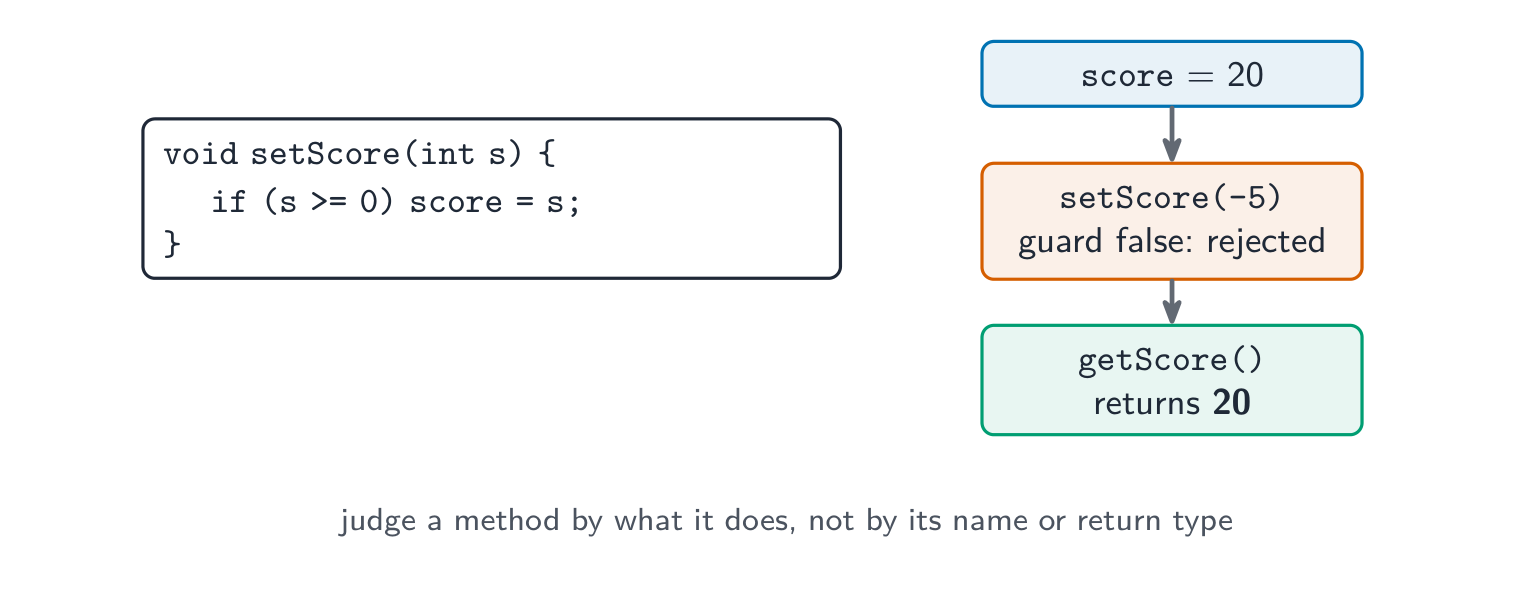
A rejected update leaves the previous state intact
- A score starts at 20. setScore(s) assigns only when s >= 0; the call setScore(-5) leaves score at 20.
- The guard prevents an invalid update. A later getScore() returns the existing state rather than the rejected argument.
Writing a method
- A method has a header and a body. Header:
public void addScore(int s)— access, return type, name, parameters. - Body: the statements in
{ }that do the work. The method can read and change the object's instance variables.
Return values
- A method's return type says what it hands back; use
return value;to send it.public int getScore() { return score; }returns the current score. - A
voidmethod returns nothing — it just does its job (e.g. printing). The returned value must be assignment-compatible with the declared return type; for example, anintvalue can be widened and returned by adoublemethod.
O método public double result() { return 3; } pode compilar mesmo que 3 seja um literal int.
Dificuldade 1/5 · Moedas 100 + pequeno bônus na primeira conclusão hoje
Java amplia o resultado int para double; valores de retorno devem ser compatíveis, não necessariamente escritos com o mesmo tipo.
Accessors and mutators
- An accessor (getter) 访问方法 returns information without changing the object:
getScore(). A mutator (setter) 修改方法 changes the object's state:addScore(s)orsetName(n). - Getters are usually
int/String-returning; setters are usuallyvoid. Together they form the object's public interface over its private data.
Um acessor retorna um valor
Começando com score 20, setScore(-5) rejeita a atualização; getScore retorna 20.
Um método que retorna informações sem alterar o objeto é um(a)...
Dificuldade 1/5 · Moedas 100 + pequeno bônus na primeira conclusão hoje
Acessores leem e retornam; mutadores alteram o estado.
Um método void...
Dificuldade 1/5 · Moedas 100 + pequeno bônus na primeira conclusão hoje
void = sem valor de retorno; ele apenas realiza uma ação.
A non-void method may reach its closing brace and complete normally without returning a value.
Dificuldade 1/5 · Moedas 100 + pequeno bônus na primeira conclusão hoje
A path completing normally must return a compatible value. A path that throws an exception is a different case.
Qual método pode validar sua entrada antes de alterar o estado?
Dificuldade 1/5 · Moedas 100 + pequeno bônus na primeira conclusão hoje
Um setter pode verificar (ex. rejeitar negativos) antes de atribuir.
Escrever valor de retorno; dentro de um método void compila normalmente.
Dificuldade 1/5 · Moedas 100 + pequeno bônus na primeira conclusão hoje
Um método void não pode retornar um valor — isso não compilará.
Methods can validate
- Because outside code goes through methods, a method can check before it acts.
public void setScore(int s) { if (s >= 0) score = s; }rejects a negative score. - Private access prevents unrelated code from directly assigning the field. Constructors and every class method that writes it must still preserve the intended rule; the guarded setter cannot repair an invalid initial score by itself.
A non-void method must return a compatible value on every path that completes normally. A path may instead throw an exception. If an int method reaches its end without returning, compilation fails. A void method returns nothing, so return; (or no return) is correct there; writing return value; in a void method won't compile.
For the stated guarded setter, what does getScore() return after setScore(-5)?
Dificuldade 2/5 · Moedas 140 + pequeno bônus na primeira conclusão hoje
The condition fails, so no assignment occurs and the old score remains 20.
Começando com score 20, replaceScore(30) salva o score antigo, atribui 30, depois retorna o score antigo. Qual valor a chamada retorna?
Dificuldade 2/5 · Moedas 140 + pequeno bônus na primeira conclusão hoje
O score antigo retornado é 20; o novo score armazenado é 30. Retornar um valor não impede a mutação.
An accessor and a mutator:
- Accessor:
public int getScore() { return score; }— reads, returnsint. - Mutator:
public void addScore(int s) { score += s; }— changes state, returns nothing. student.addScore(10); int now = student.getScore();
Carry the reasoning to a new case
- Consider
public int replaceScore(int s) { int old = score; score = s; return old; }. It is a mutator even though it returns a value: starting at 20, replaceScore(30) returns 20 and leaves the score at 30. - Judge behavior rather than names or return types. A method called getScore that increments the score is not a pure accessor, and a void method that merely prints a message need not mutate the object.
A method has a header (access, return type, name, parameters) and a body. A non-void method must return an assignment-compatible value on every normally completing path; a void method returns nothing. Accessors (getters) return state without changing it; mutators (setters) change state and can validate the new value.