Passando e Retornando Referências
Introduzido| English | Significado |
|---|---|
| NullPointerException/nʌl ˈpɔɪntə ekˈsepʃn/ | NullPointerException |
Mutating an object differs from reassigning a parameter
- A caller refers to a Student with score 10. The method executes s.addScore(5); then s = new Student("Other");
- The score of the original shared object becomes 15. Reassigning the local parameter does not change the caller variable, because Java copies the reference value into the parameter.
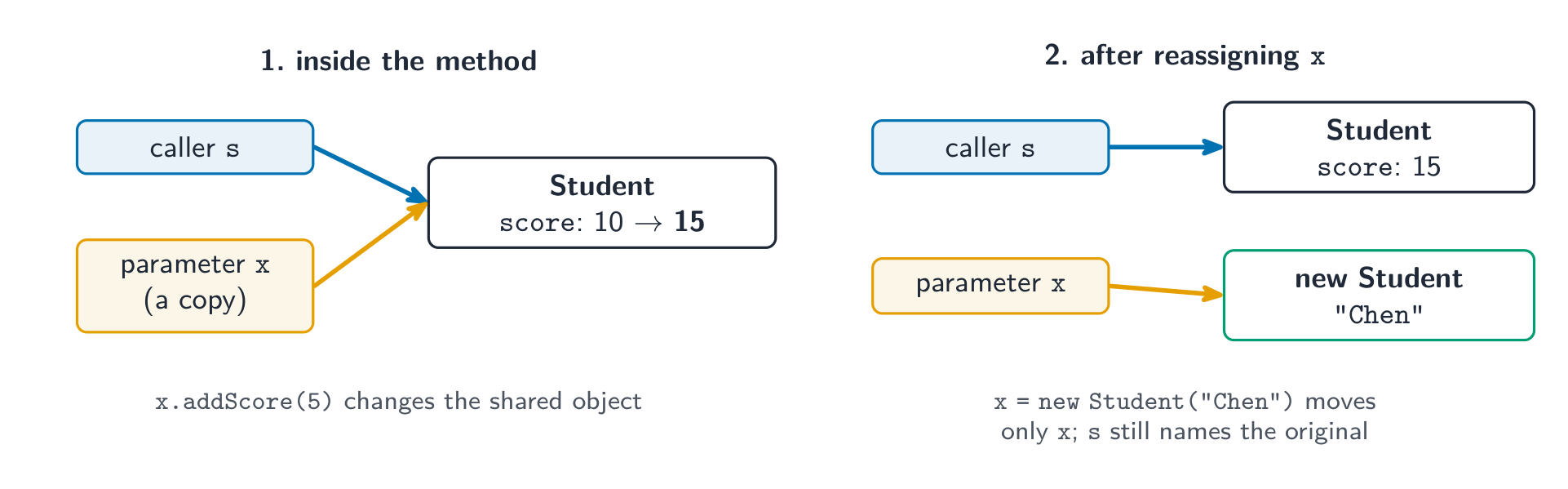
Passing an object to a method
- Java copies the reference value into the method parameter; it does not copy the object. The method's parameter points at the same object as the caller's variable.
- So changes the method makes to the object are visible to the caller. Both primitive and reference arguments are passed by value; the copied reference can still reach a shared object.
Primitives vs. objects as arguments
- A primitive argument is copied — the method can't change the caller's variable. For an object argument, the copied reference reaches the same object — the method can mutate that object.
changeInt(x)can't alterx;student.addScore(10)does change that student. Ask whether the method mutates the shared object or reassigns only its local parameter.
Returning an object
- A method can return a reference to an object — the caller then shares it.
public Student topStudent() { return best; }hands back a reference tobest. - Returning
bestshares an existing object. In contrast,return new Student("Copy");constructs a new object and returns its reference; a method can also returnnull. Read the return expression before deciding whether state is shared.
Referência copiada, objeto compartilhado; primitivo copiado
A nota do objeto muda; a primitiva x não muda.
Quando você passa um objeto para um método, o método recebe...
Dificuldade 1/5 · Moedas 100 + pequeno bônus na primeira conclusão hoje
Java copia o valor da referência em uma variável de parâmetro separada. As duas referências podem apontar para o mesmo objeto; a reatribuição do parâmetro não substitui a variável do chamador.
Um método pode alterar a variável int do chamador modificando seu parâmetro.
Dificuldade 1/5 · Moedas 100 + pequeno bônus na primeira conclusão hoje
Primitivas são copiadas — o int do chamador permanece intacto.
Chamar um método de instância através de uma referência nula lançará...
Dificuldade 1/5 · Moedas 100 + pequeno bônus na primeira conclusão hoje
null aponta para nenhum objeto, então não há nada sobre o qual chamar o método.
Um método pode retornar uma referência para um objeto, que o chamador então compartilha.
Dificuldade 1/5 · Moedas 100 + pequeno bônus na primeira conclusão hoje
Um método pode retornar uma referência de objeto existente e compartilhar seu objeto com o chamador. Um método diferente pode construir e retornar um novo objeto.
Para usar com segurança uma referência que pode ser null, você deve primeiro verificar...
Dificuldade 1/5 · Moedas 100 + pequeno bônus na primeira conclusão hoje
Proteja-se contra null antes de chamar um método nele.
Todo método que retorna uma referência Student deve retornar um objeto previamente existente.
Dificuldade 1/5 · Moedas 100 + pequeno bônus na primeira conclusão hoje
Falso: return new Student("Outro"); constrói e retorna um novo objeto.
The null reference
- A reference that points at no object is
null. Calling an instance method throughnullthrows a NullPointerException 空指针异常. - Returning
null(e.g. "not found") is common — the caller must check for it. Guard withif (s != null) { s.addScore(10); }before using a possibly-null reference.
Passing an object copies a reference value — the method can change the caller's object; passing a primitive copies the value — it can't. So student.addScore(10) mutates the caller's object, but changeInt(x) leaves the caller's x untouched. And calling an instance method through a null reference throws a NullPointerException — check != null first when a reference might be null.
After the two statements, what is the original caller-referenced Student score?
Dificuldade 2/5 · Moedas 140 + pequeno bônus na primeira conclusão hoje
The first statement mutates the original object to 15. The later local reassignment does not replace the caller reference.
Um método retorna new Student("Outro"); mas o chamador ignora o resultado. O que acontece com a variável Student existente do chamador?
Dificuldade 1/5 · Moedas 100 + pequeno bônus na primeira conclusão hoje
Retornar uma referência não a atribui à variável do chamador. A variável existente ainda aponta para seu objeto original.
Reference vs. value:
void addTen(Student s) { s.addScore(10); }— changes the passed object (shared reference).void addTen(int x) { x += 10; }— the caller'sintis unchanged (copied value).- Both parameter values are copied; only the copied reference reaches shared mutable state.
Carry the reasoning to a new case
- Compare
return s;withreturn new Student("Other");: the first returns the supplied reference; the second returns a newly constructed object. Neither return changes the caller's variable until the caller assigns the result. - To predict a change, draw the caller and parameter as separate reference variables pointing to objects. Update the object for a mutator call, and update only the parameter arrow for parameter reassignment.
Passing an object reference copies its value into the parameter, so the method can change the caller's object; passing a primitive copies the value, so it can't. A method can return a reference to an object. A reference to no object is null — calling an instance method through it throws a NullPointerException, so check first.