Coupled Reactions
Introduzido| English | Significado |
|---|---|
| coupled reactions/ˈkʌpld rɪˈækʃnz/ | reações acopladas |
| ATP/ˌeɪ tiː ˈpiː/ | Adenosine triphosphate, a molecule that transfers usable energy between cellular processes. |
Powering the impossible
- Your cells build proteins, and copper is extracted from its ore, yet both reactions have $\Delta G>0$: on their own they are thermodynamically unfavourable.
- They happen because each is linked to a strongly favourable reaction, or driven by an outside energy source such as light or electricity.
Linking two reactions
- In coupled reactions 偶联反应, a favourable reaction drives an unfavourable one. The two must share a species, so they can be added into one overall equation.
- The free energies add: $\Delta G^\circ_{\text{total}}=\Delta G^\circ_1+\Delta G^\circ_2$. If the total is negative, the overall process is favourable.
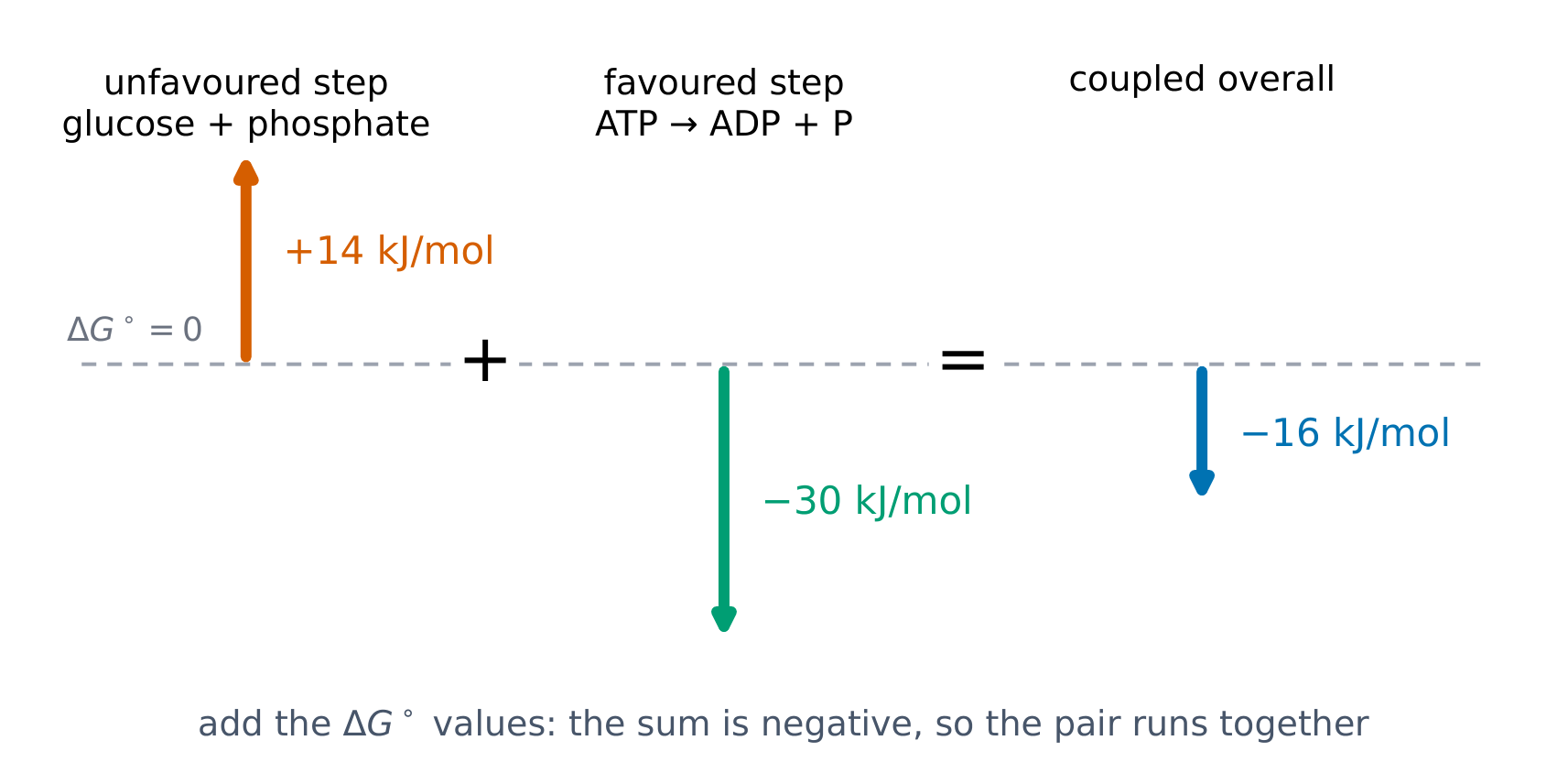
Coupling lets a favourable reaction drive one that is...
Dificuldade 1/5 · Moedas 100 + pequeno bônus na primeira conclusão hoje
A favourable partner supplies the free energy to drive an unfavourable one.
ATP powers the cell
- Cells couple unfavourable reactions to the hydrolysis of ATP 三磷酸腺苷: $\text{ATP}+\text{H}_2\text{O}\rightarrow\text{ADP}+\text{P}_i$, $\Delta G^\circ\approx-30.5$ kJ mol⁻¹.
- The shared species is the phosphate group, which ATP hands to the molecule being built.
The free energies of coupled reactions add together.
Dificuldade 1/5 · Moedas 100 + pequeno bônus na primeira conclusão hoje
$\Delta G_{total} = \Delta G_1 + \Delta G_2$.
A coupled pair proceeds only if the ____ free energy is negative.
Dificuldade 1/5 · Moedas 100 + pequeno bônus na primeira conclusão hoje
The sum of the two free energies must be negative.
Outside energy sources
- An unfavourable process can also be driven by energy from outside. Light drives photosynthesis ($\Delta G^\circ\approx+2870$ kJ per mole of glucose).
- An electric current drives electrolysis, for example charging a battery or making aluminium from Al₂O₃.
Coupled reactions
A favourable reaction can drive an unfavourable one if they share an intermediate.
Cells couple unfavourable reactions to the breakdown of ATP.
Dificuldade 1/5 · Moedas 100 + pequeno bônus na primeira conclusão hoje
ATP's large negative $\Delta G$ drives many cellular reactions.
Which drives photosynthesis, an unfavourable process?
Dificuldade 1/5 · Moedas 100 + pequeno bônus na primeira conclusão hoje
Photosynthesis has $\Delta G>0$. Absorbed light supplies the energy. Catalysts never change $\Delta G$.
Biology: making glucose-6-phosphate.
- Step 1: glucose + P$_i$ → glucose-6-phosphate + H₂O, $\Delta G^\circ=+13.8$ kJ mol⁻¹ (unfavourable).
- Step 2: ATP + H₂O → ADP + P$_i$, $\Delta G^\circ=-30.5$ kJ mol⁻¹. Adding them, P$_i$ and H₂O cancel: glucose + ATP → glucose-6-phosphate + ADP, $\Delta G^\circ=13.8-30.5=$ −16.7 kJ mol⁻¹, favourable.
For compatible amounts and conditions, linked reaction A has $\Delta G=+15\ \text{kJ}$ and B has $\Delta G=-40\ \text{kJ}$. Find the total in kJ.
Dificuldade 2/5 · Moedas 140 + pequeno bônus na primeira conclusão hoje
Add the values for the linked equations: $\Delta G_{total}=15+(-40)=-25\ \text{kJ}$, so the overall process is favourable.
For two reactions to be coupled, they must share a...
Dificuldade 1/5 · Moedas 100 + pequeno bônus na primeira conclusão hoje
A shared intermediate links the two reactions.
Industry: copper from its ore. Is the overall process favourable?
- $\text{Cu}_2\text{S}(s)\rightarrow2\text{Cu}(s)+\text{S}(s)$, $\Delta G^\circ=+86.2$ kJ mol⁻¹. $\text{S}(s)+\text{O}_2(g)\rightarrow\text{SO}_2(g)$, $\Delta G^\circ=-300.1$ kJ mol⁻¹.
- S is made in the first step and used in the second, so they add: $\text{Cu}_2\text{S}+\text{O}_2\rightarrow2\text{Cu}+\text{SO}_2$, $\Delta G^\circ=$ −213.9 kJ mol⁻¹. Yes, favourable.
Reaction 1 has $\Delta G^\circ=+21$ kJ mol⁻¹. It is coupled to ATP hydrolysis ($-30.5$ kJ mol⁻¹). What is $\Delta G^\circ$ for the overall process, in kJ mol⁻¹?
Dificuldade 2/5 · Moedas 140 + pequeno bônus na primeira conclusão hoje
$+21+(-30.5)=-9.5$ kJ mol⁻¹, so the coupled process is favourable.
- You cannot couple any two reactions. They must share a species that cancels when the equations are added.
- The total $\Delta G^\circ$ decides favourability, not each step. A negative total says nothing about the rate.
- If a step is multiplied (e.g. ×2), multiply its $\Delta G^\circ$ too.
A reaction has $\Delta G^\circ=+45$ kJ mol⁻¹. What is the smallest whole number of ATP molecules (each $-30.5$ kJ mol⁻¹) that must be hydrolysed to make the overall $\Delta G^\circ$ negative?
Dificuldade 2/5 · Moedas 140 + pequeno bônus na primeira conclusão hoje
One ATP: $45-30.5=+14.5$ (still unfavourable). Two: $45-61=-16$ kJ mol⁻¹.
Coupled reactions let a favourable reaction drive an unfavourable one through a shared species: add the equations, add the $\Delta G^\circ$ values, and a negative total means the overall process is favourable. Cells use ATP hydrolysis (−30.5 kJ mol⁻¹); light and electric current can also drive unfavourable processes.