Molecular Structure of Acids and Bases
Introduzido| English | Significado |
|---|---|
| oxoacid/ˈɒksəʊsɪd/ | oxiacido |
| resonance/ˈrezənəns/ | Describing a molecule by two or more structures because no single structure shows its real bonding. |
Why is one acid stronger than another?
- HF is a weak acid, but HCl, HBr and HI are strong. $\text{HClO}_4$ is one of the strongest acids known, while HClO is weak. The differences come from structure.
- Two questions decide it: how easily does the H–A bond break, and how stable is the conjugate base $\text{A}^-$ once the proton has gone?
Binary acids down a group: bond strength wins
- Down group 17, the atom X gets bigger, so the H–X bond gets longer and weaker. A weaker bond lets $\text{H}^+$ leave more easily.
- So acid strength rises: $\text{HF}<\text{HCl}<\text{HBr}<\text{HI}$, even though F is the most electronegative. Bond strength matters more than electronegativity down a group.
Order these acids from WEAKEST to STRONGEST.
Dificuldade 3/5 · Moedas 200 + pequeno bônus na primeira conclusão hoje
Down group 17 the H–X bond gets weaker, so the proton leaves more easily.
Binary acids across a period: polarity wins
- Across period 2, the atoms are similar in size, so electronegativity decides. A more electronegative atom makes the H–A bond more polar and holds the negative charge of $\text{A}^-$ better.
- So acidity rises: $\text{CH}_4<\text{NH}_3<\text{H}_2\text{O}<\text{HF}$. Methane is not acidic at all in water.
Why is $\text{H}_2\text{O}$ more acidic than $\text{NH}_3$?
Dificuldade 1/5 · Moedas 100 + pequeno bônus na primeira conclusão hoje
Across a period, electronegativity decides acid strength.
Oxoacids: more oxygen, stronger acid
- In an oxoacid 含氧酸 the acidic H is bonded to O. Extra O atoms on the central atom pull electron density away from the O–H bond and spread the negative charge of the conjugate base.
- $K_a$ rises sharply: HClO $3.0\times10^{-8}$, $\text{HClO}_2$ $1.1\times10^{-2}$, then $\text{HClO}_3$ and $\text{HClO}_4$ are strong.
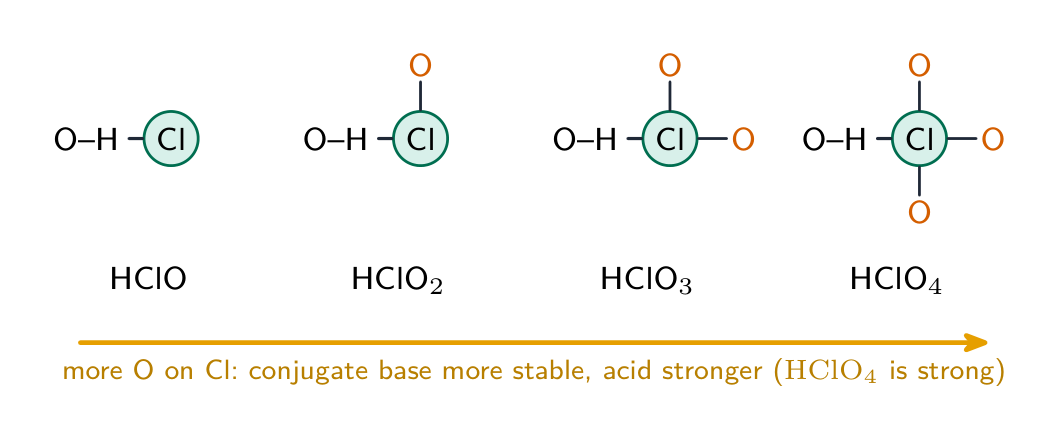
Which is the strongest acid?
Dificuldade 1/5 · Moedas 100 + pequeno bônus na primeira conclusão hoje
Same central atom; $\text{H}_2\text{SO}_4$ has one more O atom, which stabilizes its conjugate base.
Oxoacids: a more electronegative central atom
- With the same number of O atoms, a more electronegative central atom pulls harder on the electrons and makes the acid stronger.
- HOCl ($K_a=3.0\times10^{-8}$) $>$ HOBr ($2\times10^{-9}$) $>$ HOI ($2\times10^{-11}$).
HOI is a stronger acid than HOCl.
Dificuldade 1/5 · Moedas 100 + pequeno bônus na primeira conclusão hoje
Cl is more electronegative than I and pulls electron density from the O–H bond more, so HOCl is stronger.
Resonance stabilizes carboxylate ions
- In a carboxylate ion $\text{RCOO}^-$, the negative charge is shared equally by two O atoms through resonance 共振. A spread-out charge is more stable, so carboxylic acids are much stronger than alcohols.
- Ethanoic acid has $K_a=1.8\times10^{-5}$; ethanol is about $10^{11}$ times weaker, because its $\text{CH}_3\text{CH}_2\text{O}^-$ keeps the charge on one O.

The negative charge in a carboxylate ion is shared by two O atoms through ____, which makes the ion more stable.
Dificuldade 1/5 · Moedas 100 + pequeno bônus na primeira conclusão hoje
Spreading the charge stabilizes the conjugate base and strengthens the acid.
Electron-withdrawing groups
- Electronegative atoms near the COOH group, such as Cl, pull electron density through the bonds and stabilize the conjugate base. More Cl atoms, and closer ones, give a stronger acid.
- $\text{CH}_3\text{COOH}$ ($1.8\times10^{-5}$) $<$ $\text{ClCH}_2\text{COOH}$ ($1.4\times10^{-3}$) $<$ $\text{Cl}_2\text{CHCOOH}$ ($5\times10^{-2}$) $<$ $\text{Cl}_3\text{CCOOH}$ (about $0.3$).
What makes an acid strong?
Sort each comparison by which structural feature gives the stronger acid.
Which has the largest $K_a$?
Dificuldade 1/5 · Moedas 100 + pequeno bônus na primeira conclusão hoje
Two very electronegative F atoms withdraw the most electron density, giving the most stable conjugate base.
Explain why $\text{HNO}_3$ is a stronger acid than $\text{HNO}_2$.
- Both have N as the central atom, but $\text{HNO}_3$ has one more O atom.
- The extra O pulls electron density from the O–H bond, so $\text{H}^+$ leaves more easily.
- It also spreads the negative charge over three O atoms in $\text{NO}_3^-$ instead of two in $\text{NO}_2^-$, so the conjugate base is more stable.
Bases: an available lone pair
- A Brønsted base needs a lone pair to accept $\text{H}^+$. Ammonia and amines ($\text{CH}_3\text{NH}_2$) are weak bases for this reason.
- Groups that pull electrons away from the N make the lone pair less available and the base weaker. The stronger an acid, the weaker its conjugate base.
The stronger an acid is, the stronger its conjugate base.
Dificuldade 1/5 · Moedas 100 + pequeno bônus na primeira conclusão hoje
It is the reverse. A strong acid holds its proton weakly, so its conjugate base has little pull for $\text{H}^+$.
Do not apply "more electronegative = stronger acid" down a group: HF is weaker than HI because the H–F bond is so strong. Electronegativity is the deciding factor across a period and in oxoacids; bond strength is the deciding factor down a group.
Binary acids: stronger down a group (weaker H–X bond) and across a period (more polar bond). Oxoacids: stronger with more O atoms and a more electronegative central atom. Carboxylic acids are stabilized by resonance, and electron-withdrawing groups make them stronger. Always explain through bond strength or conjugate-base stability.