Enthalpy of Formation
Introduzido| English | Significado |
|---|---|
| enthalpy of formation/enˈθælpi ɒv fɔːˈmeɪʃn/ | entalpia de formação |
Building compounds from scratch
- The energy on a food label and the fuel value of natural gas are both found from tables, not from burning every sample. The table lists enthalpies of formation 生成焓.
- With one table and "products minus reactants", you can find ΔH for thousands of reactions.
The heat of formation
- The enthalpy of formation 生成焓 is the heat to make 1 mol from its elements.
- For standard formation enthalpy, use each element in its most stable reference form at the stated temperature and standard pressure (1 bar).
- An element in its reference form has standard formation enthalpy zero by convention.
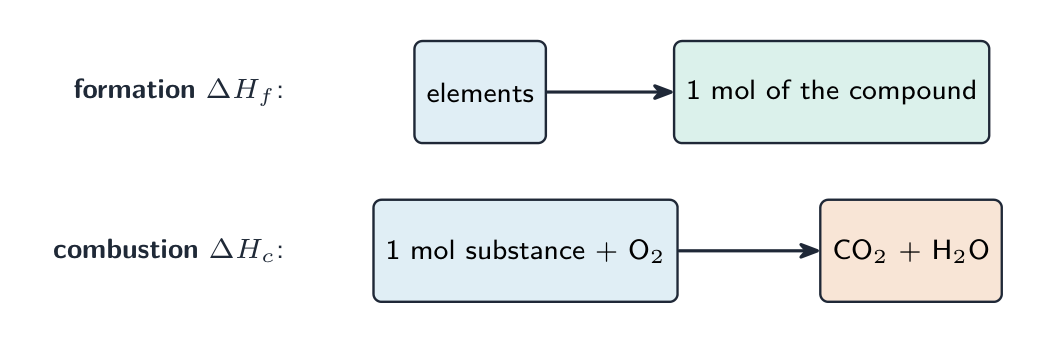
Formation makes a compound from its elements; combustion burns it in oxygen
The enthalpy of formation is for making exactly 1 mole of a substance from its elements.
Dificuldade 1/5 · Moedas 100 + pequeno bônus na primeira conclusão hoje
It is defined per mole of the compound formed.
Products minus reactants
- $\Delta H_{rxn} = \sum \Delta H_f(\text{products}) - \sum \Delta H_f(\text{reactants})$.
- Add up the products' formation enthalpies, then subtract the reactants'.
- Multiply each one by its coefficient first.
The reaction enthalpy from formation data is...
Dificuldade 1/5 · Moedas 100 + pequeno bônus na primeira conclusão hoje
$\Delta H_{rxn} = \sum \Delta H_f(\text{products}) - \sum \Delta H_f(\text{reactants})$.
You must multiply each formation enthalpy by its coefficient before summing.
Dificuldade 1/5 · Moedas 100 + pequeno bônus na primeira conclusão hoje
Coefficients scale the amount of each substance.
Why elements count as zero
- The most stable elemental form is the reference assigned zero; another allotrope need not have zero formation enthalpy.
- $\text{O}_2(g)$, $\text{N}_2(g)$ and carbon as graphite have $\Delta H_f^\circ=0$ at 298 K; diamond does not.
- This simplifies the arithmetic.
Enthalpy of formation
ΔHf is the energy change when one mole of a compound forms from its elements.
What is the standard enthalpy of formation of $\text{O}_2$ gas?
Dificuldade 1/5 · Moedas 100 + pequeno bônus na primeira conclusão hoje
Oxygen gas is the elemental reference form at 298 K, so its standard formation enthalpy is zero.
An element in its most stable reference form has standard formation enthalpy of ____.
Dificuldade 1/5 · Moedas 100 + pequeno bônus na primeira conclusão hoje
Zero is assigned by convention to the elemental reference form; other allotropes, such as diamond, need not have zero formation enthalpy.
Coefficient-weighted formation totals for the reaction as written are $-400\ \text{kJ}$ for products and $-250\ \text{kJ}$ for reactants.
- $\Delta H_{rxn} = -400 - (-250) = -150\ \text{kJ}$.
- The reaction is exothermic.
Products' $\sum \Delta H_f = -300$; reactants' $= -100$. Find $\Delta H_{rxn}$ (in kJ).
Dificuldade 2/5 · Moedas 140 + pequeno bônus na primeira conclusão hoje
$\Delta H_{rxn} = -300 - (-100) = -200\ \text{kJ}$.
Which substance has ΔH°f = 0 at 298 K?
Dificuldade 1/5 · Moedas 100 + pequeno bônus na primeira conclusão hoje
Only an element in its most stable standard form is zero. Ozone and diamond are less stable forms.
Standard enthalpies of formation (298 K)
| Substance | ΔH°f / kJ/mol |
|---|---|
| CH₄(g) | −74.8 |
| C₂H₅OH(l) | −277.7 |
| CO₂(g) | −393.5 |
| H₂O(l) | −285.8 |
| H₂O(g) | −241.8 |
| NH₃(g) | −46.1 |
| O₂(g), N₂(g), C(graphite) | 0 |
Use the table to find ΔH° in kJ for C₂H₅OH(l) + 3O₂(g) → 2CO₂(g) + 3H₂O(l).
Dificuldade 2/5 · Moedas 140 + pequeno bônus na primeira conclusão hoje
Products: 2(−393.5) + 3(−285.8) = −1644.4. Reactants: −277.7. ΔH = −1644.4 − (−277.7) = −1366.7 kJ.
Burning methane. Find ΔH° for $\text{CH}_4(g) + 2\text{O}_2(g) \rightarrow \text{CO}_2(g) + 2\text{H}_2\text{O}(l)$.
- Products: $-393.5 + 2(-285.8) = -965.1$ kJ. Reactants: $-74.8 + 2(0) = -74.8$ kJ.
- $\Delta H^\circ = -965.1 - (-74.8) = -890.3$ kJ per mole of CH₄. With H₂O(g) instead it would be −802.3 kJ: the state matters.
- Products minus reactants; take care with double negatives.
- Multiply each ΔH°f by its coefficient; elements in their standard state are zero.
- Use the right state: H₂O(l) and H₂O(g) have different values.
The enthalpy of formation is the heat to make 1 mol of a substance from its elements, and standard formation enthalpy is zero for an element in its reference form. Any reaction's heat is $\Delta H_{rxn} = \sum \Delta H_f(\text{products}) - \sum \Delta H_f(\text{reactants})$, each scaled by its coefficient.