Writing the Rate Law
Introduzido| English | Significado |
|---|---|
| rate law/reɪt lɔː/ | lei da velocidade |
| reaction order | reaction order |
| rate constant/reɪt ˈkɒnstənt/ | constante de velocidade |
Twice the reactant, twice the speed?
- Double the concentration of one reactant and the rate might double, go up four times, or not change at all. The balanced equation does not tell you which.
- The rate law 速率定律 does. It is found from experiments, and AP free-response questions almost always ask you to find it from a table of initial rates.
The rate law
- For $a\text{A}+b\text{B}\rightarrow\text{products}$: $\text{rate}=k[\text{A}]^m[\text{B}]^n$. The exponents $m$ and $n$ are the reaction orders 反应级数; the overall order is $m+n$.
- $k$ is the rate constant 速率常数. It changes with temperature and with a catalyst, but not with concentration.
Which change alters the value of the rate constant k?
Dificuldade 1/5 · Moedas 100 + pequeno bônus na primeira conclusão hoje
k depends on temperature (and on a catalyst), not on concentration.
What each order means
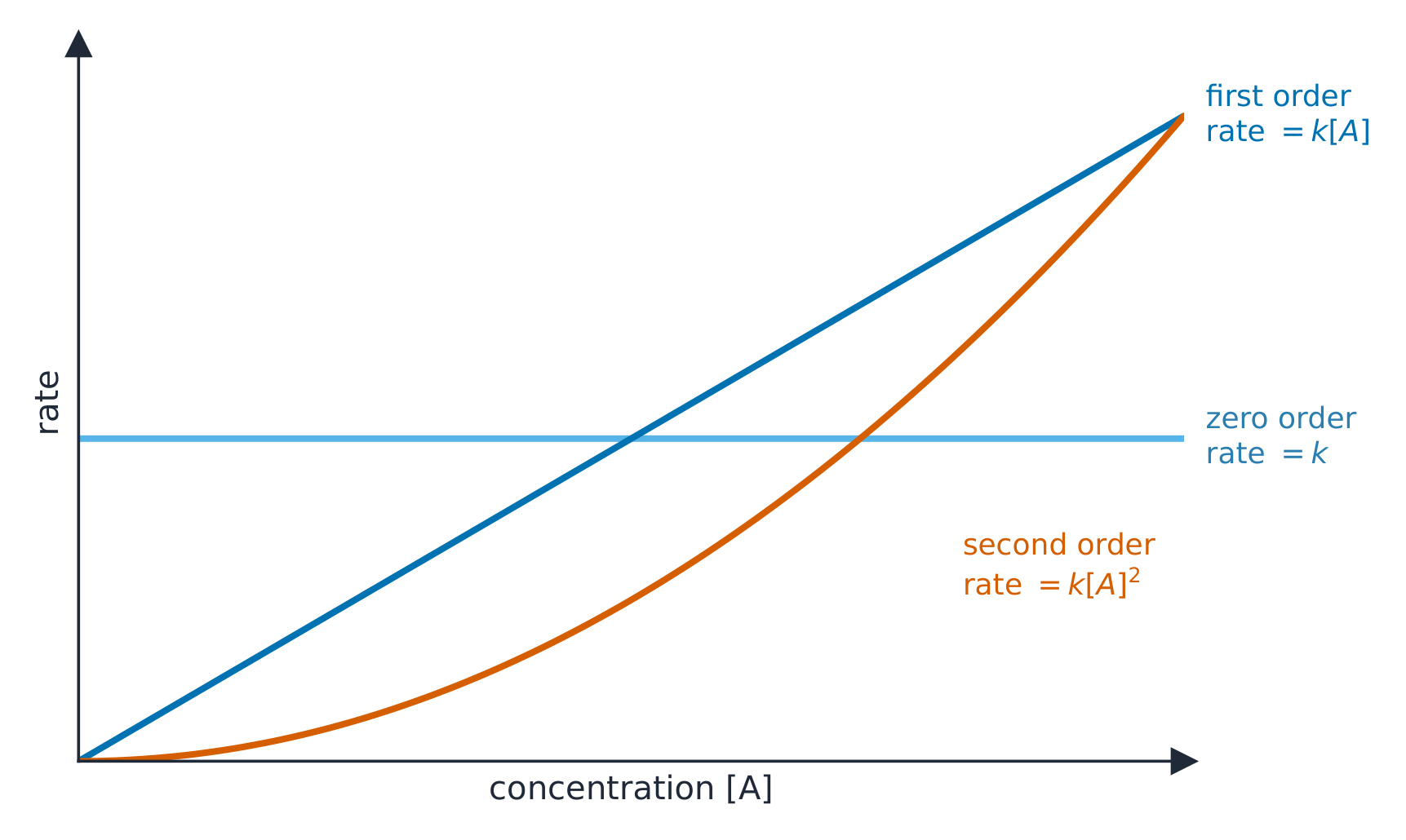
- Multiply $[\text{A}]$ by a factor $x$ and the rate is multiplied by $x^m$. Zero order: no change. First order: rate × $x$. Second order: rate × $x^2$.
- Triple a second-order reactant and the rate goes up $3^2=9$ times.
Find the reaction order
Use how the rate responds to concentration to find the order in A.
rate = k[A]²[B]. By what factor does the rate change if [A] is doubled and [B] is unchanged?
Dificuldade 2/5 · Moedas 140 + pequeno bônus na primeira conclusão hoje
2² = 4.
If a reaction is zero order in B, removing B completely leaves the rate unchanged.
Dificuldade 1/5 · Moedas 100 + pequeno bônus na primeira conclusão hoje
False. B must still be present to react; within the experiment's range, changing [B] has no effect on the rate.
The method of initial rates
- Run several trials and measure the rate right at the start, when the concentrations are known. Compare two trials in which only one concentration changes.
- Find each order this way, write the rate law, then put one trial's numbers in to find $k$.
Initial rates for $2\text{NO}(g)+\text{O}_2(g)\rightarrow2\text{NO}_2(g)$.
| Trial | [NO] / M | [O₂] / M | initial rate / M s⁻¹ |
|---|---|---|---|
| 1 | 0.010 | 0.010 | $2.5\times10^{-5}$ |
| 2 | 0.020 | 0.010 | $1.0\times10^{-4}$ |
| 3 | 0.010 | 0.020 | $5.0\times10^{-5}$ |
- Trials 1 → 2: [NO] × 2, rate × 4, so second order in NO. Trials 1 → 3: [O₂] × 2, rate × 2, so first order in O₂.
- $\text{rate}=k[\text{NO}]^2[\text{O}_2]$, third order overall.
- $k=\dfrac{2.5\times10^{-5}}{(0.010)^2(0.010)}=25\ \text{M}^{-2}\text{s}^{-1}$.
Trial 1: [X] = 0.10 M, [Y] = 0.10 M, rate = 4.0 × 10⁻³ M s⁻¹. Trial 2: [X] = 0.30 M, [Y] = 0.10 M, rate = 1.2 × 10⁻² M s⁻¹. Trial 3: [X] = 0.10 M, [Y] = 0.20 M, rate = 4.0 × 10⁻³ M s⁻¹. What is the rate law?
Dificuldade 1/5 · Moedas 100 + pequeno bônus na primeira conclusão hoje
[X] × 3 gives rate × 3 (first order). [Y] × 2 gives no change (zero order).
For rate = k[X] with Trial 1 above ([X] = 0.10 M, rate = 4.0 × 10⁻³ M s⁻¹), find k in s⁻¹.
Dificuldade 2/5 · Moedas 140 + pequeno bônus na primeira conclusão hoje
k = 4.0 × 10⁻³ ÷ 0.10 = 0.040 s⁻¹.
When two concentrations change at once. Using the rate law above, predict the rate for [NO] = 0.030 M and [O₂] = 0.020 M.
- [NO] × 3 multiplies the rate by 9; [O₂] × 2 multiplies it by 2. Total: × 18.
- Rate $=18\times2.5\times10^{-5}=4.5\times10^{-4}\ \text{M s}^{-1}$. Check with $k$: $25(0.030)^2(0.020)=4.5\times10^{-4}$ ✓
rate = k[NO]²[O₂]. [NO] is halved and [O₂] is multiplied by 4. By what factor does the rate change?
Dificuldade 2/5 · Moedas 140 + pequeno bônus na primeira conclusão hoje
(1/2)² × 4 = 1, so the rate is unchanged.
Units of $k$
| Overall order | Units of $k$ |
|---|---|
| 0 | M s⁻¹ |
| 1 | s⁻¹ |
| 2 | M⁻¹ s⁻¹ |
| 3 | M⁻² s⁻¹ |
- The rule: units of $k$ = M$^{1-n}$ s⁻¹, where $n$ is the overall order. The units of $k$ tell you the overall order.
Match the overall order to the units of k.
Dificuldade 2/5 · Moedas 140 + pequeno bônus na primeira conclusão hoje
Units of k = M^(1−n) s⁻¹.
A rate constant has units M⁻¹ s⁻¹. What is the overall order of the reaction?
Dificuldade 1/5 · Moedas 100 + pequeno bônus na primeira conclusão hoje
1 − n = −1, so n = 2.
- Never take orders from the coefficients. In the example the coefficient of $\text{O}_2$ is 1 and its order is 1, but that is a coincidence; the orders come from the data.
- Use trials where only one concentration changes. If none exist, use the order you already know to remove that effect first.
- A zero-order reactant still has to be present; it just does not change the rate.
- $\text{rate}=k[\text{A}]^m[\text{B}]^n$; orders from experiment only; overall order $m+n$.
- Concentration × $x$ → rate × $x^{\text{order}}$. Compare trials where one concentration changes.
- Find $k$ by substituting one trial; units M$^{1-n}$ s⁻¹. $k$ depends on temperature, not concentration.