Net Ionic Equations
Introduzido| English | Significado |
|---|---|
| net ionic equation/net aɪˈɒnɪk ɪˈkweɪʒn/ | equação iônica líquida |
| spectator ions/spekˈteɪtə ˈaɪɒnz/ | íons espectadores |
Cutting a reaction to its core
- Kidney stones form when calcium ions and oxalate ions in urine meet and precipitate. The sodium, potassium and chloride ions around them take no part.
- A net ionic equation 净离子方程式 shows only the species that actually change, so the real chemistry stands out.
Three ways to write it
- The molecular equation shows whole compounds.
- The complete ionic equation writes aqueous strong electrolytes as ions, including soluble salts and strong acids and bases; weak electrolytes stay whole.
- The net ionic equation 净离子方程式 keeps only the species that react, which may include molecules, solids or gases as well as ions.
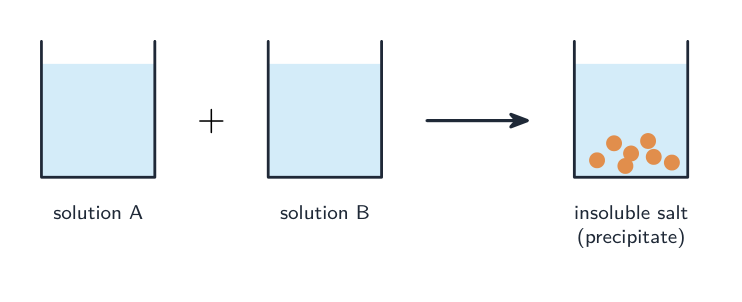
Mixing two solutions can form an insoluble precipitate
Which species is split into ions in the complete ionic equation?
Dificuldade 1/5 · Moedas 100 + pequeno bônus na primeira conclusão hoje
An aqueous soluble salt is a strong electrolyte and is written as separate ions. Aqueous strong acids and bases are also split; weak electrolytes and solid precipitates stay whole.
Spectator ions cancel
- Spectator ions 旁观离子 appear unchanged on both sides.
- Cancel them, just like identical terms in algebra.
- What remains is the net ionic equation.
A spectator ion is one that...
Dificuldade 1/5 · Moedas 100 + pequeno bônus na primeira conclusão hoje
Spectators do not change, so they cancel out.
After cancelling spectator ions, what remains is the ____ ionic equation.
Dificuldade 1/5 · Moedas 100 + pequeno bônus na primeira conclusão hoje
The leftover reacting ions form the net ionic equation.
The real change
- The net ionic equation shows only the species that actually change.
- For a precipitate, it is the two ions that join to form the solid.
- It captures the true chemistry, stripped of clutter.
Write a net ionic equation
Strip a reaction down to the ions that actually react.
A solid precipitate is written as separate ions in the net ionic equation.
Dificuldade 1/5 · Moedas 100 + pequeno bônus na primeira conclusão hoje
A solid precipitate stays as one formula with its state symbol. In complete ionic equations, only aqueous strong electrolytes are separated into ions; weak electrolytes and pure liquids also stay intact.
A net ionic equation only needs to balance atoms, not charge.
Dificuldade 1/5 · Moedas 100 + pequeno bônus na primeira conclusão hoje
False. Both mass and charge are conserved, so a correct net ionic equation balances atoms and total charge.
$\text{AgNO}_3(aq)+\text{NaCl}(aq)\to\text{AgCl}(s)+\text{NaNO}_3(aq)$.
- Complete ionic: $\text{Ag}^+(aq)+\text{NO}_3^-(aq)+\text{Na}^+(aq)+\text{Cl}^-(aq)\to\text{AgCl}(s)+\text{Na}^+(aq)+\text{NO}_3^-(aq)$. Cancel the unchanged sodium and nitrate ions.
- Net ionic equation: $\text{Ag}^+(aq)+\text{Cl}^-(aq)\to\text{AgCl}(s)$. There is one Ag and one Cl on each side, and total charge $+1-1=0$.
A favor $\text{Ag}^+ + \text{NO}_3^- + \text{Na}^+ + \text{Cl}^- \to \text{AgCl} + \text{Na}^+ + \text{NO}_3^-$, the net ionic equation is...
Dificuldade 1/5 · Moedas 100 + pequeno bônus na primeira conclusão hoje
$\text{Na}^+$ e $\text{NO}_3^-$ are spectators; only Ag and Cl react.
What to split into ions
| Write as ions | Keep whole |
|---|---|
| soluble salts in water (all Na⁺, K⁺, NH₄⁺ and NO₃⁻ salts) | solids (precipitates) |
| strong acids: HCl, HBr, HI, HNO₃, H₂SO₄, HClO₄ | weak acids (CH₃COOH, HF) and weak bases (NH₃) |
| strong bases: Group 1 hydroxides, Ba(OH)₂ | water, gases, pure liquids |
BaCl₂(aq) and Na₂SO₄(aq) are mixed and a white solid forms. What is the net ionic equation?
Dificuldade 1/5 · Moedas 100 + pequeno bônus na primeira conclusão hoje
Na⁺ and Cl⁻ stay in solution unchanged (spectators). Only Ba²⁺ and SO₄²⁻ form the solid.
Two neutralizations. Write the net ionic equations for (a) HNO₃ + KOH and (b) CH₃COOH + NaOH.
- (a) Both are strong and split; K⁺ and NO₃⁻ are spectators: $\text{H}^+(aq) + \text{OH}^-(aq) \rightarrow \text{H}_2\text{O}(l)$.
- (b) Ethanoic acid is weak, so it stays whole: $\text{CH}_3\text{COOH}(aq) + \text{OH}^-(aq) \rightarrow \text{CH}_3\text{COO}^-(aq) + \text{H}_2\text{O}(l)$.
Aqueous ammonia (a weak base) reacts with hydrochloric acid. What is the net ionic equation?
Dificuldade 1/5 · Moedas 100 + pequeno bônus na primeira conclusão hoje
NH₃ is weak, so it stays whole; HCl is strong, so only H⁺ reacts and Cl⁻ is a spectator.
- Split only aqueous strong electrolytes; keep weak acids, weak bases, solids, liquids and gases whole.
- Cancel only ions that are identical on both sides, with the same state.
- Check the final equation balances atoms and charge.
A net ionic equation retains all species that actually react, including molecules or solids when involved. Split aqueous strong electrolytes into ions, keep weak electrolytes intact, cancel unchanged spectator ions, and retain the reacting species — like $\text{Ag}^+ + \text{Cl}^- \to \text{AgCl}$. The result must balance atoms and charge.