Photoelectron Spectroscopy
Introduzido| English | Significado |
|---|---|
| photoelectron spectroscopy/ˌfəʊtəʊɪˈlektrɒn spekˈtrɒskəpi/ | espectroscopia fotoeletrônica |
| binding energy/ˈbaɪndɪŋ ˈenədʒi/ | energia de ligação |
Knocking electrons loose
- Shine high-energy light on an atom and electrons fly off.
- How hard each one was held shows up in how fast it leaves.
- Collect them and you get a chart of steps and peaks.
- That chart is a direct map of an atom's inner shells.
Measuring how tightly held
- Photoelectron spectroscopy 光电子能谱 (PES) ejects electrons with photons.
- Each electron's binding energy 结合能 is how tightly it was held.
- Electrons closer to the nucleus need more energy to remove.
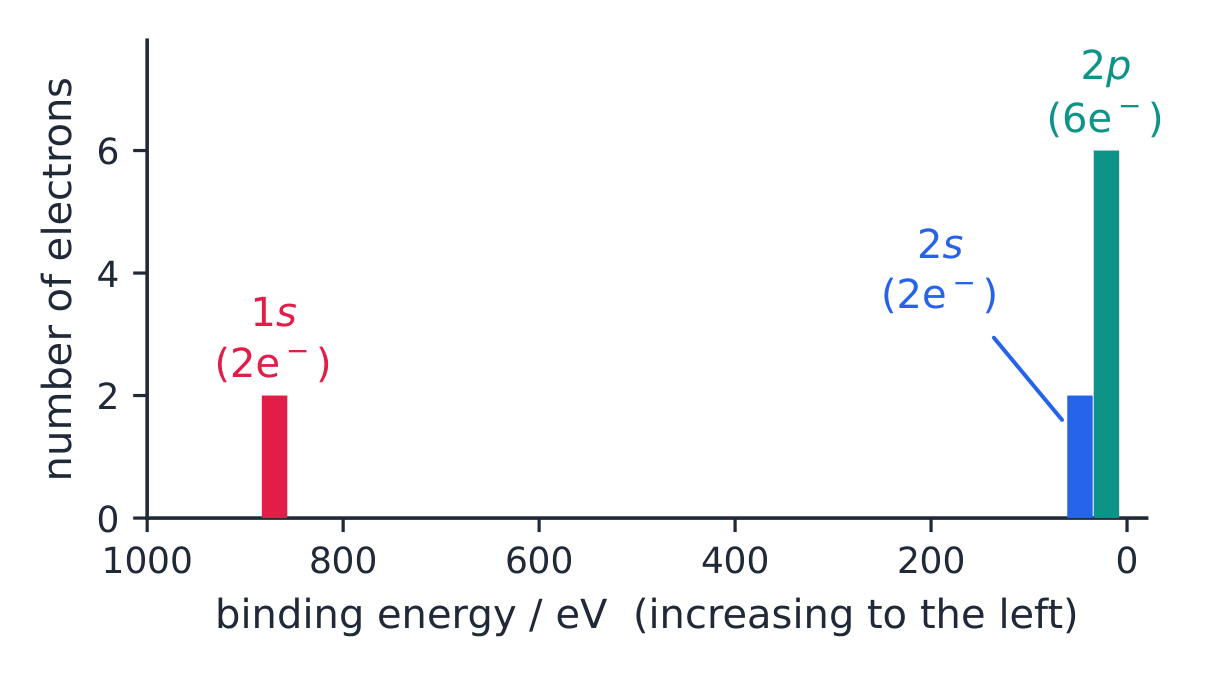
The photoelectron spectrum of neon: one peak per subshell, height set by electron count
Electrons closer to the nucleus have a higher binding energy.
Dificuldade 1/5 · Moedas 100 + pequeno bônus na primeira conclusão hoje
They are held tighter, so more energy is needed to remove them.
Photoelectron spectroscopy measures the energy needed to...
Dificuldade 1/5 · Moedas 100 + pequeno bônus na primeira conclusão hoje
PES ejects electrons and records their binding energies.
What each peak means
- Each peak stands for one subshell.
- Peak position gives the binding energy; within an atom, inner subshells have higher binding energies. Read the labelled axis direction.
- Peak height is proportional to the number of electrons in that subshell.
In a PES spectrum, the height of a peak is proportional to...
Dificuldade 1/5 · Moedas 100 + pequeno bônus na primeira conclusão hoje
More electrons in a subshell means a taller peak.
The subshell with the highest binding energy is the one closest to the ____.
Dificuldade 1/5 · Moedas 100 + pequeno bônus na primeira conclusão hoje
Closest to the nucleus = held tightest = highest binding energy.
From spectrum to configuration
- The peaks line up with the electron configuration.
- A $2p^6$ subshell gives a peak three times taller than a $2s^2$ one.
- So PES confirms how the electrons are arranged.
Neon's PES shows peaks of relative height 2:2:6. These correspond to...
Dificuldade 1/5 · Moedas 100 + pequeno bônus na primeira conclusão hoje
$2:2:6$ correspondem $1s^2\ 2s^2\ 2p^6$.
A filled $2p$ subshell gives a PES peak the same height as a filled $2s$.
Dificuldade 1/5 · Moedas 100 + pequeno bônus na primeira conclusão hoje
False. $2p$ holds 6 electrons and $2s$ holds 2, so the $2p$ peak is three times taller.
Neon's PES has three peaks in the height ratio 2 : 2 : 6.
- These are the $1s$, $2s$, and $2p$ subshells.
- The $1s$ peak sits at the highest binding energy, closest to the nucleus.
Match the PES peaks
In a photoelectron spectrum, peak position shows binding energy and peak height shows how many electrons. Match each peak to its subshell in sodium.
Higher binding energy means the electron is held tighter and closer in, so the $1s$ peak is always on the high-energy side. Peak height reflects the electron count, not the energy. And PES charts often plot energy increasing to the left, so read the axis direction carefully.
Photoelectron spectroscopy ejects electrons with photons and measures each one's binding energy. Every peak is a subshell: its position gives the binding energy and its height gives the electron count in these idealized spectra. Compare binding energies using the axis labels, not left-to-right position alone. A spectrum like neon's 2 : 2 : 6 reads straight off as $1s^2\,2s^2\,2p^6$.