Representing Functions as Power Series
Introduzido| English | Significado |
|---|---|
| power series/ˈpaʊə ˈsɪəriːz/ | Serie de potencias |
| geometric series/ˌdʒiːəʊˈmetrɪk ˈsɪəriːz/ | Série geométrica |
| substitution/ˌsʌbstɪˈtjuːʃn/ | substituição |
| endpoint | extremidade |
| term by term | termo a termo |
| indefinite integral/ɪnˈdefɪnət ˈɪntɪɡrəl/ | integral indefinida |
| alternating series test | Teste da Série Alternada |
| radius of convergence/ˈreɪdɪəs ɒv kənˈvɜːdʒəns/ | Raio de convergencia |
| alternating series error bound/ˈɔːltəneɪtɪŋ ˈsɪəriːz ˈerə baʊnd/ | Limite de erro da serie alternada |
Build an approximation without many derivatives
- A calculator can approximate $\arctan(0.5)$ using powers, addition and division. A power series 幂级数 gives the recipe.
- Build it from a known series. Keep both the formula and the values of $x$ where it works.
Start with a complete known identity
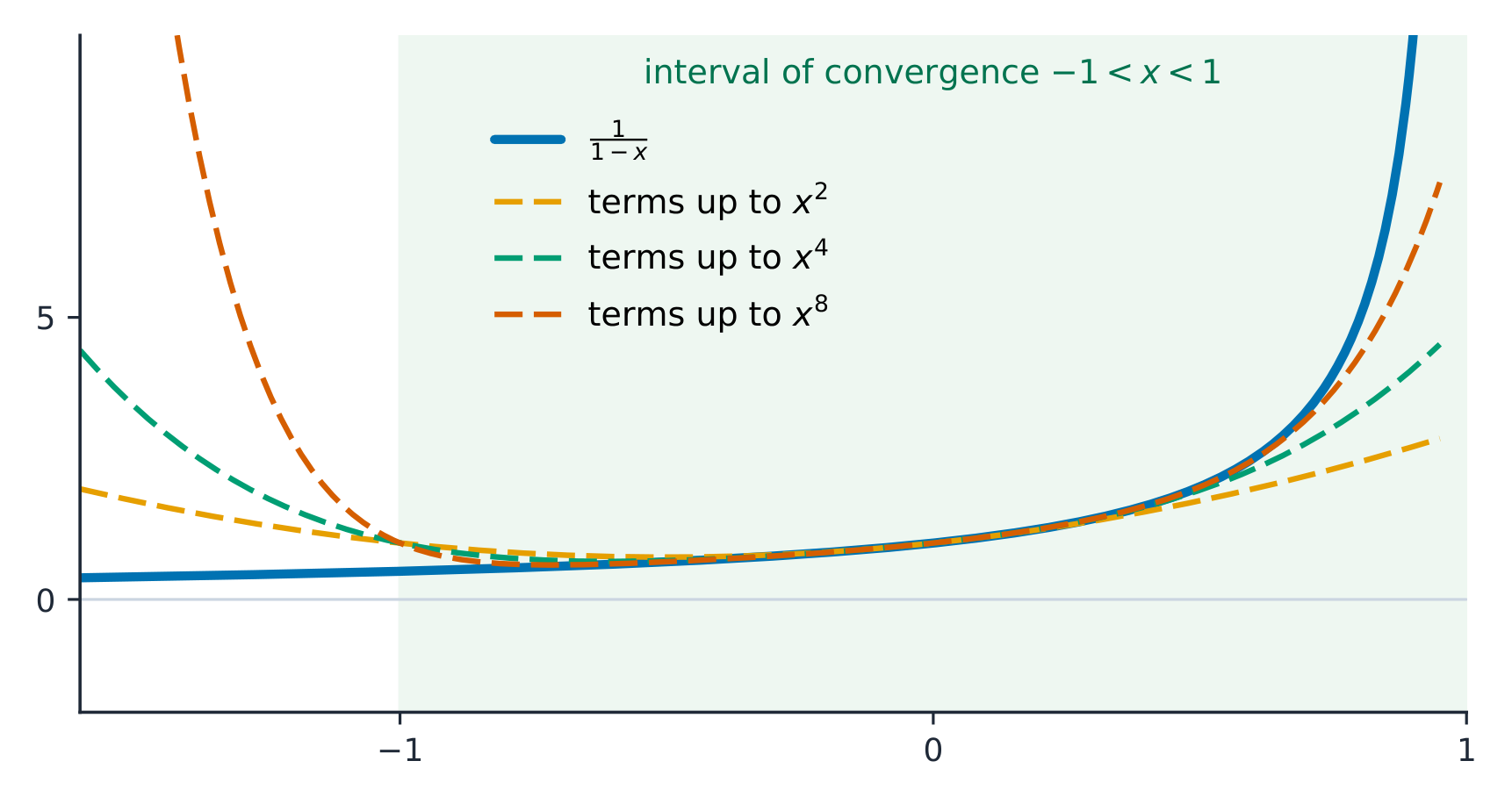
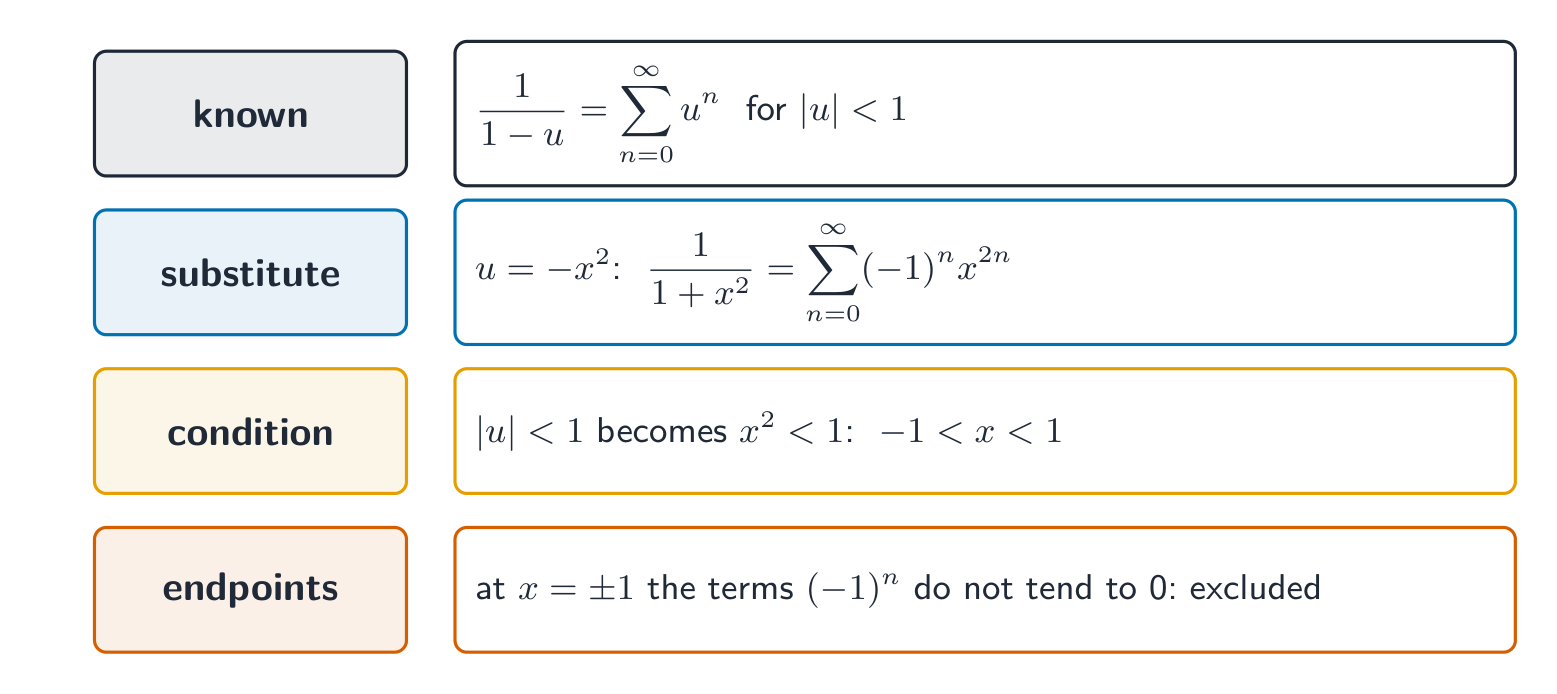
- The geometric series 几何级数 is $\dfrac{1}{1-u}=\sum_{n=0}^{\infty}u^n$ for $|u|<1$. Its first term is $1$.
- Also know $e^u=\sum_{n=0}^{\infty}u^n/n!$, valid for every real $u$. Write the index and starting value.
What is the $n=0$ term of $\sum_{n=0}^{\infty}u^n$?
Dificuldade 2/5 · Moedas 140 + pequeno bônus na primeira conclusão hoje
The constant term is 1.
Substitute in the formula and its condition
- A substitution 代换 replaces every $u$ by the same expression. With $u=-x^2$, the geometric terms become $(-1)^nx^{2n}$.
- The condition becomes $|-x^2|<1$, so $|x|<1$. The function exists outside this interval, but this series does not converge there.
At $x=\pm1$, the terms alternate between $1$ and $-1$. They do not tend to $0$. Both endpoints are excluded.
A favor $|x|<1$, substitute $u=-x^2$ em $1/(1-u)=\sum_{n=0}^{\infty}u^n$. Which series equals $1/(1+x^2)$?
Dificuldade 1/5 · Moedas 100 + pequeno bônus na primeira conclusão hoje
$(-x^2)^n=(-1)^nx^{2n}$.
Depois $u=-x^2$, which real-x condition follows from $|u|<1$?
Dificuldade 1/5 · Moedas 100 + pequeno bônus na primeira conclusão hoje
The condition is x²<1, giving −1<x<1.
Porque $1/(1+x^2)$ exists for every real x, its series $\sum_{n=0}^{\infty}(-1)^nx^{2n}$ converges for every real x.
Dificuldade 1/5 · Moedas 100 + pequeno bônus na primeira conclusão hoje
The function has a larger domain than this series has convergence interval.
Scaling can change the radius
- For $\dfrac{1}{2+x}$, first write $\dfrac{1}{2}\dfrac{1}{1-(-x/2)}$. Then expand as $\sum_{n=0}^{\infty}\dfrac{(-1)^nx^n}{2^{n+1}}$.
- Here $|-x/2|<1$ gives $|x|<2$. At $x=\pm2$, the terms fail to tend to $0$. The full interval is $(-2,2)$.
What is the radius for $\sum_{n=0}^{\infty}(-1)^nx^n/2^{n+1}$?
Dificuldade 2/5 · Moedas 140 + pequeno bônus na primeira conclusão hoje
Solve |−x/2|<1 to get |x|<2.
What is the constant term in the power series for $1/(2+x)$?
Dificuldade 2/5 · Moedas 140 + pequeno bônus na primeira conclusão hoje
At x=0, the value and constant term are 1/2.
Multiply every term
- Multiplying by $x^2$ gives $\dfrac{x^2}{1+x^2}=\sum_{n=0}^{\infty}(-1)^nx^{2n+2}=x^2-x^4+x^6-\cdots$.
- The denominator $1+x^2$ has not changed. This series still has interval $(-1,1)$. Multiplying by $x^2$ does not square the index $n$.
Multiplicar $(-1)^nx^{2n}$ by $x^2$. What is the new term?
Dificuldade 1/5 · Moedas 100 + pequeno bônus na primeira conclusão hoje
Add 2 to the exponent; leave n and the sign unchanged.
Differentiate the powers carefully
- On the open interval $(-1,1)$, differentiate $\sum_{n=0}^{\infty}x^n=1/(1-x)$ term by term 逐项. The constant term disappears.
- The result is $\dfrac{1}{(1-x)^2}=\sum_{n=1}^{\infty}nx^{n-1}=1+2x+3x^2+\cdots$. Both endpoints diverge because the terms do not tend to $0$.
Inside its open interval of convergence, a power series can be differentiated and integrated term by term.
Dificuldade 1/5 · Moedas 100 + pequeno bônus na primeira conclusão hoje
The radius stays the same, but the new endpoint series need separate tests.
When $\sum_{n=0}^{\infty}x^n$ is differentiated, what is the smallest n in $\sum nx^{n-1}$?
Dificuldade 2/5 · Moedas 140 + pequeno bônus na primeira conclusão hoje
The n=0 constant disappears; start at n=1.
What is the coefficient of $x^2$ in the series for $1/(1-x)^2$?
Dificuldade 2/5 · Moedas 140 + pequeno bônus na primeira conclusão hoje
Differentiate x³ to get 3x².
Integrate and fix the constant
- Integrate $1/(1+t^2)$ from $0$ to $x$. On $|x|<1$, integrate each power of $t$ and divide by its new exponent.
- Since $\arctan 0=0$, the result has no added constant. An indefinite integral 不定积分 would include $+C$.
The formula is first established on $(-1,1)$. At $x=1$ and $x=-1$, the numerical series converge by the alternating-series test 交错级数判别法. The full convergence interval is $[-1,1]$.
One known series, three functions
Compare finite sums with 1/(1+x²), then their term-by-term integrals arctan x and ln(1+x). Endpoint tests distinguish the full intervals.
Which function equals $\int_0^x\sum_{n=0}^{\infty}(-1)^nt^{2n}\,dt$ for $|x|<1$?
Dificuldade 1/5 · Moedas 100 + pequeno bônus na primeira conclusão hoje
The integrand sums to 1/(1+t²); the lower limit fixes the constant.
An indefinite term-by-term integral introduces an arbitrary constant, usually written ____.
Dificuldade 1/5 · Moedas 100 + pequeno bônus na primeira conclusão hoje
A definite integral from 0 to x instead fixes the constant from the value at 0.
In $\sum_{n=0}^{\infty}(-1)^nx^{2n+1}/(2n+1)$, what is the denominator of the $x^7$ term?
Dificuldade 2/5 · Moedas 140 + pequeno bônus na primeira conclusão hoje
Integrating t⁶ gives x⁷/7.
Which endpoints converge for $\sum_{n=0}^{\infty}(-1)^nx^{2n+1}/(2n+1)$?
Dificuldade 2/5 · Moedas 140 + pequeno bônus na primeira conclusão hoje
Both endpoint series alternate, with term sizes 1/(2n+1) decreasing to 0.
A different integral gives a different endpoint
- Integrate $1/(1+t)=\sum_{n=0}^{\infty}(-1)^nt^n$ from $0$ to $x$. This gives $\ln(1+x)=\sum_{n=0}^{\infty}\dfrac{(-1)^nx^{n+1}}{n+1}$ on $|x|<1$.
- At $x=1$, the series is alternating harmonic and converges. At $x=-1$, it is $-\sum_{n=1}^{\infty}1/n$ and diverges. The full interval is $(-1,1]$.
The series $\sum_{n=0}^{\infty}(-1)^nx^{n+1}/(n+1)$ converges at x=−1.
Dificuldade 1/5 · Moedas 100 + pequeno bônus na primeira conclusão hoje
Every term is −1/(n+1), so the series is a negative harmonic series.
What is the full interval for the series representing $\ln(1+x)$?
Dificuldade 1/5 · Moedas 100 + pequeno bônus na primeira conclusão hoje
The interior is (−1,1); include only x=1.
Separate radius from endpoint behaviour
- Differentiation and integration preserve the radius of convergence 收敛半径 about the same center. They can change which endpoints 端点 converge.
- Substitution needs a new condition. For example, replacing $u$ by $3x$ in $e^u$ still allows every real $x$: $e^{3x}=\sum_{n=0}^{\infty}3^nx^n/n!$.
A function's domain is not automatically its series' convergence interval. Carry the original condition through substitution, then test finite endpoints in the new series. Never copy the old brackets without checking.
Which operations can build a new power series from a known one?
Dificuldade 2/5 · Moedas 140 + pequeno bônus na primeira conclusão hoje
Apply the operation to every term and keep its validity conditions.
Substituting u=3x into a geometric series valid for |u|<1 leaves radius 1 in x.
Dificuldade 1/5 · Moedas 100 + pequeno bônus na primeira conclusão hoje
Solve |3x|<1: the new radius is 1/3.
What is the coefficient of $x^2$ in $e^{3x}$?
Dificuldade 2/5 · Moedas 140 + pequeno bônus na primeira conclusão hoje
Substitute $u=3x$ em $e^u=\sum_{n=0}^{\infty}u^n/n!$. The quadratic term is $(3x)^2/2!=9x^2/2$, so its coefficient is $9/2=4.5$.
Check a useful approximation
- The first three nonzero terms give $\arctan(0.5)\approx0.5-0.5^3/3+0.5^5/5=0.4645833\ldots$ radians.
- The next term is negative. The alternating-series error bound 交错级数误差界 gives error at most $0.5^7/7<0.00112$. This bound applies because the term sizes decrease to $0$.
For the three-term approximation $0.5-0.5^3/3+0.5^5/5$ to arctan(0.5), is the approximation above or below the exact value?
Dificuldade 1/5 · Moedas 100 + pequeno bônus na primeira conclusão hoje
The next term is negative, so the partial sum is above the limit.
Build a fresh series and check it
- Find a series for $1/(3-x)$: factor out $1/3$, then use $u=x/3$. State the first three terms, general term and full interval.
- Next, build a series for $\int_0^x t^2/(1+t^2)\,dt$. Track the new exponents, denominators and both endpoint tests.
Build a power series for $1/(3-x)$ about 0. Give its first three terms, general term, radius and full interval, with endpoint reasons.
Factor out 1/3, then use geometric ratio x/3.
Build a series for $F(x)=\int_0^x t^2/(1+t^2)\,dt$. Give the first three nonzero terms, general term and full convergence interval.
Multiply the known reciprocal series by t², then integrate.
Keep a complete answer
- Name the known identity, show the operation, and write the general term with its starting index.
- State the resulting convergence interval. Check constants, first terms and endpoints before using a finite sum as an approximation.
Use algebra, substitution, multiplication, differentiation or integration to build a new power series. Differentiation and integration keep the radius; substitution requires a new condition. Endpoint behaviour always belongs to the final series.
Review: substitute u=4x into a geometric series valid for |u|<1. What is the new radius in x?
Dificuldade 2/5 · Moedas 140 + pequeno bônus na primeira conclusão hoje
The distance from 0 must be less than 1/4.