Defining Average and Instantaneous Rates of Change at a Point
Introduzido| English | Significado |
|---|---|
| average rate of change/ˈævrɪdʒ reɪt ɒv tʃeɪndʒ/ | taxa média de variação |
| instantaneous rate of change/ˌɪnstənˈteɪnɪəs reɪt ɒv tʃeɪndʒ/ | taxa instantânea de variação |
| difference quotient/ˈdɪfrəns ˈkwəʊʃənt/ | quociente de diferenças |
| secant line/ˈsiːkənt laɪn/ | reta secante |
| tangent line/ˈtændʒənt laɪn/ | reta tangente |
From "over an interval" to "at an instant"
- A trip of 120 km in 2 hours has an average rate of change 平均变化率 of 60 km/h. The speedometer at one moment shows the instantaneous rate of change 瞬时变化率.
- Unit 2 builds the bridge between the two, and the bridge is a limit.
Average rate = slope of a secant
- From $x=a$ to $x=b$, the average rate is the difference quotient 差商 $\dfrac{f(b)-f(a)}{b-a}$: total change ÷ interval width.
- On the graph it is the slope of the secant line 割线 through $\big(a,f(a)\big)$ and $\big(b,f(b)\big)$.
Find the average rate of change of $f(x)=x^2$ on $[1,3]$.
Dificuldade 2/5 · Moedas 140 + pequeno bônus na primeira conclusão hoje
$\dfrac{9-1}{3-1}=\dfrac{8}{2}=4$.
The average rate of change over an interval equals the slope of the...
Dificuldade 1/5 · Moedas 100 + pequeno bônus na primeira conclusão hoje
Average rate = rise over run between the two endpoints = secant slope.
Shrink the interval
- Slide $b$ toward $a$. The secant pivots toward the tangent line 切线 at $a$.
- The limit of the secant slopes is the instantaneous rate at $a$.
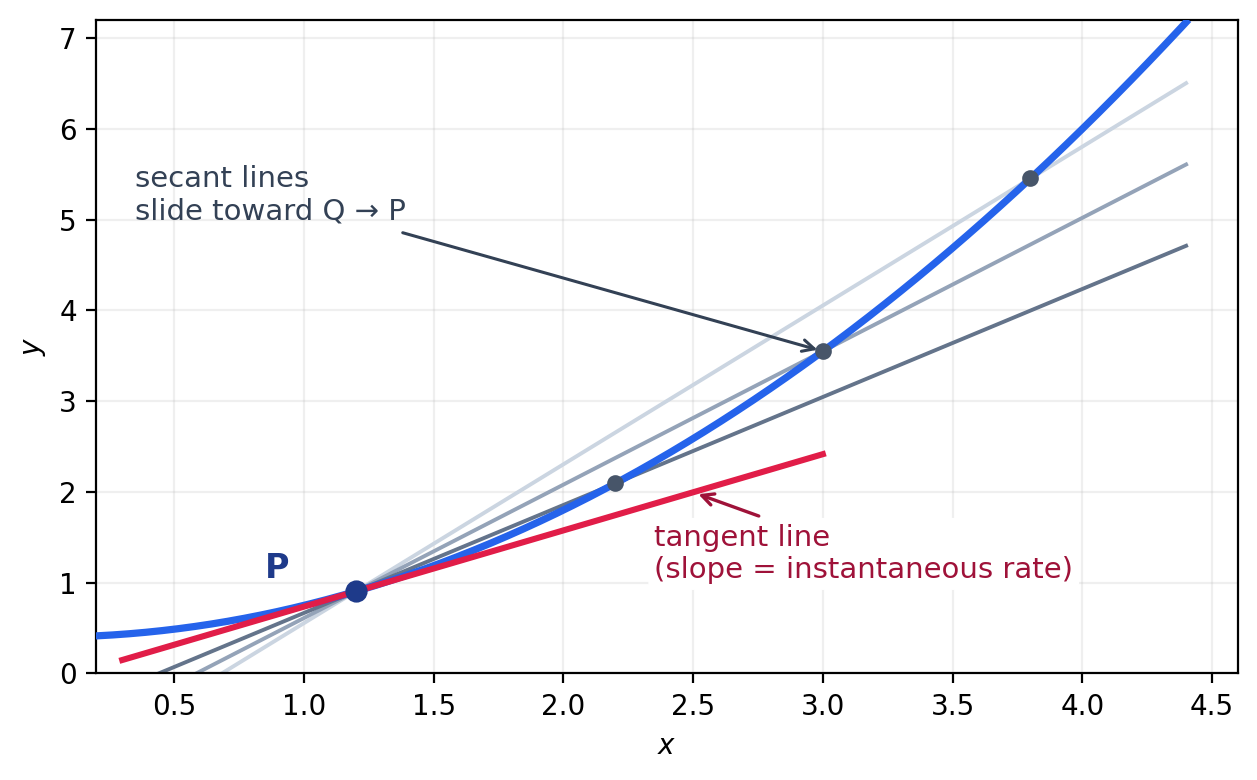
Slide the secant into a tangent
y = x²
Move the point along $y=x^2$ — the tangent slope you read off is the instantaneous rate, the limit of the secant slopes.
The instantaneous rate of change at a point equals the slope of the ____ line there.
Dificuldade 1/5 · Moedas 100 + pequeno bônus na primeira conclusão hoje
It is the limit of secant slopes as the interval shrinks — the tangent slope.
For $f(x)=x^2$, find the average rate on $[2,4]$ and estimate the instantaneous rate at $x=2$.
- Average on $[2,4]$: $\dfrac{16-4}{2}=6$. On $[2,2.1]$: $\dfrac{4.41-4}{0.1}=4.1$. On $[2,2.01]$: $4.01$.
- The average rates close in on $4$, so the instantaneous rate at $x=2$ is $4$.
A favor $f(x)=x^2$, average rates on $[3,3.1]$ e $[3,3.01]$ are $6.1$ e $6.01$. Estimate the instantaneous rate at $x=3$.
Dificuldade 2/5 · Moedas 140 + pequeno bônus na primeira conclusão hoje
The averages close in on $6$.
AP style: rates in context. Water in a tank, $W(t)$ litres, $t$ in minutes:
| $t$ (min) | 0 | 4 | 10 |
|---|---|---|---|
| $W(t)$ (L) | 120 | 96 | 84 |
- Average rate on $[0,10]$: $\dfrac{84-120}{10-0}=-3.6$ L/min.
- In words: "On average, the water in the tank decreases by 3.6 litres per minute over the first 10 minutes."
A town has $P(2)=350$ people in year 2 and $P(8)=410$ in year 8. Find the average rate of change of $P$ on $[2,8]$, in people per year.
Dificuldade 2/5 · Moedas 140 + pequeno bônus na primeira conclusão hoje
$\dfrac{410-350}{8-2}=\dfrac{60}{6}=10$ people per year.
Reading a rate
- The sign gives direction (positive: increasing). The size gives speed.
- The units are (output units) per (input units): m/s, L/min, people per year.
A position function has instantaneous rate $-5\,\tfrac{\text{m}}{\text{s}}$ at time $t$. Select todos correct readings.
Dificuldade 2/5 · Moedas 140 + pequeno bônus na primeira conclusão hoje
Negative rate = moving in the negative direction (so position decreases); its magnitude is the speed; and it is the tangent slope.
For water depth $D(t)$ in cm, $t$ in hours, the average rate of change on $[1,5]$ é $-2$. Which sentence is correct?
Dificuldade 1/5 · Moedas 100 + pequeno bônus na primeira conclusão hoje
An average rate is over the whole interval, in cm per hour. It is not the rate at one moment, and the total change is $-2\times4=-8$ cm.
- An average rate of 0 does not mean nothing changed in between. $(x-2)^2$ on $[0,4]$ goes down and then up again.
- Interpret with units, the time interval and increasing/decreasing. A bare number gets no AP credit.
If the average rate of change of $f$ on $[0,4]$ é $0$, then $f$ must be constant on $[0,4]$.
Dificuldade 1/5 · Moedas 100 + pequeno bônus na primeira conclusão hoje
It only means $f(0)=f(4)$; $f$ could rise then fall (e.g. go out and come back).
Average rate on $[a,b]$ = $\frac{f(b)-f(a)}{b-a}$ = slope of a secant. Shrinking the interval turns the secant into the tangent, whose slope is the instantaneous rate. Always state units and direction.