Exploring Types of Discontinuities · Explorando Tipos de Descontinuidades
| English | Português |
|---|---|
| discontinuity/dɪskɒntɪˈnjuːɪti/ | descontinuidade |
| removable discontinuity/rɪˈmuːvəbl dɪskɒntɪˈnjuːɪti/ | descontinuidade removível |
| jump discontinuity/dʒʌmp dɪskɒntɪˈnjuːɪti/ | descontinuidade de salto |
| infinite discontinuity/ˈɪnfɪnət dɪskɒntɪˈnjuːɪti/ | descontinuidade infinita |
| vertical asymptote/ˈvɜːtɪkl ˈæsɪmptəʊt/ | assíntota vertical |
Where a graph "breaks"
- A continuous curve can be drawn without lifting your pen. A discontinuity 间断点 is a break in that flow.
- Not all breaks are the same — there are three distinct types, each with its own graph signature.
- Naming the type tells you instantly whether the break can be repaired.
- Let's meet all three: removable, jump, and infinite.
Onde um gráfico "quebra"
- Uma curva contínua pode ser desenhada sem levantar a caneta. Uma descontinuidade 间断点 é uma quebra nesse fluxo.
- Nem todas as quebras são iguais — existem três tipos distintos, cada um com sua própria assinatura gráfica.
- Nomear o tipo diz imediatamente se a interrupção pode ser reparada.
- Vamos conhecer os três: removível, salto e infinito.
Removable: a single missing point
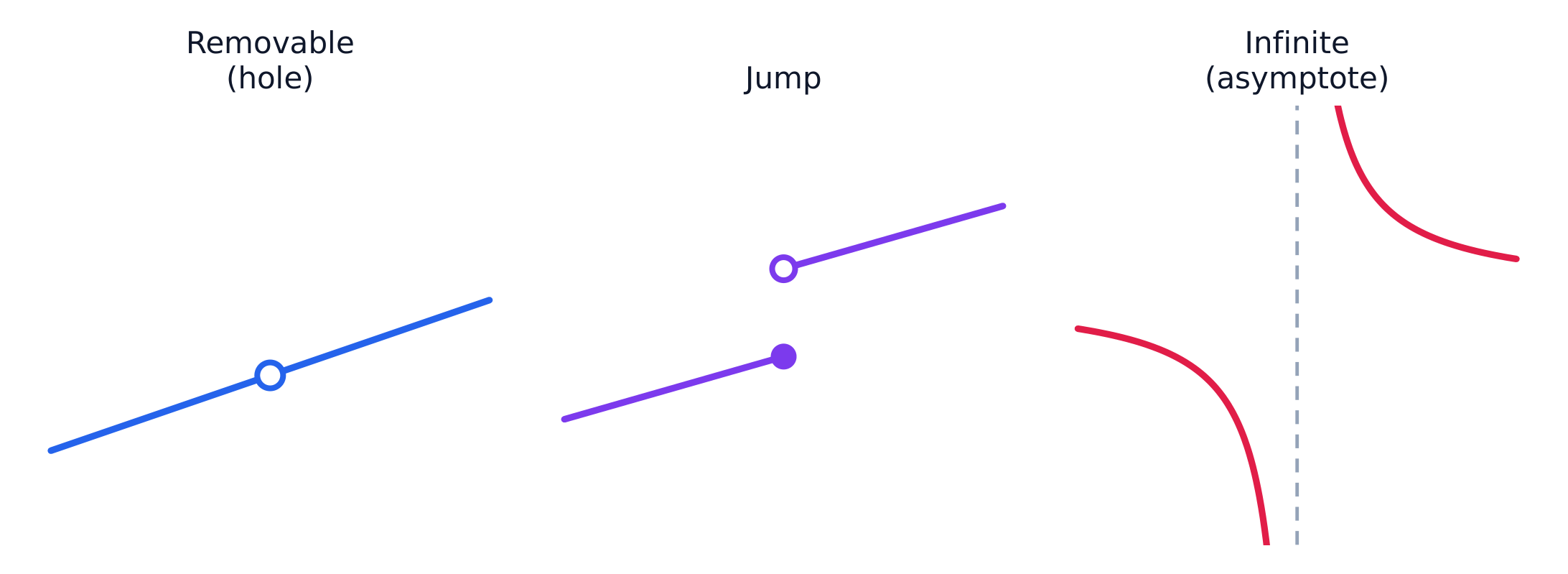
- A removable discontinuity 可去间断点 is just a hole in an otherwise smooth curve.
- The limit exists (both sides meet at one height), but $f(c)$ is missing or plotted elsewhere.
- $f(x)=\dfrac{x^2-4}{x-2}$ has a hole at $x=2$: the limit is $4$, yet $f(2)$ is undefined.
- Because the limit exists, you could "fill the hole" — hence removable (lesson 1.13).
Removível: um único ponto faltante
- Uma descontinuidade removível 可去间断点 é apenas um buraco em uma curva de outra forma suave.
- O limite existe (ambos os lados encontram-se em uma altura), mas $f(c)$ está ausente ou plotado em outro lugar.
- $f(x)=\dfrac{x^2-4}{x-2}$ tem um buraco em $x=2$: o limite é $4$, porém $f(2)$ é indefinido.
- Como o limite existe, você poderia "preencher o buraco" — daí removível (lição 1.13).
At $x=3$, $f(x)=\dfrac{x^2-9}{x-3}$ has a limit of $6$ but $f(3)$ undefined. The discontinuity is... · Em $x=3$, $f(x)=\dfrac{x^2-9}{x-3}$ tem um limite de $6$ mas $f(3)$ não está definido. A descontinuidade é...
A limit exists but the value is missing — a hole, i.e. removable. · Um limite existe mas o valor falta — um buraco, ou seja, removível.
Jump: the sides disagree
- A jump discontinuity 跳跃间断点 happens when the left and right limits are both finite but different.
- The graph leaps from one height to another — think of a step or a tax bracket.
- Here $\displaystyle\lim_{x\to c}f(x)$ does not exist, because the one-sided limits disagree.
- No single point value can bridge a gap of nonzero width, so a jump is not removable.
Salto: os lados discordam
- Uma descontinuidade de salto 跳跃间断点 acontece quando os limites laterais são ambos finitos mas diferentes.
- O gráfico salta de uma altura para outra — pense em um degrau ou alíquota de imposto.
- Aqui $\displaystyle\lim_{x\to c}f(x)$ não existe, porque os limites laterais discordam.
- Nenhum valor pontual único pode preencher uma lacuna de largura não nula, então um salto não é removível.
A curve that blows up · Uma curva que explode
y = a / (x − b)
A reciprocal shoots to $\pm\infty$ near where its denominator hits zero — that is an infinite discontinuity and a vertical asymptote. · Um recíproco dispara para $\pm\infty$ próximo onde seu denominador atinge zero — isso é uma descontinuidade infinita e uma assíntota vertical.
A jump discontinuity can be removed by redefining the function at the single point. · Uma descontinuidade de salto pode ser removida redefinindo a função no único ponto.
The one-sided limits differ, so no single value bridges the gap — jumps are not removable. · Os limites laterais diferem, então nenhum valor único conecta a lacuna — saltos não são removíveis.
A step function is $1$ for $x<0$ and · e $4$ for $x\ge0$. What is the size of the jump at $x=0$? · Uma função degrau é $1$ para $x<0$ e $4$ para $x\ge0$. Qual é o tamanho do salto em $x=0$?
Right minus left: $4-1=3$. · Direita menos esquerda: $4-1=3$.
Infinite: off to $\pm\infty$
- An infinite discontinuity 无穷间断点 is where the function grows without bound near $c$.
- The graph rockets up or down along a vertical asymptote — as in $f(x)=\dfrac1{x-2}$ at $x=2$.
- The limit is infinite (or DNE), so this break is also not removable.
- Signature: a denominator heading to zero while the numerator does not.
Infinito: indo para $\pm\infty$
- Uma descontinuidade infinita 无穷间断点 é onde a função cresce sem limite próximo a $c$.
- O gráfico dispara para cima ou para baixo ao longo de uma assíntota vertical — como em $f(x)=\dfrac1{x-2}$ em $x=2$.
- O limite é infinito (ou DNE), então essa quebra também não é removível.
- Assinatura: um denominador indo para zero enquanto o numerador não.
An infinite discontinuity appears on a graph as a vertical ____. · Uma descontinuidade infinita aparece em um gráfico como uma ____ vertical.
The function grows without bound along the vertical asymptote. · A função cresce sem limite ao longo da assíntota vertical.
Which discontinuity type is the only one where the two-sided limit exists? · Qual tipo de descontinuidade é a única onde o limite bilateral existe?
Removable = a hole where both sides agree, so the limit exists. · Removível = um buraco onde ambos os lados concordam, então o limite existe.
Select all · todos functions with an infinite discontinuity at the marked point. · Selecione todas as funções com uma descontinuidade infinita no ponto marcado.
The third is removable (limit $=2$). The others blow up to $\pm\infty$. · A terceira é removível (limite $=2$). As outras explodem para $\pm\infty$.
Only the removable type has a genuine two-sided limit. For jump and infinite discontinuities the limit does not exist, so no clever redefinition at the single point can make the function continuous. Don't try to "fill" a jump — the gap has real width.
Apenas o tipo removível tem um verdadeiro limite duplo. Para descontinuidades de salto e infinita o limite não existe, então nenhuma redefinição engenhosa no ponto único pode tornar a função contínua. Não tente "preencher" um salto — a lacuna tem largura real.
Classify the discontinuity of each at the marked point:
- $\dfrac{x^2-9}{x-3}$ at $x=3$: limit $=6$, value undefined → removable (hole).
- $f(x)=\begin{cases}1,&x;<0\\2,&x;\ge0\end{cases}$ at $x=0$: left $\to1$, right $\to2$ → jump.
- $\dfrac{1}{x^2}$ at $x=0$: grows to $+\infty$ → infinite.
Classifique a descontinuidade de cada uma no ponto marcado:
- $\dfrac{x^2-9}{x-3}$ em $x=3$: limite $=6$, valor indefinido → removível (buraco).
- $f(x)=\begin{cases}1,&x;<0\\2,&x;\ge0\end{cases}$ em $x=0$: esquerdo $\to1$, direito $\to2$ → salto.
- $\dfrac{1}{x^2}$ em $x=0$: cresce até $+\infty$ → infinita.
Three discontinuity types: removable (a hole — the limit exists but $f(c)$ doesn't match), jump (finite one-sided limits that disagree), and infinite (unbounded near $c$, a vertical asymptote). Only the removable type has a two-sided limit, so only it can be repaired.
Três tipos de descontinuidade: removível (um buraco — o limite existe, mas $f(c)$ não corresponde), salto (limites laterais finitos que discordam) e infinito (ilimitado perto de $c$, uma assíntota vertical). Apenas o tipo removível possui um limite bilateral, portanto apenas ele pode ser reparado.