Estimating Limit Values from Graphs · Estimando Valores de Limite a Partir de Gráficos
| English | Português |
|---|---|
| left-hand limit/left hænd ˈlɪmɪt/ | limite lateral esquerdo |
| right-hand limit/raɪt hænd ˈlɪmɪt/ | limite lateral direito |
| hole/həʊl/ | buraco |
| jump/dʒʌmp/ | salto |
| unbounded/ʌnˈbaʊndɪd/ | sem limites |
| oscillation/ˌɒsɪˈleɪʃn/ | oscilação |
Read the limit straight off the picture
- Given a graph, you can often see a limit without any algebra.
- Put your finger on the curve a little left of $x=c$ and trace it toward $c$: what height are you heading for?
- Do the same from the right. If both fingers aim at the same height, that height is the limit.
- The trick: watch where the curve is going, and ignore any single plotted dot at $x=c$.
Leia o limite diretamente no desenho
- Dado um gráfico, você pode muitas vezes ver um limite sem álgebra alguma.
- Coloque seu dedo na curva um pouco à esquerda de $x=c$ e traçá-lo em direção a $c$: para que altura você está indo?
- Faça o mesmo pela direita. Se ambos os dedos mirarem na mesma altura, essa altura é o limite.
- O truque: observe para onde a curva está indo, e ignore qualquer ponto único plotado em $x=c$.
Trace the curve toward a point · Siga a curva em direção a um ponto
y = ax² + bx + c
Slide toward an input from the left and the right — the limit is the shared height the curve approaches, whatever a lone dot might say. · Deslize em direção a uma entrada pela esquerda e pela direita — o limite é a altura partilhada que a curva aproxima-se, independentemente do que um ponto isolado possa indicar.
To read $\lim_{x\to c} f(x)$ from a graph, you should look at... · Para ler $\lim_{x\to c} f(x)$ num gráfico, deve olhar para...
A limit is the shared height approached from both sides — the dot at $c$ is irrelevant. · Um limite é a altura partilhada aproximada de ambos os lados — o ponto em $c$ é irrelevante.
Left and right, read separately
- Trace from the left only → the left-hand limit 左极限 $\displaystyle\lim_{x\to c^-}f(x)$.
- Trace from the right only → the right-hand limit 右极限 $\displaystyle\lim_{x\to c^+}f(x)$.
- On a graph a filled dot ● means the point is on the curve; an open dot ○ (a hole 空洞) means it is not.
- The limit ignores whether the dot is filled or open — it only cares about the approach.
Esquerda e direita, leia separadamente
- Trace apenas da esquerda → o limite lateral esquerdo 左极限 $\displaystyle\lim_{x\to c^-}f(x)$.
- Trace apenas pela direita → o limite lateral direito 右极限 $\displaystyle\lim_{x\to c^+}f(x)$.
- Em um gráfico, um ponto cheio ● indica que o ponto está na curva; um ponto vazio ○ (um buraco 空洞) indica que não está.
- O limite ignora se o ponto é cheio ou vazio — ele se importa apenas com a aproximação.
A graph rises steadily and, just left of $x=5$, the curve is passing through heights $2.9, 2.99, 2.999$. Estimate $\lim_{x\to 5^-} f(x)$. · Um gráfico sobe constantemente e, pouco antes de $x=5$, a curva passa por alturas $2.9, 2.99, 2.999$. Estime $\lim_{x\to 5^-} f(x)$.
The left-hand values close in on $3$, so the left-hand limit is $3$. · Os valores laterais esquerdos convergem para $3$, logo o limite lateral esquerdo é $3$.
When the limit does not exist
- Three classic graph shapes make a limit fail (DNE):
- A jump 跳跃: the two sides trace to different heights.
- An unbounded 无界 blow-up: the curve rockets to $\pm\infty$ near a vertical asymptote.
- An oscillation 振荡: the curve wiggles infinitely fast (like $\sin\frac1x$) and never settles.
Quando o limite não existe
- Três formas clássicas de gráficos fazem o limite falhar (DNE):
- Um salto 跳跃: os dois lados traçam para alturas diferentes.
- Uma explosão ilimitada 无界: a curva dispara para $\pm\infty$ perto de uma assíntota vertical.
- Uma oscilação 振荡: a curva oscila infinitamente rápido (como $\sin\frac1x$) e nunca se estabiliza.
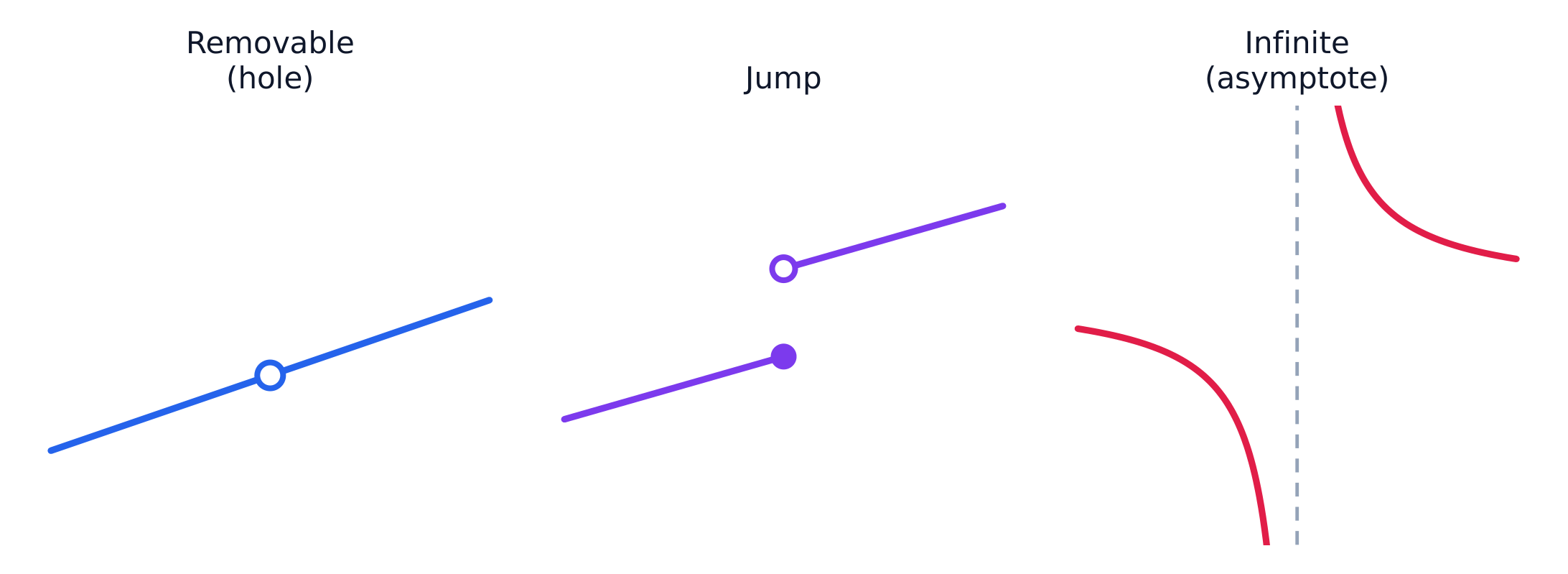
If the left side of a graph heads to $2$ and the right side heads to $6$, the limit does not exist because of a ____. · Se o lado esquerdo de um gráfico tende para $2$ e o lado direito tende para $6$, o limite não existe devido a um ____.
Different one-sided heights means a jump · salto discontinuity, so the two-sided limit is DNE. · Alturas laterais diferentes significam uma descontinuidade de salto, logo o limite bilateral é DNE.
From a graph, select all · todos features that make $\lim_{x\to c} f(x)$ fail to exist. · A partir de um gráfico, selecione todas as características que fazem com que $\lim_{x\to c} f(x)$ deixe de existir.
Blow-ups, jumps, and oscillation all kill a limit. A removable hole does not · não — both sides still agree. · Explosões, saltos e oscilações anulam todos um limite. Um buraco removível não — ambos os lados ainda concordam.
The dot at $c$ is a decoy
- The height the curve reaches for, $\lim_{x\to c}f(x)$, is a separate question from the plotted value $f(c)$.
- A curve can head smoothly toward $4$ while a lone dot sits at $f(c)=1$ — the limit is still $4$.
- $f(c)$ can even be undefined (a hole) while the limit exists.
- So always answer two questions separately: where is the curve going? and is there a dot, and where?
O ponto em $c$ é um engano
- A altura que a curva tende para, $\lim_{x\to c}f(x)$, é uma pergunta separada do valor plotado $f(c)$.
- Uma curva pode tender suavemente a $4$ enquanto um ponto solitário fica em $f(c)=1$ — o limite ainda é $4$.
- $f(c)$ pode até estar indefinido (um buraco) enquanto o limite existe.
- Então, responda sempre duas perguntas separadamente: para onde a curva está indo? e existe um ponto, e onde ele está?
If the graph shows an open hole at $(2,4)$ and a filled dot at $(2,1)$, then $\lim_{x\to 2} f(x) = 4$. · Se o gráfico mostrar um buraco aberto em $(2,4)$ e um ponto preenchido em $(2,1)$, então $\lim_{x\to 2} f(x) = 4$.
The curve approaches height $4$ from both sides, so the limit is $4$; the filled dot is only $f(2)=1$. · A curva aproxima-se da altura $4$ de ambos os lados, logo o limite é $4$; o ponto preenchido é apenas $f(2)=1$.
A smooth curve passes through height $7$ at $x=3$ with no · nenhuma hole or dot elsewhere. What are $f(3)$ and · e $\lim_{x\to 3} f(x)$? · Uma curva suave passa pela altura $7$ em $x=3$ sem buraco nem ponto noutro lugar. Quais são $f(3)$ e $\lim_{x\to 3} f(x)$?
With no hole or jump, the curve is continuous there, so limit $= f(3) = 7$. · Sem buraco nem salto, a curva é contínua ali, logo limite $= f(3) = 7$.
A common trap: reading $f(c)$ (the plotted dot) when the question asks for $\lim_{x\to c}f(x)$ (the approach). They are different. If you see a filled dot floating above a smooth curve, the limit is the curve's height — not the dot's.
Uma armadilha comum: ler $f(c)$ (o ponto plotado) quando a pergunta pede $\lim_{x\to c}f(x)$ (a aproximação). Eles são diferentes. Se você ver um ponto cheio flutuando acima de uma curva suave, o limite é a altura da curva — não a do ponto.
From a graph: near $x=2$ the curve rises to a hole at height $4$, and a filled dot is plotted at $(2,\,1)$.
- Left-hand limit: heading to $4$. Right-hand limit: heading to $4$.
- Both agree, so $\displaystyle\lim_{x\to 2}f(x) = 4$.
- But $f(2) = 1$ (the filled dot). Limit $\neq$ function value here.
De um gráfico: próximo a $x=2$ a curva sobe até um buraco na altura $4$, e um ponto cheio é plotado em $(2,\,1)$.
- Limite lateral esquerdo: tendendo para $4$. Limite lateral direito: tendendo para $4$.
- Ambos concordam, então $\displaystyle\lim_{x\to 2}f(x) = 4$.
- Mas $f(2) = 1$ (o ponto preenchido). Limite o valor da função $\neq$ aqui.
To read a limit off a graph, trace the curve toward $c$ from both sides and ask what height you head for; the plotted dot at $c$ is a decoy. The limit is DNE when the sides give different heights (jump), the curve is unbounded, or it oscillates endlessly.
Para ler um limite de um gráfico, trace a curva em direção a $c$ de ambos os lados e pergunte para qual altura você tende; o ponto plotado em $c$ é um engano. O limite é DNE quando os lados dão alturas diferentes (salto), a curva é ilimitada ou ela oscila interminavelmente.