Facilitated Diffusion
Introduzido| English | Significado |
|---|---|
| facilitated diffusion/fəˈsɪlɪteɪtɪd dɪˈfjuːʒn/ | difusão facilitada |
| channel protein/ˈtʃænl ˈprəʊtiːn/ | proteína canal |
| carrier protein/ˈkærɪə ˈprəʊtiːn/ | proteína carreadora |
A door for the stuck molecules
- Oxygen slips through the membrane freely, but many molecules cannot.
- A charged ion or a large sugar is blocked by the oily middle.
- Yet cells still need these substances to cross.
- The answer is a doorway built from protein.
Why some molecules are blocked
- The membrane's core is made of water-fearing fatty tails.
- Charged particles and large polar molecules are repelled by this oily layer.
- On their own, they simply cannot get through.
- They need a helper embedded in the membrane.
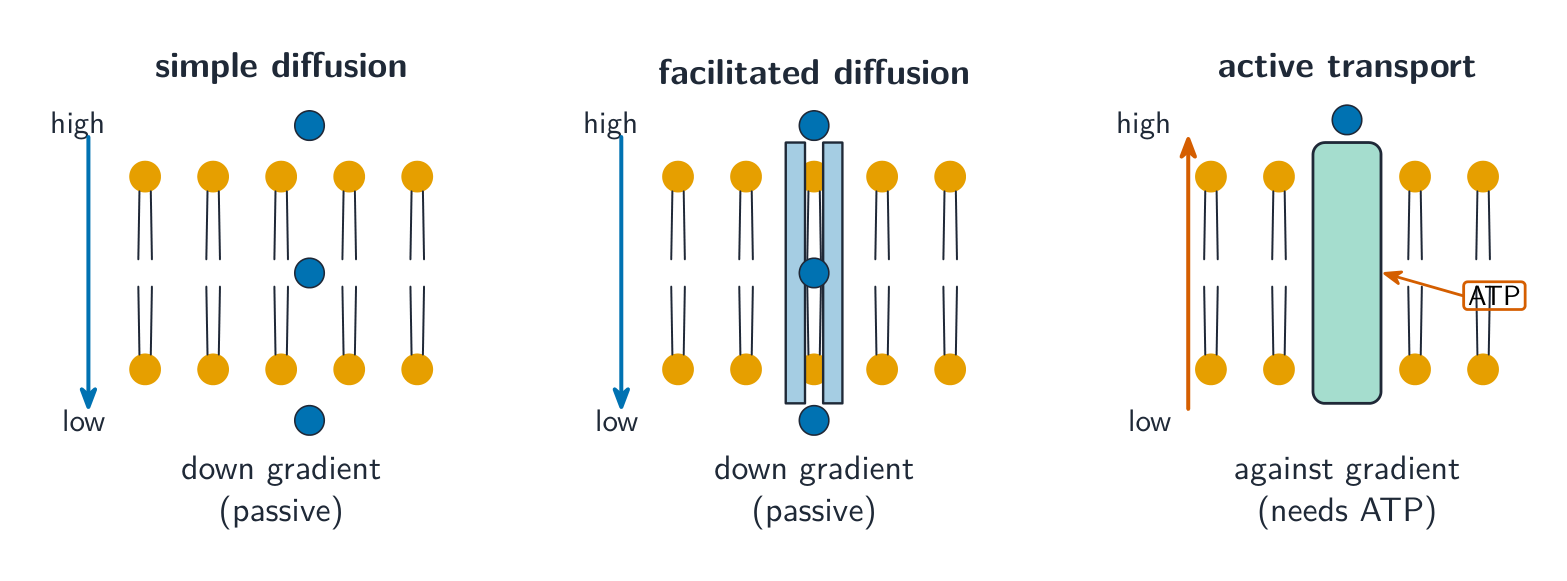
Simple diffusion, facilitated diffusion 易化扩散 through a protein channel, and active transport
Why do some molecules need facilitated diffusion instead of crossing the bilayer directly?
Dificuldade 1/5 · Moedas 100 + pequeno bônus na primeira conclusão hoje
Charged ions and large polar molecules cannot cross the oily core, so a protein must help them.
Channels and carriers
- Facilitated diffusion is diffusion helped by a membrane protein.
- A channel protein 通道蛋白 is a lined pore that lets specific particles pass.
- A carrier protein 载体蛋白 binds a molecule, then changes shape to release it on the other side.
- Each protein is specific — shaped to fit just one kind of particle.
Diffusion through a protein
Particles still move down their gradient — but here a membrane protein gives charged or large molecules a way through.
A channel protein helps diffusion by…
Dificuldade 1/5 · Moedas 100 + pequeno bônus na primeira conclusão hoje
A channel protein is a lined pore; a proteína transportadora binds a molecule and changes shape to move it.
Still passive, still downhill
- Even with a protein's help, the particles move down their gradient.
- No ATP is spent — the protein only provides a route.
- So facilitated diffusion is a form of passive transport.
- It just widens the range of what diffusion can move.
Facilitated diffusion is still passive — it uses no ATP.
Dificuldade 1/5 · Moedas 100 + pequeno bônus na primeira conclusão hoje
The protein only provides a route; the particles still move para baixo their gradient, so no ATP is used.
In facilitated diffusion, particles still move down their concentration ____.
Dificuldade 1/5 · Moedas 100 + pequeno bônus na primeira conclusão hoje
The protein just opens a route; the direction is still down the gradiente.
Select todos true statements about facilitated diffusion.
Dificuldade 2/5 · Moedas 140 + pequeno bônus na primeira conclusão hoje
It never pumps uphill — that would be active transport. The other three are correct.
Facilitated diffusion is not active transport. The protein is only a doorway — the particle still travels down its gradient, and no ATP is used. If it were going uphill, that would be active transport instead.
Glucose entering a cell:
- Glucose is large and polar, so it cannot cross the bilayer alone.
- A carrier protein binds it and flips it to the inside.
- Because blood glucose is higher than inside the cell, it still moves down its gradient — passive, no ATP.
Facilitated diffusion lets charged or large molecules cross the membrane using a channel protein (a pore) or a carrier protein (a shape-changing binder). It is still passive: the particles move down their gradient and no ATP is used — the protein just provides the route.
Write from this case
- Glucose enters through a GLUT carrier.
- Glucose is higher outside than inside, and no ATP is used.
What kind of transport is this?
A carrier plus a downhill gradient, without ATP, is facilitated diffusion.
What is GLUT doing here?
Dificuldade 1/5 · Moedas 100 + pequeno bônus na primeira conclusão hoje
The protein helps a downhill move and does not use ATP.