Energy levels and line spectra · Níveis de energia e espectros de linhas
| English | Português |
|---|---|
| discrete/dɪˈskriːt/ | discretos |
| energy levels/ˈenədʒi ˈlevlz/ | níveis de energia |
| ground state/ɡraʊnd steɪt/ | estado fundamental |
| excited states/ekˈsaɪtɪd steɪts/ | estados excitados |
| emission spectrum/ɪˈmɪʃn ˈspektrəm/ | espectro de emissão |
| transition/trænˈsɪʃn/ | transição |
| absorption spectrum/əbˈsɔːpʃn ˈspektrəm/ | espectro de absorção |
Every element has a barcode
- A sodium street lamp is orange. A neon sign is red. A mercury lamp is bluish-white. None of them can be persuaded to be any other colour.
- Split that light with a prism and you do not get a rainbow. You get a few sharp lines, always at the same wavelengths for that element.
- Those lines are how we know what the Sun and every distant star are made of, without going there.
- This lesson is why the lines exist: discrete energy levels 能级 inside the atom, and $hf = E_2 - E_1$.
Cada elemento possui um código de barras
- Uma lâmpada de sódio é laranja. Um letreiro de néon é vermelho. Uma lâmpada de mercúrio é branco-azulado. Nenhuma delas pode ser convencida a emitir qualquer outra cor.
- Se você separar essa luz com um prisma, não obterá um arco-íris. Você obterá algumas linhas nítidas, sempre nos mesmos comprimentos de onda para aquele elemento.
- São essas linhas que nos permitem saber o que são compostos o Sol e cada estrela distante, sem precisar ir até lá.
- Esta lição explica por que as linhas existem: níveis de energia discretos 能级 dentro do átomo, e $hf = E_2 - E_1$.
Discrete energy levels
- In an isolated atom an electron can sit only at certain discrete 分立 energies, never in between. The lowest is the ground state 基态; the rest are excited states 激发态.
- By convention the energies are written negative, with $E = 0$ for an electron just free of the atom. For hydrogen the ground state is $E_1 = -13.6\ \text{eV}$, and the higher levels creep up towards zero.
- The negative sign means bound. The number is how much energy you would have to supply to remove the electron altogether.
- The levels get closer together as they rise, which is why the spectral lines crowd towards the short-wavelength end.
Rungs that get closer as they climb
Níveis de energia discretos
- Em um átomo isolado, um elétron pode ocupar apenas certas energias discretas 分立, nunca entre elas. A mais baixa é o estado fundamental 基态; as demais são estados excitados 激发态.
- Por convenção, as energias são escritas como negativas, com $E = 0$ para um elétron livre do átomo. Para o hidrogênio, o estado fundamental é $E_1 = -13.6\ \text{eV}$, e os níveis superiores se aproximam gradualmente de zero.
- O sinal negativo indica ligação. O valor numérico representa a quantidade de energia necessária para remover completamente o elétron.
- Os níveis ficam mais próximos à medida que sobem, razão pela qual as linhas espectrais se aglomeram em direção à extremidade de comprimento de onda curto.

Degraus que ficam mais próximos conforme sobem
Electrons in an atom can only occupy certain ____ energy levels. · Elétrons em um átomo podem ocupar apenas certos ____ níveis de energia.
The levels are discrete (quantised) — an electron cannot have an energy in between them. · Os níveis são discretos (quantizados) — um elétron não pode ter uma energia entre eles.
Atomic energy levels are written as negative, with 0 for a just-free electron. · Os níveis de energia atômica são escritos como negativos, com 0 para um elétron livre.
The most tightly bound (ground) state is the most negative; energy rises toward 0 as the electron is freed. · O estado mais fortemente ligado (fundamental) é o mais negativo; a energia sobe em direção a 0 conforme o elétron é liberado.
Emission: one drop, one photon
- When an electron falls from a higher level $E_2$ to a lower level $E_1$, it emits one photon:
- Both energies are negative and their difference is positive, so subtract carefully: $-3.40 - (-13.6) = 10.2\ \text{eV}$.
- Because the levels are discrete, only certain photon energies come out. The emission spectrum 发射光谱 is a set of sharp bright lines on a dark background, one line per transition 跃迁.
A handful of lines, always the same ones
Emissão: uma queda, um fóton
- Quando um elétron cai de um nível mais alto $E_2$ para um nível mais baixo $E_1$, ele emite um fóton:
- Ambas as energias são negativas e sua diferença é positiva, então subtraia com cuidado: $-3.40 - (-13.6) = 10.2\ \text{eV}$.
- Como os níveis são discretos, apenas energias de fótons específicas são emitidas. O espectro de emissão 发射光谱 é um conjunto de linhas brilhantes e nítidas sobre fundo escuro, uma linha por transição 跃迁.

Um punhado de linhas, sempre as mesmas
Make an element's spectral lines · Formam as linhas espectrais de um elemento
An electron dropping between fixed energy levels emits a photon of exactly the gap's energy — a fixed wavelength and colour. Each jump is one line of the element's barcode. · Um elétron caindo entre níveis de energia fixos emite um fóton com exatamente a energia da diferença — um comprimento de onda e cor fixos. Cada salto é uma linha do código de barras do elemento.
When an electron drops from level $E_2$ to · até $E_1$, the emitted photon has energy: · Quando um elétron cai do nível $E_2$ para $E_1$, o fóton emitido tem energia:
$hf = E_2 - E_1$ — a positive amount, since $E_2$ is the higher (less negative) level. · $hf = E_2 - E_1$ — uma quantidade positiva, já que $E_2$ é o nível mais alto (menos negativo).
Explaining a line spectrum, the standard four-marker
- One. The electrons in an isolated atom can occupy only discrete energy levels.
- Two. An electron in an excited state falls to a lower level, and the energy it loses is emitted as one photon.
- Three. The photon energy equals the difference between the two levels, $hf = E_2 - E_1$, so only certain frequencies are emitted.
- Four. Each possible transition gives one line, and the same set of levels always gives the same lines, which is why a spectrum identifies the element.
- All four are separate marks. Answers that stop after "the levels are discrete" collect one of them.
Explicando um espectro de linhas, os quatro marcadores padrão
- Um. Os elétrons em um átomo isolado podem ocupar apenas níveis de energia discretos.
- Dois. Um elétron em um estado excitado cai para um nível mais baixo, e a energia que perde é emitida como um fóton.
- Três. A energia do fóton é igual à diferença entre os dois níveis, $hf = E_2 - E_1$, portanto apenas certas frequências são emitidas.
- Quatro. Cada transição possível resulta em uma linha, e o mesmo conjunto de níveis sempre produz as mesmas linhas, razão pela qual um espectro identifica o elemento.
- As quatro são marcas separadas. Respostas que param depois de "os níveis são discretos" ganham apenas uma dessas marcas.
An emission spectrum looks like: · Um espectro de emissão parece com:
Discrete transitions give discrete wavelengths — bright lines. (Dark lines on bright is an absorption spectrum.) · Transições discretas dão comprimentos de onda discretos — linhas brilhantes. (Linhas escuras sobre brilhante é um espectro de absorção.)
Put the four-mark explanation of a line emission spectrum in order. · Organize a explicação de quatro marcas de um espectro de emissão de linhas.
All four ideas are separately marked. Stopping at "the levels are discrete" collects one mark of four. · Todas as quatro ideias são marcadas separadamente. Parar em "os níveis são discretos" coleta apenas uma das quatro marcas.
Worked example: hydrogen's ultraviolet lines
- The lowest four levels of hydrogen are $-13.6$, $-3.40$, $-1.51$ and $-0.85\ \text{eV}$. Find the wavelengths of the three lines from transitions to the ground state, and how many lines the four levels give altogether.
- $2 \to 1$: $\Delta E = 10.2\ \text{eV}$, so $\lambda = 1240/10.2 = 122\ \text{nm}$.
- $3 \to 1$: $12.09\ \text{eV}$, $\lambda = 103\ \text{nm}$. $4 \to 1$: $12.75\ \text{eV}$, $\lambda = 97.3\ \text{nm}$. All three are ultraviolet, and the largest jump gives the shortest wavelength.
- Altogether: $4\to3$, $4\to2$, $4\to1$, $3\to2$, $3\to1$, $2\to1$, so six lines. Count every downward pair, not just the drops to the ground state.
- The visible red line of hydrogen is $3\to2$: $1.89\ \text{eV}$, $656\ \text{nm}$.
Exemplo resolvido: linhas ultravioleta do hidrogênio
- Os quatro níveis mais baixos do hidrogênio são $-13.6$, $-3.40$, $-1.51$ e $-0.85\ \text{eV}$. Encontre os comprimentos de onda das três linhas resultantes de transições para o estado fundamental, e quantas linhas os quatro níveis produzem no total.
- $2 \to 1$: $\Delta E = 10.2\ \text{eV}$, então $\lambda = 1240/10.2 = 122\ \text{nm}$.
- $3 \to 1$: $12.09\ \text{eV}$, $\lambda = 103\ \text{nm}$. $4 \to 1$: $12.75\ \text{eV}$, $\lambda = 97.3\ \text{nm}$. Todos os três são ultravioleta, e a maior transição dá o menor comprimento de onda.
- No total: $4\to3$, $4\to2$, $4\to1$, $3\to2$, $3\to1$, $2\to1$, logo seis linhas. Conte todos os pares descendentes, não apenas as quedas para o estado fundamental.
- A linha vermelha visível do hidrogênio corresponde a $3\to2$: $1.89\ \text{eV}$, $656\ \text{nm}$.
An electron drops from $-1.5\ \text{eV}$ to · até $-3.4\ \text{eV}$. What is the energy of the emitted photon? · Um elétron cai de $-1.5\ \text{eV}$ para $-3.4\ \text{eV}$. Qual é a energia do fóton emitido?
$hf = E_2 - E_1 = (-1.5) - (-3.4) = 1.9\ \text{eV}$.
How many different spectral lines can four energy levels produce? · Quantas linhas espectrais diferentes podem ser produzidas por quatro níveis de energia?
Every downward pair counts: 4-3, 4-2, 4-1, 3-2, 3-1, 2-1. In general n levels give n(n-1)/2 lines, not n-1. · Todo par descendente conta: 4-3, 4-2, 4-1, 3-2, 3-1, 2-1. Em geral, n níveis produzem n(n-1)/2 linhas, não n-1.
From levels to lines
- The rule for matching a diagram to a spectrum is short: the largest energy gap gives the highest frequency and the shortest wavelength.
- So the widest arrow on the level diagram is the line furthest to the left on a wavelength scale.
- Two atoms with completely different levels but the same gap emit the same line. The gap fixes the colour, never either level on its own.
Widest arrow, leftmost line
De níveis para linhas
- A regra para associar um diagrama a um espectro é simples: o maior gap de energia resulta na maior frequência e no menor comprimento de onda.
- Assim, a seta mais larga no diagrama de níveis corresponde à linha mais à esquerda em uma escala de comprimentos de onda.
- Dois átomos com níveis completamente diferentes, mas com o mesmo gap, emitem a mesma linha. O gap fixa a cor, nunca nenhum nível isoladamente.
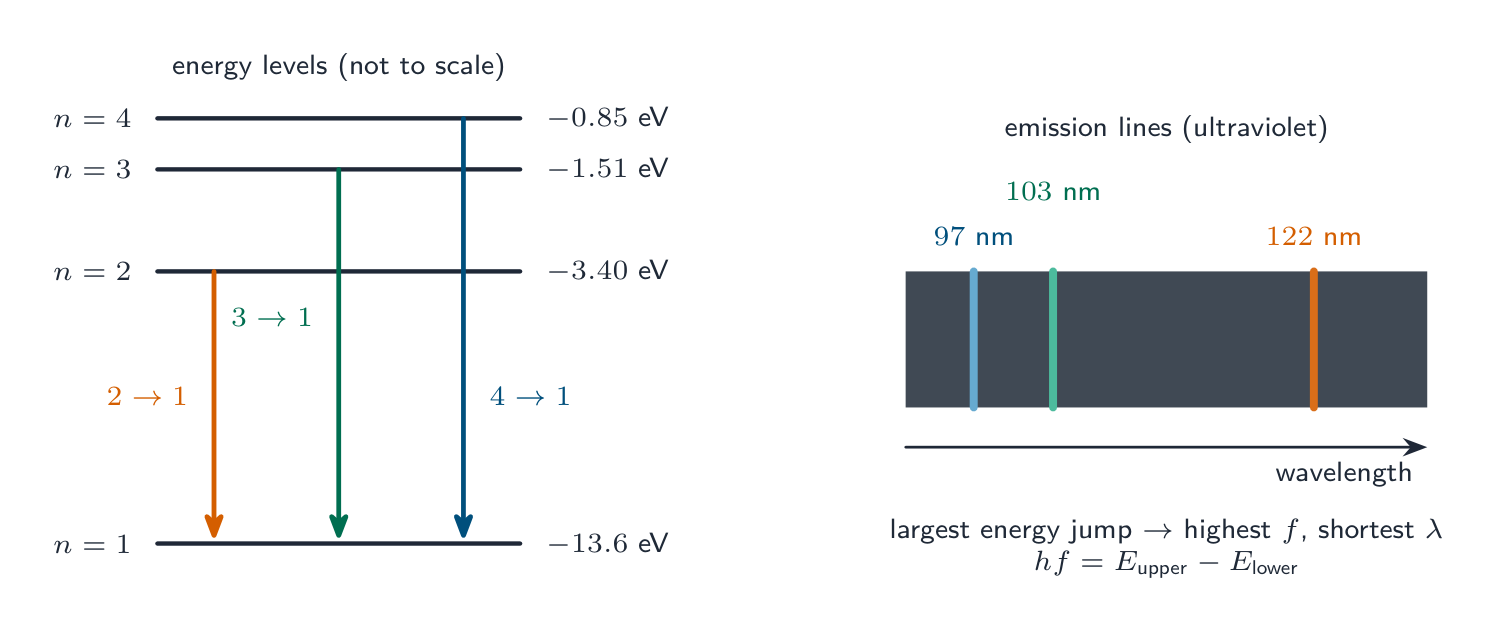
Seta mais larga, linha mais à esquerda
Match each transition to the line it produces. · Combine cada transição com a linha que ela produz.
Frequency and wavelength move in opposite directions, which is where most of the confusion in this question type comes from. · Frequência e comprimento de onda variam em direções opostas, que é onde vem a maioria das confusões neste tipo de questão.
On an energy-level diagram, the largest downward jump produces the line of ____ wavelength. · Em um diagrama de níveis de energia, o maior salto descendente produz a linha de ____ comprimento de onda.
Largest gap, largest photon energy, highest frequency, shortest wavelength. On a wavelength scale that line sits furthest to the left. · Maior diferença, maior energia do fóton, maior frequência, menor comprimento de onda. Em uma escala de comprimento de onda, essa linha fica mais à esquerda.
Absorption: the same lines, dark
- Pass white light through a cool gas and photons whose energy exactly matches an upward transition are absorbed, lifting electrons to higher levels.
- The result is dark lines on a bright continuous background, the absorption spectrum 吸收光谱, at exactly the same wavelengths as that gas emits.
- The subtle part, and the marked part: the excited electron soon falls back and re-emits a photon of the same energy, but in a random direction, so almost none of it continues along the original beam.
- Everything else in the white light matches no gap and passes straight through. The Sun's dark lines are made by the cooler gases in its outer layers.
A rainbow with pieces missing
Absorção: as mesmas linhas, mas escuras
- Ao passar luz branca através de um gás frio, fótons cuja energia corresponda exatamente a uma transição ascendente são absorvidos, elevando elétrons para níveis mais altos.
- O resultado são linhas escuras sobre um fundo contínuo brilhante, o espectro de absorção 吸收光谱, em exatamente os mesmos comprimentos de onda que aquele gás emite.
- A parte sutil, e a parte pontuada: o elétron excitado rapidamente volta a cair e reemite um fóton da mesma energia, mas em direção aleatória, assim quase nada dele continua ao longo do feixe original.
- Tudo o resto na luz branca não corresponde a nenhum gap e passa diretamente. As linhas escuras do Sol são causadas pelos gases mais frios em suas camadas externas.

Um arco-íris com pedaços faltando
A gas absorbs light at the same wavelengths at which it emits. · Um gás absorve luz nos mesmos comprimentos de onda em que emite.
The same energy gaps work both ways — so absorption lines sit exactly where the emission lines are. · As mesmas diferenças de energia funcionam em ambos os sentidos — logo, as linhas de absorção ficam exatamente onde estão as linhas de emissão.
Why does a cool gas produce dark lines in a continuous spectrum? Select all · todos that apply. · Por que um gás frio produz linhas escuras em um espectro contínuo? Selecione todas as opções aplicáveis.
The random direction is the marked point. Absorption alone would not darken the line, because the energy could have carried on forwards. · A direção aleatória é o ponto marcado. A absorção sozinha não escureceria a linha, porque a energia poderia continuar adiante.
Worked example: from a wavelength to a gap
- A laser emits red light of wavelength $650\ \text{nm}$ when electrons drop between two levels. Find the energy gap.
- $\Delta E = \dfrac{hc}{\lambda} = \dfrac{1240}{650} = 1.91\ \text{eV} = 3.1\times10^{-19}\ \text{J}$.
- Use $hc = 1240\ \text{eV nm}$ when the answer is wanted in eV, and $hc = 1.99\times10^{-25}\ \text{J m}$ when it is wanted in joules. Mixing them is the standard slip.
- Note what the question can and cannot tell you: the gap, not either level. Two different atoms with the same gap give the same line.
Exemplo resolvido: de um comprimento de onda para um gap
- Um laser emite luz vermelha de comprimento de onda $650\ \text{nm}$ quando elétrons caem entre dois níveis. Encontre o gap de energia.
- $\Delta E = \dfrac{hc}{\lambda} = \dfrac{1240}{650} = 1.91\ \text{eV} = 3.1\times10^{-19}\ \text{J}$.
- Use $hc = 1240\ \text{eV nm}$ quando a resposta for pedida em eV, e $hc = 1.99\times10^{-25}\ \text{J m}$ quando for pedida em joules. Misturá-los é o erro padrão.
- Note o que a questão pode e não pode lhe dizer: o gap, não nenhum nível. Dois átomos diferentes com o mesmo gap produzem a mesma linha.
A laser emits light of wavelength 650 nm. What is the energy gap between the two levels, in eV? · Um laser emite luz de comprimento de onda 650 nm. Qual é a diferença de energia entre os dois níveis, em eV?
1240/650 = 1.91 eV. The measurement fixes the GAP, not either level: two different atoms with the same gap emit the same line. · 1240/650 = 1.91 eV. A medição fixa a DIFERENÇA, não cada nível: dois átomos diferentes com a mesma diferença emitem a mesma linha.
Marks that slip away
- Energy levels are negative. Subtracting them the wrong way round gives a negative photon energy and a negative wavelength.
- $n$ levels give $\tfrac{1}{2}n(n-1)$ lines, not $n - 1$. Count every pair.
- The largest gap gives the shortest wavelength. The two words move in opposite directions.
- For absorption, say the re-emission goes in a random direction. "The photon is absorbed" alone does not explain a dark line, since the energy could have carried on forwards.
- Convert eV to joules before mixing with SI quantities, or stay in eV and use $1240\ \text{eV nm}$ throughout.
Marcas que escapam
- Os níveis de energia são negativos. Subtraí-los na ordem errada resulta em energia de fóton negativa e comprimento de onda negativo.
- $n$ níveis produzem $\tfrac{1}{2}n(n-1)$ linhas, não $n - 1$. Conte todos os pares.
- O maior gap resulta no menor comprimento de onda. As duas palavras se movem em direções opostas.
- Para absorção, diga que a reemissão ocorre em uma direção aleatória. Dizer apenas "o fóton é absorvido" não explica uma linha escura, pois a energia poderia ter continuado para frente.
- Converta eV para joules antes de misturar com quantidades SI, ou permaneça em eV e use $1240\ \text{eV nm}$ em toda parte.
You've got it
- electrons in an isolated atom occupy discrete, negative energy levels, the lowest being the ground state
- a drop from $E_2$ to $E_1$ emits one photon with $hf = E_2 - E_1$, giving sharp bright lines unique to the element
- an absorption spectrum is dark lines on a bright background at the same wavelengths, because the re-emitted photons go off in random directions
- the largest energy gap gives the highest frequency and shortest wavelength, and $n$ levels give $\tfrac{1}{2}n(n-1)$ possible lines
Entendeu?
- elétrons em um átomo isolado ocupam níveis de energia discretos e negativos, sendo o mais baixo o estado fundamental
- uma queda de $E_2$ para $E_1$ emite um fóton com $hf = E_2 - E_1$, resultando em linhas brilhantes e nítidas exclusivas do elemento
- um espectro de absorção apresenta linhas escuras sobre fundo brilhante nos mesmos comprimentos de onda, porque os fótons reemitidos saem em direções aleatórias
- o maior gap de energia resulta na maior frequência e menor comprimento de onda, e $n$ níveis produzem $\tfrac{1}{2}n(n-1)$ linhas possíveis