Mass defect and nuclear binding energy · Defeito de massa e energia de ligação nuclear
| English | Português |
|---|---|
| energy/ˈenədʒi/ | energia |
| nucleus/ˈnjuːklɪəs/ | núcleo |
| mass-energy equivalence/mæs ˈenədʒi ɪˈkwɪvələns/ | equivalência massa-energia |
| mass defect/mæs ˈdiːfekt/ | defeito de massa |
| binding energy/ˈbaɪndɪŋ ˈenədʒi/ | energia de ligação |
| luminosity/ˌluːmɪˈnɒsɪti/ | luminosidade |
| nuclear reaction/ˈnjuːklɪə rɪˈækʃn/ | reação nuclear |
| nucleon number/ˈnjuːklɪən ˈnʌmbə/ | número nucleônico |
| conservation of charge/ˌkɒnsəˈveɪʃn ɒv tʃɑːdʒ/ | conservação de carga |
| positron/ˈpɒzɪtrɒn/ | pósitron |
| neutrino/njuːˈtriːnəʊ/ | neutrino |
| protons/ˈprəʊtɒnz/ | prótons |
| neutrons/ˈnjuːtrɒnz/ | nêutrons |
| binding energy per nucleon/ˈbaɪndɪŋ ˈenədʒi pɜː ˈnjuːklɪən/ | energia de ligação por nucleon |
The Sun is four million tonnes lighter than a second ago
- Every second the Sun radiates $3.8\times10^{26}\ \text{J}$, and every second it is about four million tonnes lighter.
- Nothing is leaking out of it. The mass has become the energy, at the exchange rate $E = mc^2$.
- On the nuclear scale the same trade explains why a nucleus weighs less than the parts it is made of, and where the energy of a reactor comes from.
- This lesson is mass-energy equivalence 质能等价, mass defect 质量亏损 and binding energy 结合能.
O Sol está quatro milhões de toneladas mais leve do que há um segundo atrás
- A cada segundo, o Sol irradia $3.8\times10^{26}\ \text{J}$, e a cada segundo ele fica cerca de quatro milhões de toneladas mais leve.
- Nada está vazando dele. A massa tornou-se energia, à taxa de troca $E = mc^2$.
- Na escala nuclear, esse mesmo comércio explica por que um núcleo tem menos massa do que as partes que o compõem, e de onde vem a energia de um reator.
- Esta lição trata de equivalência massa-energia 质能等价, defeito de massa 质量亏损 e energia de ligação 结合能.
Mass and energy are the same currency
- $E = mc^2$, with $c = 3.00\times10^{8}\ \text{m/s}$. For a change of mass:
- In nuclear physics the mass changes are tiny and $c^2$ is enormous, so a minute mass change is a large energy 能量.
- Learn the conversion, because almost every question uses it:
One quantity, two units
Massa e energia são a mesma moeda
- $E = mc^2$, com $c = 3.00\times10^{8}\ \text{m/s}$. Para uma variação de massa:
- Na física nuclear, as variações de massa são minúsculas e $c^2$ é enorme, então uma pequena variação de massa equivale a uma grande energia 能量.
- Aprenda a conversão, pois quase todas as questões a utilizam:

Uma única quantidade, duas unidades
The mass-energy relation is: · A relação massa-energia é:
Mass and energy are equivalent: $E = mc^{2}$, so a mass change $\Delta m$ releases $c^{2}\Delta m$. · Massa e energia são equivalentes: $E = mc^{2}$, então uma mudança de massa $\Delta m$ libera $c^{2}\Delta m$.
A mass change of $1\ \text{u}$ corresponds to about how many MeV? · Uma mudança de massa de $1\ \text{u}$ corresponde aproximadamente a quantos MeV?
$1\ \text{u} = 1.66 \times 10^{-27}\ \text{kg}$ gives $\Delta E = c^{2}\Delta m \approx 931\ \text{MeV}$. · $1\ \text{u} = 1.66 \times 10^{-27}\ \text{kg}$ fornece $\Delta E = c^{2}\Delta m \approx 931\ \text{MeV}$.
Worked example: weighing the output of a star
- Sirius loses mass by fusion at $1.09\times10^{11}\ \text{kg/s}$. Find the power it radiates.
- $P = c^2 \times (\text{mass lost per second}) = (3.00\times10^{8})^2(1.09\times10^{11}) = 9.8\times10^{27}\ \text{W}$.
- That is its luminosity 光度, and it is about $26$ times the Sun's $3.8\times10^{26}\ \text{W}$.
- The same sum backwards: a $1\ \text{GW}$ power station running for a year converts $E/c^2 = 3.2\times10^{16}/9.0\times10^{16} = 0.35\ \text{kg}$ of mass. That is why the spent fuel weighs almost exactly what it did going in.
Exemplo resolvido: pesando a saída de uma estrela
- Sirius perde massa por fusão a $1.09\times10^{11}\ \text{kg/s}$. Encontre a potência que ela irradia.
- $P = c^2 \times (\text{mass lost per second}) = (3.00\times10^{8})^2(1.09\times10^{11}) = 9.8\times10^{27}\ \text{W}$.
- Essa é sua luminosidade 光度, e equivale a cerca de $26$ vezes a luminosidade do Sol $3.8\times10^{26}\ \text{W}$.
- A mesma conta inversa: uma usina de $1\ \text{GW}$ funcionando por um ano converte $E/c^2 = 3.2\times10^{16}/9.0\times10^{16} = 0.35\ \text{kg}$ de massa. É por isso que o combustível gasto pesa quase exatamente o mesmo que tinha ao entrar.
Nuclear equations balance twice
- A nuclear reaction 核反应 conserves nucleon number 核子数 (the top numbers) and charge (the bottom numbers), which is conservation of charge 电荷守恒:
- Alpha decay: $A$ falls by $4$, $Z$ by $2$. Beta-minus: a neutron becomes a proton, so $A$ is unchanged and $Z$ rises by $1$, with an electron and an antineutrino.
- Beta-plus: a proton becomes a neutron, $Z$ falls by $1$, emitting a positron 正电子 and a neutrino 中微子. Gamma changes neither number.
- The neutrino is in the mark scheme. Leaving it out of a beta equation costs a mark every time.
Equações nucleares equilibram duas vezes
- Uma reação nuclear 核反应 conserva o número de núcleons 核子数 (os números de cima) e a carga (os números de baixo), o que é conservação de carga 电荷守恒:
- Decaimento Alfa: $A$ diminui em $4$, $Z$ diminui em $2$. Beta-negativo: um nêutron vira próton, então $A$ permanece inalterado e $Z$ aumenta em $1$, emitindo um elétron e um antineutrino.
- Beta-positivo: um próton vira nêutron, $Z$ diminui em $1$, emitindo um pósitron 正电子 e um neutrino 中微子. Gama não altera nenhum número.
- O neutrino está no gabarito. Deixá-lo de fora de uma equação beta custa uma marca a cada vez.
In alpha decay the nucleon number falls by 4 and the proton number falls by ____. · Na desintegração alfa, o número de nucleons diminui em 4 e o número de prótons diminui em ____.
An alpha particle is a helium-4 nucleus, 2 protons and 2 neutrons. Beta-minus leaves A unchanged and raises Z by 1, and the antineutrino must be written too. · Uma partícula alfa é um núcleo de hélio-4, com 2 prótons e 2 nêutrons. A emissão beta-menos mantém A inalterado e aumenta Z em 1, e o antineutrino também deve ser escrito.
Mass defect and binding energy
- A nucleus 原子核 has less mass than its separate protons 质子 and neutrons 中子. The difference is the mass defect:
- The mass defect is the difference between the total mass of the separate nucleons and the mass of the nucleus.
- The binding energy is the minimum energy required to separate the nucleus into its individual nucleons, and $B = \Delta m\, c^2$.
- Say "separate nucleons" or "individual protons and neutrons". "The energy holding the nucleus together" scores nothing.
- Binding energy is released when the nucleus forms, not stored in it. The nucleus has less energy than its parts, which is exactly why it stays together.
Assemble it and mass goes missing
Defeito de massa e energia de ligação
- Um núcleo 原子核 tem menos massa do que seus prótons 质子 e nêutrons 中otohs separados. A diferença é o defeito de massa:
- O defeito de massa é a diferença entre a massa total dos núcleons separados e a massa do núcleo.
- A energia de ligação é a energia mínima necessária para separar o núcleo em seus núcleons individuais, e $B = \Delta m\, c^2$.
- Diga "separar núcleons" ou "prótons e nêutrons individuais". Dizer "a energia que mantém o núcleo unido" não pontua.
- A energia de ligação é liberada quando o núcleo se forma, não armazenada nele. O núcleo tem menos energia do que suas partes, o que é exatamente o motivo pelo qual ele permanece unido.

Monte-o e a massa desaparece
A nucleus has ____ mass than its separate protons and neutrons added together. · Um núcleo tem ____ massa do que seus prótons e nêutrons separados somados juntos.
That missing mass (the mass defect) was released as energy when the nucleus formed. · Essa massa faltante (o defeito de massa) foi liberada como energia quando o núcleo se formou.
The binding energy is the energy needed to pull a nucleus completely apart. · A energia de ligação é a energia necessária para desmontar completamente um núcleo.
$B = \Delta m\,c^{2}$ — the energy released on forming the nucleus, which must be returned to separate it. · $B = \Delta m\,c^{2}$ — a energia liberada na formação do núcleo, que deve ser reintroduzida para separá-lo.
Match each term to the definition the examiner marks. · Combine cada termo com a definição que o avaliador marca.
"The energy holding the nucleus together" scores nothing. The marked phrase is separating it into individual nucleons. · "A energia que mantém o núcleo unido" não pontua. A frase marcada é separá-lo em nucleons individuais.
Worked example: helium-4
- A helium-4 nucleus has a mass defect of $0.0304\ \text{u}$. Find its binding energy.
- $B = 0.0304 \times 931 = 28\ \text{MeV}$.
- Per nucleon that is $28/4 = 7.1\ \text{MeV}$, already high for such a light nucleus, which is why helium-4 shows as a spike on the curve.
- Binding energy per nucleon 比结合能 is $B/A$, and it is the fair way to compare two nuclides of very different size.
Exemplo resolvido: hélio-4
- Um núcleo de hélio-4 tem um defeito de massa de $0.0304\ \text{u}$. Encontre sua energia de ligação.
- $B = 0.0304 \times 931 = 28\ \text{MeV}$.
- Por núcleon, isso equivale a $28/4 = 7.1\ \text{MeV}$, já alto para um núcleo tão leve, razão pela qual o hélio-4 aparece como um pico na curva.
- Energia de ligação por núcleon 比结合能 é $B/A$, e é a maneira justa de comparar dois nuclídeos de tamanhos muito diferentes.
Worked example: polonium-212
- Proton $1.007276\ \text{u}$, neutron $1.008665\ \text{u}$, $^{212}_{84}\text{Po}$ nucleus $211.9454\ \text{u}$. Find the mass defect and the binding energy per nucleon.
- $Z = 84$ protons and $N = 212 - 84 = 128$ neutrons: $84(1.007276) + 128(1.008665) = 213.7203\ \text{u}$.
- $\Delta m = 213.7203 - 211.9454 = 1.7749\ \text{u}$.
- $B = 1.7749 \times 931.5 = 1653\ \text{MeV}$, so $B/A = 1653/212 = 7.80\ \text{MeV}$ per nucleon, on the falling part of the curve.
- Keep every decimal place until the subtraction. The defect is a small difference between two large numbers, and rounding early destroys it.
Exemplo resolvido: polônio-212
- Próton $1.007276\ \text{u}$, nêutron $1.008665\ \text{u}$, núcleo $^{212}_{84}\text{Po}$ $211.9454\ \text{u}$. Encontre o defeito de massa e a energia de ligação por nucleon.
- $Z = 84$ prótons e $N = 212 - 84 = 128$ nêutrons: $84(1.007276) + 128(1.008665) = 213.7203\ \text{u}$.
- $\Delta m = 213.7203 - 211.9454 = 1.7749\ \text{u}$.
- $B = 1.7749 \times 931.5 = 1653\ \text{MeV}$, logo $B/A = 1653/212 = 7.80\ \text{MeV}$ por nucleon, na parte descendente da curva.
- Mantenha todas as casas decimais até a subtração. O defeito é uma pequena diferença entre dois números grandes, e arredondar cedo o destrói.
Polonium-212 has a mass defect of 1.7749 u. What is its binding energy per nucleon, in MeV? (Use 931.5 MeV per u.) · O Polônio-212 tem um defeito de massa de 1.7749 u. Qual é sua energia de ligação por nucleon, em MeV? (Use 931.5 MeV por u.)
B = 1.7749 x 931.5 = 1653 MeV, then divide by A = 212 to get 7.80 MeV per nucleon, on the falling side of the curve. · B = 1.7749 x 931.5 = 1653 MeV, depois divida por A = 212 para obter 7.80 MeV por nucleon, no lado descendente da curva.
The curve everything hangs on
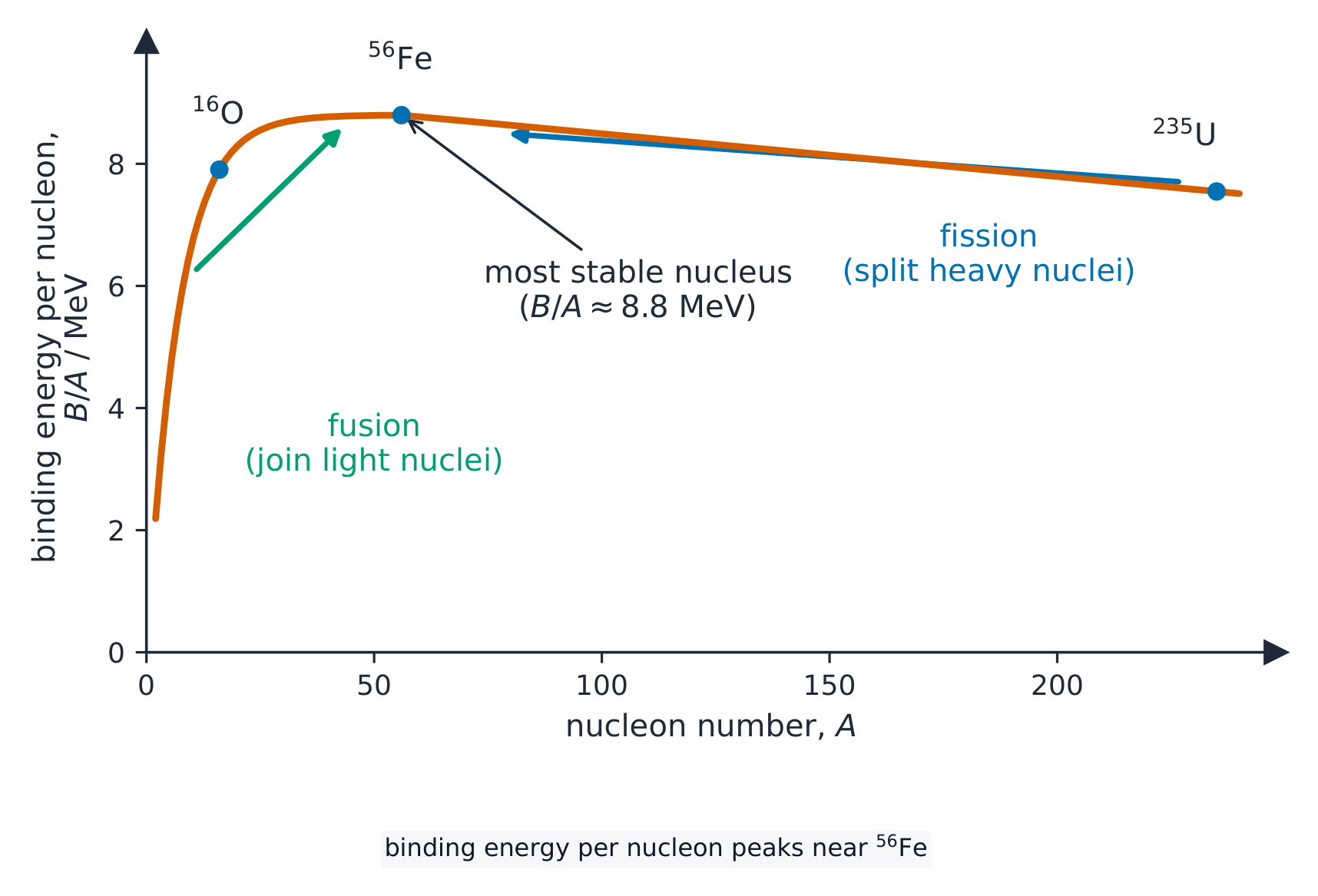
- Plot $B/A$ against $A$ and you get a dome: a steep rise for light nuclei, a maximum near $A = 56$ (iron) at about $8.8\ \text{MeV}$, then a slow fall to about $7.5\ \text{MeV}$ at uranium.
- Iron-56 is the most stable nucleus, and everything else can release energy by moving towards it.
- Sketching rules the exam marks: do not start at the origin, do not make the fall as steep as the rise, and do not let the curve reach zero on the right.
- Mark a nucleus that alpha decays on the far right ($A > 200$), and one that fuses on the far left ($A < 10$). Both sit low and both move up the curve when they react.
Everything climbs towards iron
A curva que sustenta tudo
- Plote $B/A$ contra $A$ e você obterá uma cúpula: um aumento íngreme para núcleos leves, um máximo próximo a $A = 56$ (ferro) em cerca de $8.8\ \text{MeV}$, seguido de uma queda lenta até cerca de $7.5\ \text{MeV}$ no urânio.
- O ferro-56 é o núcleo mais estável, e todos os outros podem liberar energia movendo-se em direção a ele.
- Regras de esboço regem as notas do exame: não comece na origem, não faça a queda tão íngreme quanto a subida, e não deixe a curva atingir zero à direita.
- Marque um núcleo que decai alfa na extrema direita ($A > 200$), e um que funde na extrema esquerda ($A < 10$). Ambos ficam baixos e ambos se movem para cima na curva quando reagem.
Tudo sobe em direção ao ferro
Mass defect energy lab · Laboratório de energia do defeito de massa
E = delta m c^2
Change mass defect and see binding energy rise with E = mc^2. · Altere o defeito de massa e veja a energia de ligação subir com E = mc^2.
The binding energy per nucleon is greatest for: · A energia de ligação por nucleon é maior para:
Iron ($A \approx 56$) sits at the peak — the most tightly bound, most stable nucleus. · Ferro ($A \approx 56$) está no pico — o núcleo mais fortemente ligado e mais estável.
Which are true of the binding-energy-per-nucleon curve? Select all · todos that apply. · Quais são verdadeiras sobre a curva de energia de ligação por nucleon? Selecione todas as opções.
It falls only to about 7.5 MeV at uranium. Drawing it back down to zero is a marked error, as is starting the curve exactly at the origin. · Ela cai apenas para cerca de 7.5 MeV no urânio. Desenhá-la voltando a zero é um erro marcado, assim como começar a curva exatamente na origem.
Sketch the curve: put the features in order from left to right. · Esboce a curva: coloque os recursos em ordem da esquerda para a direita.
A fusing nucleus is marked at the far left and an alpha emitter at the far right. Both are low on the curve and both move up it when they react. · Um núcleo fundindo é marcado à extrema esquerda e um emissor alfa à extrema direita. Ambos estão baixos na curva e ambos sobem nela quando reagem.
Marks that slip away
- Binding energy is the energy to pull the nucleus apart into separate nucleons, not "the energy holding it together".
- Keep full precision until you subtract. A mass defect is a small difference of large numbers.
- $1\ \text{u} \leftrightarrow 931\ \text{MeV}$ works only when $\Delta m$ is in u. In kilograms you must use $c^2$ and you get joules.
- Balance both lines of a nuclear equation, and include the neutrino in beta decay.
- The nucleus is lighter than its parts. Writing the mass defect the other way round makes the binding energy negative.
Marcas que escapam
- Energia de ligação é a energia para desmontar o núcleo em nucleons separados, não "a energia que o mantém unido".
- Mantenha precisão total até subtrair. Um defeito de massa é uma pequena diferença de números grandes.
- $1\ \text{u} \leftrightarrow 931\ \text{MeV}$ funciona apenas quando $\Delta m$ está em u. Em quilogramas você deve usar $c^2$ e obterá joules.
- Equilibre ambas as linhas de uma equação nuclear, e inclua o neutrino no decaimento beta.
- O núcleo é mais leve do que suas partes. Escrever o defeito de massa ao contrário torna a energia de ligação negativa.
You've got it
- $\Delta E = c^2 \Delta m$, and $1\ \text{u} \leftrightarrow 931\ \text{MeV}$ is the conversion nearly every question needs
- a nuclear equation conserves nucleon number and charge, and beta decay emits a neutrino or antineutrino
- the mass defect is the mass of the separate nucleons minus the mass of the nucleus, and the binding energy $B = \Delta m c^2$ is the minimum energy to separate it into individual nucleons
- binding energy per nucleon peaks near iron-56 at about $8.8\ \text{MeV}$, so light nuclei fusing and heavy nuclei splitting both climb the curve
Entendeu?
- $\Delta E = c^2 \Delta m$, e $1\ \text{u} \leftrightarrow 931\ \text{MeV}$ é a conversão quase toda questão precisa
- uma equação nuclear conserva número de nucleons e carga, e o decaimento beta emite um neutrino ou antineutrino
- o defeito de massa é a massa dos nucleons separados menos a massa do núcleo, e a energia de ligação $B = \Delta m c^2$ é a energia mínima para separá-lo em nucleons individuais
- energia de ligação por nucleon atinge pico próximo ao ferro-56 em cerca de $8.8\ \text{MeV}$, então núcleos leves fundindo e núcleos pesados dividindo ambos sobem a curva