Alternating currents · Correntes alternadas
| English | Português |
|---|---|
| peak value/piːk ˈvæljuː/ | valor de pico |
| root-mean-square/ruːt miːn skweə/ | raiz da média quadrática |
| alternating current/ˈɔːltəneɪtɪŋ ˈkʌrənt/ | corrente alternada |
| sinusoidal/ˌsaɪnəˈsɔɪdl/ | senoidal |
| angular frequency/ˈæŋɡjʊlə ˈfriːkwənsi/ | frequência angular |
| radians/ˈreɪdɪənz/ | radianos |
| cathode-ray oscilloscope/ˈkæθəʊd reɪ ɒˈsɪləskəʊp/ | osciloscópio de raios catódicos |
| time-base/taɪm beɪs/ | base de tempo |
The 230 volts that is never 230 volts
- A mains socket is labelled $230\ \text{V}$, yet an oscilloscope shows the voltage swinging up to about $325\ \text{V}$ and down to $-325\ \text{V}$, fifty times a second.
- Neither number is a mistake. The mains voltage really does reach $325\ \text{V}$, and it really does behave like a steady $230\ \text{V}$ battery when it heats a kettle.
- Reconciling those two facts is what this lesson is about.
- The tools are the peak value 峰值, the root-mean-square 均方根 value, and the fact that average a.c. power is half the peak power.
Os 230 volts que nunca são 230 volts
- Uma tomada é rotulada com $230\ \text{V}$, mas um osciloscópio mostra a tensão subindo até cerca de $325\ \text{V}$ e descendo até $-325\ \text{V}$, cinquenta vezes por segundo.
- Nenhum dos números é erro. A tensão realmente chega a $325\ \text{V}$, e ela realmente se comporta como uma bateria constante de $230\ \text{V}$ quando aquece uma chaleira.
- Conciliar esses dois fatos é o que esta lição trata.
- As ferramentas são o valor de pico 峰值, o valor raiz quadrada da média dos quadrados 均方根, e o fato de que a potência média de c.a. é metade da potência de pico.
Period, frequency and peak value
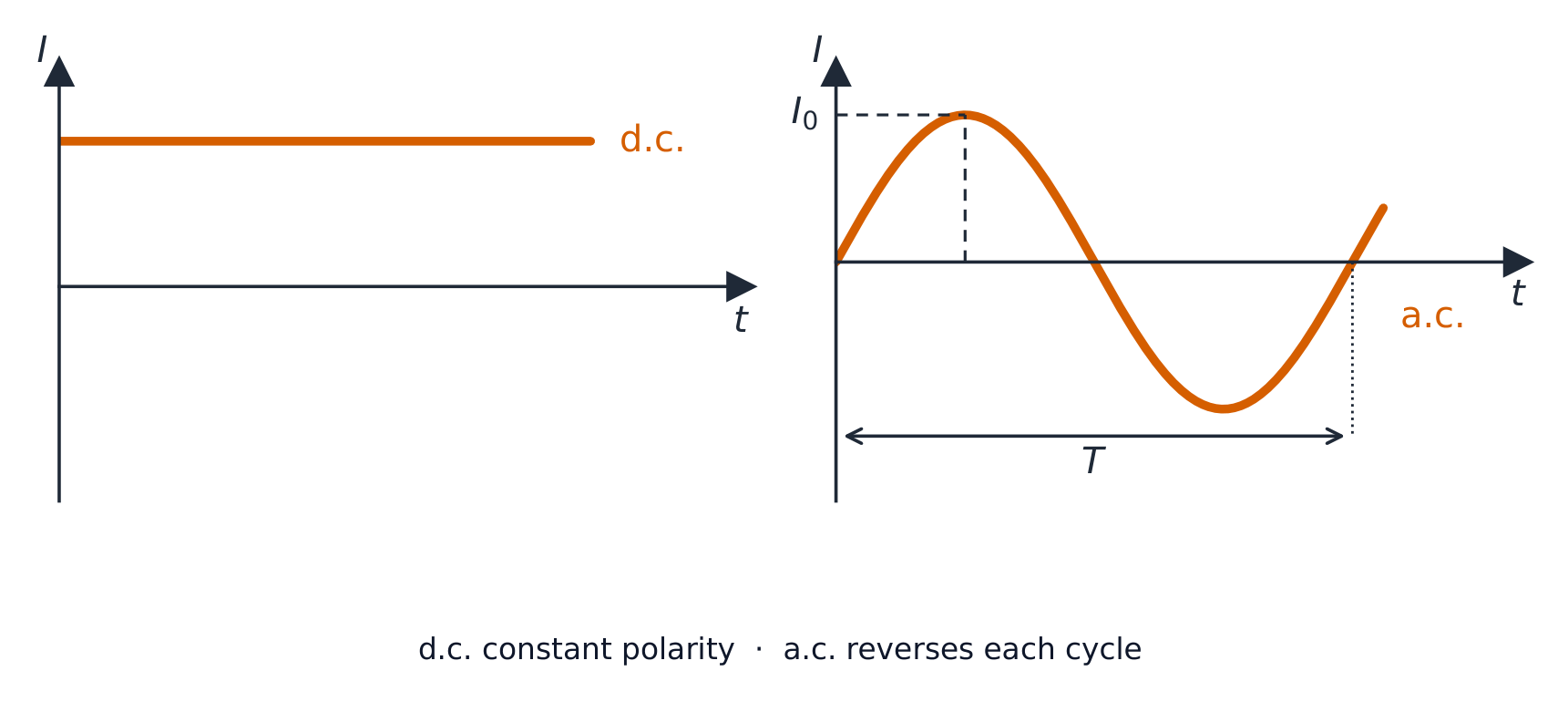
- An alternating current 交流电 keeps reversing direction; the mains is sinusoidal 正弦, so $I$ and $V$ follow sine waves in time.
- The period $T$ is the time for one complete cycle. The frequency $f$ is the number of complete cycles per unit time, so $f = 1/T$.
- The peak value is the maximum value of the current or voltage in a cycle. Those three sentences are the marked wordings.
- The mean value over a whole cycle is zero, since the wave spends as long negative as positive. That is precisely why an r.m.s. value is needed at all.
One line that never moves, one that never stops
Período, frequência e valor de pico
- Uma corrente alternada 交流电 continua invertendo a direção; a rede é senoidal 正弦, então $I$ e $V$ seguem ondas senoidais no tempo.
- O período $T$ é o tempo para um ciclo completo. A frequência $f$ é o número de ciclos completos por unidade de tempo, logo $f = 1/T$.
- O valor de pico é o valor máximo da corrente ou tensão em um ciclo. Essas três frases são as formulações marcadas.
- O valor médio sobre um ciclo completo é zero, pois a onda passa tanto tempo negativa quanto positiva. É exatamente por isso que um valor r.m.s. (eficaz) é necessário.
Uma linha que nunca se move, outra que nunca para
Alternating current · Corrente alternada
I = a sin(bt)
AC is a sine · seno wave — amplitude is the peak, b sets the frequency. · CA é uma onda senoidal — a amplitude é o pico, b define a frequência.
An alternating current: · Uma corrente alternada:
a.c. keeps swapping direction — mains does so 50 (or 60) times a second. · CA continua trocando de direção — a rede faz isso 50 (ou 60) vezes por segundo.
Match each term to the definition the examiner marks. · Combine cada termo com a definição que o avaliador marca.
Each is a fixed wording. The r.m.s. one is the only definition that mentions another current, because that is what it compares itself to. · Cada uma é uma redação fixa. A definição de eficaz é a única que menciona outra corrente, pois é com ela que se compara.
Reading the equation
- A supply is written $V = V_0 \sin(\omega t)$. The number in front is the peak value; the number multiplying $t$ is the angular frequency 角频率 $\omega = 2\pi f$.
- So $f = \omega / 2\pi$ and $T = 1/f$. The angle $\omega t$ is in radians 弧度, so put the calculator in radians before evaluating anything.
- A supply written with $\cos$ is the same wave started at its peak rather than at zero.
Lendo a equação
- Uma fonte é escrita como $V = V_0 \sin(\omega t)$. O número na frente é o valor de pico; o número multiplicando $t$ é a frequência angular 角频率 $\omega = 2\pi f$.
- Então $f = \omega / 2\pi$ e $T = 1/f$. O ângulo $\omega t$ está em radianos 弧度, então coloque a calculadora em radianos antes de avaliar qualquer coisa.
- Uma fonte escrita com $\cos$ é a mesma onda começando no seu pico em vez de em zero.
In $V = V_0\sin(\omega t)$ the coefficient of $t$ is the ____ frequency, equal to $2\pi f$. · Em $V = V_0\sin(\omega t)$, o coeficiente de $t$ é a frequência ____ igual a $2\pi f$.
omega is 2pif, so a supply written sin(100pit) has f = 50 Hz, not 100pi Hz. The angle is in radians, so a calculator left in degrees turns every such step into nonsense. · omega é 2pif, então uma fonte escrita sin(100pit) tem f = 50 Hz, não 100pi Hz. O ângulo está em radianos, então deixar a calculadora em graus transforma cada passo em nonsens.
Worked example: unpacking a supply equation
- A supply has $V = 320\sin(100\pi t)$, with $V$ in volts and $t$ in seconds. Find the peak value, frequency, period and r.m.s. voltage, and the first time after $t = 0$ at which $V = 160\ \text{V}$.
- Peak: $V_0 = 320\ \text{V}$. Angular frequency: $\omega = 100\pi\ \text{rad/s}$, so $f = 100\pi / 2\pi = 50\ \text{Hz}$ and $T = 1/50 = 0.020\ \text{s}$.
- $V_{\text{r.m.s.}} = 320/\sqrt{2} = 226\ \text{V}$.
- For $V = 160\ \text{V}$: $\sin(100\pi t) = 0.5$, so $100\pi t = \pi/6$ and $t = 1/600 = 1.7 \times 10^{-3}\ \text{s}$. In degrees mode this last step gives nonsense.
Exemplo resolvido: desconstruindo uma equação de fonte
- Uma fonte tem $V = 320\sin(100\pi t)$, com $V$ em volts e $t$ em segundos. Encontre o valor de pico, frequência, período e tensão eficaz, e o primeiro tempo após $t = 0$ no qual $V = 160\ \text{V}$.
- Pico: $V_0 = 320\ \text{V}$. Frequência angular: $\omega = 100\pi\ \text{rad/s}$, logo $f = 100\pi / 2\pi = 50\ \text{Hz}$ e $T = 1/50 = 0.020\ \text{s}$.
- $V_{\text{r.m.s.}} = 320/\sqrt{2} = 226\ \text{V}$.
- Para $V = 160\ \text{V}$: $\sin(100\pi t) = 0.5$, logo $100\pi t = \pi/6$ e $t = 1/600 = 1.7 \times 10^{-3}\ \text{s}$. No modo graus, este último passo dá um resultado absurdo.
Mains supply is $50\ \text{Hz}$. What is its period? · A rede elétrica é $50\ \text{Hz}$. Qual é seu período?
$T = \dfrac{1}{f} = \dfrac{1}{50} = 0.020\ \text{s}$.
Reading a CRO trace
- A cathode-ray oscilloscope 示波器 is read exactly as in Topic 7.
- Horizontal: count the divisions for one full cycle and multiply by the time-base 时基 setting. That gives $T$, and $f = 1/T$.
- Vertical: count the divisions from the centre line to a peak and multiply by the $y$-gain. That gives $V_0$. Measuring peak to peak and halving is usually more accurate, because the centre line is easy to misjudge.
Lendo um traço do CRO
- Um osciloscópio de raios catódicos 示波器 é lido exatamente como no Tópico 7.
- Horizontal: conte as divisões para um ciclo completo e multiplique pela configuração da base de tempo 时基. Isso dá $T$, e $f = 1/T$.
- Vertical: conte as divisões da linha central até um pico e multiplique pelo ganho de $y$. Isso dá $V_0$. Medir pico a pico e dividir pela metade geralmente é mais preciso, porque a linha central é fácil de julgar erroneamente.
On a CRO trace one complete cycle spans 4.0 divisions with the time-base at 5.0 ms per division. What is the frequency, in Hz? · Num traçado de um CRO, um ciclo completo abrange 4.0 divisões com a base de tempo em 5.0 ms por divisão. Qual é a frequência, em Hz?
T = 4.0 x 5.0 ms = 20 ms, so f = 1/0.020 = 50 Hz. Count divisions for a WHOLE cycle, not a half. · T = 4.0 x 5.0 ms = 20 ms, portanto f = 1/0.020 = 50 Hz. Conte as divisões para um ciclo COMPLETO, não metade.
Power in a resistor
- For a resistive load the instantaneous power is $P = I^2 R$, and with $I = I_0\sin(\omega t)$:
- This is always positive, since the current is squared, so a reversing current still heats the resistor. It pulses between zero and $I_0^2 R$ at twice the frequency of the current.
- The mean of $\sin^2$ over a cycle is $\tfrac{1}{2}$, so the average power is half the peak power.
Twice the frequency, and never negative
Potência em um resistor
- Para uma carga resistiva, a potência instantânea é $P = I^2 R$, e com $I = I_0\sin(\omega t)$:
- Isso é sempre positivo, pois a corrente é elevada ao quadrado, então uma corrente reversa ainda aquece o resistor. Ela pulsa entre zero e $I_0^2 R$ em dobro da frequência da corrente.
- A média de $\sin^2$ sobre um ciclo é $\tfrac{1}{2}$, então a potência média é metade da potência de pico.

Dobro da frequência, e nunca negativo
The average power of a.c. in a resistor is ____ the peak power. · A potência média da c.a. em um resistor é ____ a potência de pico.
The mean of $\sin^{2}$ over a cycle is $\tfrac{1}{2}$, so $\langle P\rangle = \tfrac{1}{2}P_{\text{peak}}$. · A média de $\sin^{2}$ sobre um ciclo é $\tfrac{1}{2}$, portanto $\langle P\rangle = \tfrac{1}{2}P_{\text{peak}}$.
Worked example: showing it is half
- A supply of peak voltage $12\ \text{V}$ drives a $680\ \Omega$ resistor. Show by calculation that the mean power is half the peak power.
- Peak power, at the instant the voltage is at its peak: $P_0 = V_0^2/R = 12^2/680 = 0.212\ \text{W}$.
- Mean power, through the r.m.s. value: $V_{\text{r.m.s.}} = 12/\sqrt{2} = 8.49\ \text{V}$, so $\langle P\rangle = V_{\text{r.m.s.}}^2/R = 8.49^2/680 = 0.106\ \text{W}$.
- The two are shown separately, and the second is half the first. Writing "half of $0.212$" scores nothing, because that is the very thing being shown.
- The factor $\tfrac{1}{2}$ is just $(1/\sqrt{2})^2$: the r.m.s. factor, squared.
Exemplo resolvido: mostrando que é metade
- Uma fonte de tensão de pico $12\ \text{V}$ alimenta um resistor de $680\ \Omega$. Mostre por cálculo que a potência média é metade da potência de pico.
- Potência de pico, no instante em que a tensão está em seu pico: $P_0 = V_0^2/R = 12^2/680 = 0.212\ \text{W}$.
- Potência média, através do valor r.m.s.: $V_{\text{r.m.s.}} = 12/\sqrt{2} = 8.49\ \text{V}$, logo $\langle P\rangle = V_{\text{r.m.s.}}^2/R = 8.49^2/680 = 0.106\ \text{W}$.
- Os dois são mostrados separadamente, e o segundo é metade do primeiro. Escrever "metade de $0.212$" não pontua, porque esse é justamente o fato que se pretende demonstrar.
- O fator $\tfrac{1}{2}$ é apenas $(1/\sqrt{2})^2$: o fator r.m.s., elevado ao quadrado.
What r.m.s. actually means
- The r.m.s. value of an alternating current is the value of the direct (steady) current that would dissipate the same mean power in the same resistor. That sentence is the two-mark definition, and "by reference to the heating effect" is asking for exactly it.
- From $\langle P\rangle = I_{\text{r.m.s.}}^2 R = \tfrac{1}{2}I_0^2 R$ it follows that, for a sine wave:
- A definition that says only "$I_0/\sqrt{2}$" scores nothing, because that formula holds for a sine wave alone.
- Quoted a.c. values are r.m.s. values, which settles the opening puzzle: $230\ \text{V}$ mains has $V_0 = 230\sqrt{2} \approx 325\ \text{V}$, and components must be rated for the peak.
One dashed line that does the same heating
O que r.m.s. realmente significa
- O valor r.m.s. de uma corrente alternada é o valor da corrente contínua (estável) que dissiparia a mesma potência média no mesmo resistor. Essa frase é a definição de duas marcas, e "por referência ao efeito térmico" pede exatamente isso.
- De $\langle P\rangle = I_{\text{r.m.s.}}^2 R = \tfrac{1}{2}I_0^2 R$ conclui-se que, para uma onda senoidal:
- Uma definição que diz apenas "$I_0/\sqrt{2}$" pontua nada, porque essa fórmula só vale para uma onda senoidal.
- Valores c.a. citados são valores r.m.s., o que resolve o enigma inicial: rede ⚡ de $230\ \text{V}$ tem $V_0 = 230\sqrt{2} \approx 325\ \text{V}$, e os componentes devem ser classificados para o pico.

Uma linha tracejada que faz o mesmo aquecimento
An a.c. has a peak current of $2.0\ \text{A}$. What is the r.m.s. current? · Uma corrente alternada tem uma corrente de pico de $2.0\ \text{A}$. Qual é a corrente eficaz (r.m.s.)?
$I_{\text{rms}} = \dfrac{I_0}{\sqrt{2}} = \dfrac{2.0}{\sqrt{2}} \approx 1.41\ \text{A}$.
A 230 V (r.m.s.) mains supply has a peak voltage of about 325 V. · Uma fonte de alimentação da rede de 230 V (eficaz) tem uma tensão de pico de aproximadamente 325 V.
$V_0 = V_{\text{rms}}\sqrt{2} = 230 \times \sqrt{2} \approx 325\ \text{V}$ — components must be rated for the peak. · $V_0 = V_{\text{rms}}\sqrt{2} = 230 \times \sqrt{2} \approx 325\ \text{V}$ — os componentes devem ser classificados para suportar o valor de pico.
Which statements belong in the definition of an r.m.s. current? Select all · todos that apply. · Quais afirmações pertencem à definição de corrente eficaz? Selecione todas as que se aplicam.
The last one is a consequence for a sine wave, not the definition. A definition giving only I0/sqrt(2) scores nothing, because it is false for any other waveform. · A última opção é uma consequência para uma onda senoidal, não a definição. Uma definição que fornece apenas I0/sqrt(2) não pontua, pois é falsa para qualquer outra forma de onda.
Worked example: a wave that is not a sine
- A current is $+2.0\ \text{A}$ for the first half of each cycle and $-1.0\ \text{A}$ for the second half. Find its r.m.s. value and the mean power in a $10\ \Omega$ resistor.
- Take the name literally. Square: $4.0\ \text{A}^2$ for half the time, $1.0\ \text{A}^2$ for the other half. Mean: $(4.0 + 1.0)/2 = 2.5\ \text{A}^2$. Root: $I_{\text{r.m.s.}} = \sqrt{2.5} = 1.6\ \text{A}$.
- Mean power $= I_{\text{r.m.s.}}^2 R = 2.5 \times 10 = 25\ \text{W}$.
- The sign of the current never matters, because it is squared away. And $I_0/\sqrt{2}$ would have given $1.4\ \text{A}$, which is wrong: that shortcut is for sine waves only.
Exemplo resolvido: uma onda que não é senoidal
- Uma corrente é $+2.0\ \text{A}$ na primeira metade de cada ciclo e $-1.0\ \text{A}$ na segunda metade. Encontre seu valor eficaz e a potência média em um resistor de $10\ \Omega$.
- Pegue o nome literalmente. Quadrado: $4.0\ \text{A}^2$ pela metade do tempo, $1.0\ \text{A}^2$ pela outra metade. Média: $(4.0 + 1.0)/2 = 2.5\ \text{A}^2$. Raiz: $I_{\text{r.m.s.}} = \sqrt{2.5} = 1.6\ \text{A}$.
- Potência média $= I_{\text{r.m.s.}}^2 R = 2.5 \times 10 = 25\ \text{W}$.
- O sinal da corrente nunca importa, porque é elevado ao quadrado. E $I_0/\sqrt{2}$ teria dado $1.4\ \text{A}$, o que está errado: esse atalho é apenas para ondas senoidais.
Put the steps for finding the r.m.s. value of a non-sinusoidal current in order. · Organize as etapas para encontrar o valor eficaz de uma corrente não-senoidal em ordem.
Root-mean-square, read backwards. For a square wave of +2.0 A and -1.0 A the mean square is 2.5 A^2 and the r.m.s. is 1.6 A, not the 1.4 A that I0/sqrt(2) would give. · Raiz quadrada da média, lida de trás para frente. Para uma onda quadrada de +2.0 A e -1.0 A, a média dos quadrados é 2.5 A^2 e o valor eficaz (r.m.s.) é 1.6 A, não os 1.4 A que I0/sqrt(2) daria.
Marks that slip away
- The r.m.s. definition is about the same power in the same resistor, not about dividing by $\sqrt{2}$. Quote the sentence, not the formula.
- "Show that the mean power is half the peak" needs two separate calculations. Halving the first one is circular.
- Put the calculator in radians before evaluating $\sin(\omega t)$.
- $\omega$ is not the frequency. Divide by $2\pi$ first.
- The mean current over a cycle is zero; the mean power is not, because power depends on $I^2$.
Marcas que escapam
- A definição de r.m.s. trata de a mesma potência no mesmo resistor, não de dividir por $\sqrt{2}$. Cite a frase, não a fórmula.
- "Mostre que a potência média é metade do pico" exige dois cálculos separados. Dividir o primeiro ao meio é circular.
- Coloque a calculadora em radianos antes de avaliar $\sin(\omega t)$.
- $\omega$ não é a frequência. Divida por $2\pi$ primeiro.
- A corrente média sobre um ciclo é zero; a potência média não é, porque a potência depende de $I^2$.
You've got it
- period is the time for one complete cycle, frequency the number of complete cycles per unit time, peak value the maximum in a cycle
- in $V = V_0\sin(\omega t)$ the coefficient of $t$ is $\omega = 2\pi f$, and the angle is in radians
- the power in a resistor pulses at twice the frequency and is never negative, so the mean power is half the peak power
- the r.m.s. value is the steady direct current dissipating the same mean power in the same resistor; only for a sine wave is it $I_0/\sqrt{2}$
Entendeu?
- período é o tempo para um ciclo completo, frequência o número de ciclos completos por unidade de tempo, valor de pico o máximo em um ciclo
- em $V = V_0\sin(\omega t)$ o coeficiente de $t$ é $\omega = 2\pi f$, e o ângulo está em radianos
- a potência em um resistor pulsa em dobro da frequência e é nunca negativa, então a potência média é metade da potência de pico
- o valor r.m.s. é a corrente contínua constante dissipando a mesma potência média no mesmo resistor; apenas para uma onda senoidal é ela $I_0/\sqrt{2}$