Electric potential · Potencial elétrico
| English | Português |
|---|---|
| electric potential/ɪˈlektrɪk pəˈtenʃl/ | potencial elétrico |
| scalar/ˈskeɪlə/ | escalar |
| electric potential energy/ɪˈlektrɪk pəˈtenʃl ˈenədʒi/ | energia potencial elétrica |
| infinity/ɪnˈfɪnɪti/ | infinito |
| potential gradient/pəˈtenʃl ˈɡreɪdɪənt/ | gradiente de potencial |
| bound/baʊnd/ | ligado |
The graph that answers four questions at once
- A favourite exam question draws the electric potential along the line between two charged spheres and asks four things: the signs of the charges, where the field is zero, the ratio of the charges, and the force on a charge placed at a point.
- All four come from the same curve, because potential is a scalar that simply adds, and the field is the gradient of the graph.
- Learn to read that one picture and a whole class of questions becomes routine.
- This lesson is electric potential 电势, its link to the field, and electric potential energy 电势能.
O gráfico que responde quatro perguntas de uma vez
- Uma questão de exame favorita desenha o potencial elétrico ao longo da linha entre duas esferas carregadas e pede quatro coisas: os sinais das cargas, onde o campo é zero, a razão entre as cargas e a força sobre uma carga colocada num ponto.
- As quatro saem da mesma curva, porque o potencial é um escalar que simplesmente soma, e o campo é o gradiente do gráfico.
- Aprenda a ler esse único quadro e uma classe inteira de questões torna-se rotina.
- Esta aula trata de potencial elétrico 电势, sua ligação com o campo e energia potencial elétrica 电势能.
Defining potential
- The electric potential at a point is the work done per unit positive charge in bringing a small test charge from infinity 无穷远 to that point:
- Both marks: work done per unit positive charge, and from infinity to the point. The potential is zero at infinity, which is what makes the definition well posed.
- For a positive source charge $V > 0$ everywhere outside it, because work must be done on a positive test charge to push it in against the repulsion. For a negative source charge $V < 0$.
Definindo potencial
- O potencial elétrico em um ponto é o trabalho realizado por unidade de carga positiva ao trazer uma pequena carga de prova de infinito 无穷远 até aquele ponto:
- Ambas as notas: trabalho realizado por unidade de carga positiva, e de infinito até o ponto. O potencial é zero no infinito, o que torna a definição bem definida.
- Para uma carga fonte positiva $V > 0$ em toda parte fora dela, porque trabalho deve ser feito em uma carga de positiva para empurrá-la contra a repulsão. Para uma carga fonte negativa $V < 0$.
Electric potential at a point is the work per unit charge to bring a positive charge from: · O potencial elétrico em um ponto é o trabalho por unidade de carga para trazer uma carga positiva de:
Like gravitational potential, it is measured from infinity, where the potential is taken as zero. · Assim como o potencial gravitacional, é medido a partir do infinito, onde o potencial é tomado como zero.
The two-mark definition of electric potential needs which elements? Select all · todos that apply. · A definição de dois pontos do potencial elétrico exige quais elementos? Selecione todas as que se aplicam.
Per unit positive charge, and from infinity. The zero at infinity is what makes the definition well posed; stationarity is not part of it. · Por unidade de carga positiva, e do infinito. O zero no infinito é o que torna a definição bem definida; a estacionariedade não faz parte dela.
Potential of a point charge
- Note the $\dfrac{1}{r}$, where the field goes as $\dfrac{1}{r^2}$. That difference is the most-tested fact in the topic.
- $V$ is a scalar 标量. For several charges, add the potentials with their signs: no directions, no resolving, just a sum.
A curve above the axis, or below it, depending only on the sign of Q
Potencial de uma carga pontual
- Note o $\dfrac{1}{r}$, onde o campo vai como $\dfrac{1}{r^2}$. Essa diferença é o fato mais cobrado no tópico.
- $V$ é um escalar 标量. Para várias cargas, some os potenciais com seus sinais: sem direções, sem decompor, apenas uma soma.
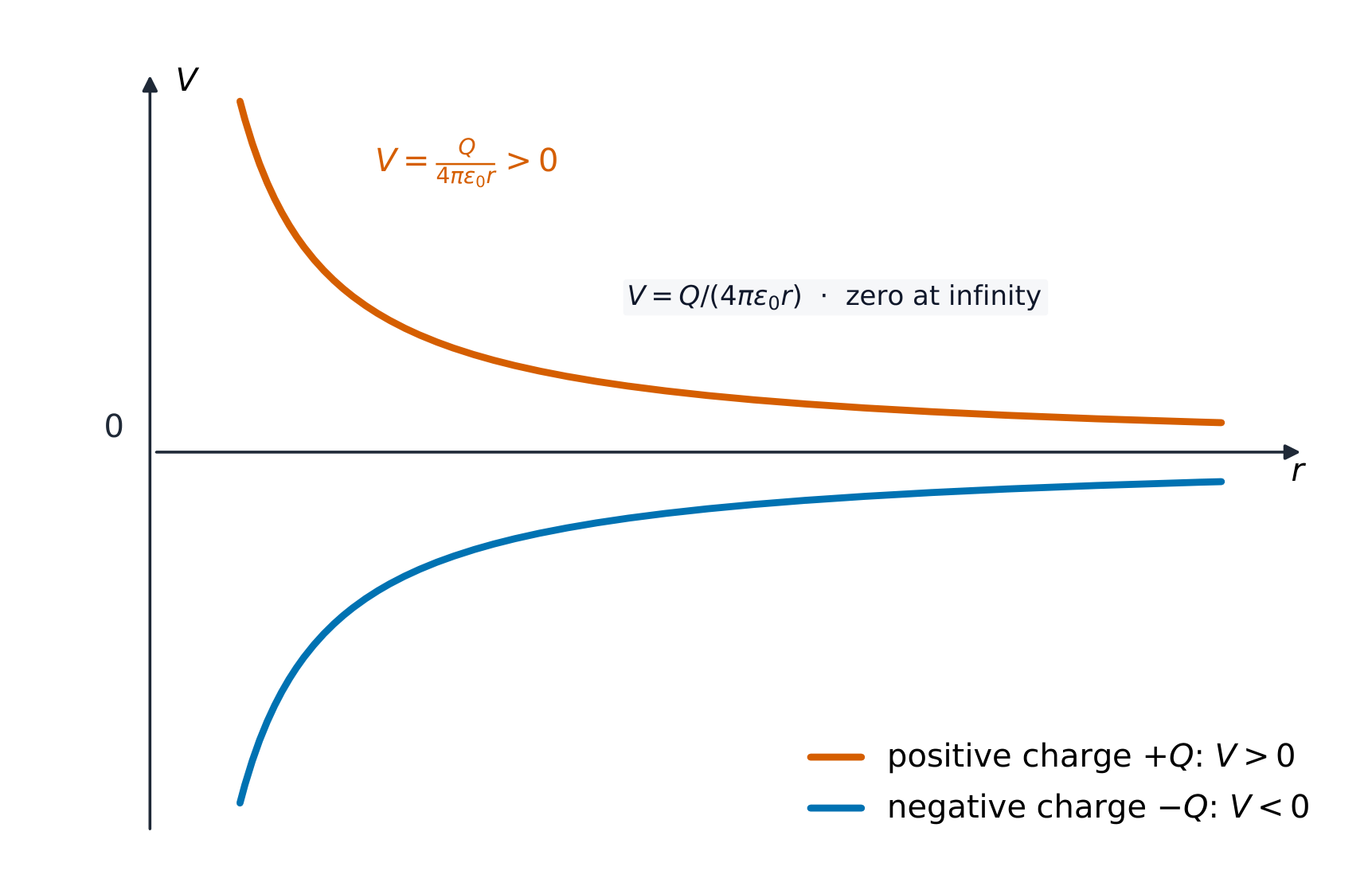
Uma curva acima ou abaixo do eixo, dependendo apenas do sinal de Q
Electric potential · Potencial elétrico
V = kQ / r
Potential ∝ 1/r around a charge — steep near it, flattening out. · Potencial ∝ 1/r ao redor de uma carga — íngreme perto dela, aplanando-se com a distância.
The electric potential near a point charge varies as 1/r. · O potencial elétrico próximo a uma carga pontual varia como 1/r.
Yes — $V = \dfrac{Q}{4\pi\varepsilon_0 r}$ goes as $1/r$, while the field goes as $1/r^{2}$. · Sim — $V = \dfrac{Q}{4\pi\varepsilon_0 r}$ vai como $1/r$, enquanto o campo vai como $1/r^{2}$.
To find the potential at a point due to several charges, add the individual potentials with their signs. · Para encontrar o potencial em um ponto devido a várias cargas, some os potenciais individuais com seus sinais.
Potential is a scalar, so there is nothing to resolve. Fields, by contrast, must be added as vectors with directions. · Potencial é um escalar, portanto não há nada para decompor. Campos, por outro lado, devem ser somados como vetores com direções.
Field is the negative potential gradient
- The field at a point equals minus the potential gradient 电势梯度 there:
- The minus sign says the field points towards lower potential: a positive charge released in the field runs "downhill" in $V$.
- In a uniform field the potential falls steadily, so the gradient is constant and this reduces to $E = V/d$, which is the parallel-plate result from earlier.
- Practically: to get the field from a $V$ against $x$ graph, draw a tangent and take minus its gradient.
Campo é o gradiente de potencial negativo
- O campo em um ponto é igual a menos o gradiente de potencial 电势梯度 ali:
- O sinal menos diz que o campo aponta para potencial mais baixo: uma carga positiva solta no campo corre "ladeira abaixo" em $V$.
- Em um campo uniforme, o potencial cai uniformemente, logo o gradiente é constante e isso se reduz a $E = V/d$, que é o resultado de placas paralelas visto anteriormente.
- Na prática: para obter o campo de um gráfico de $V$ contra $x$, desenhe uma tangente e tire menos seu gradiente.
The electric field equals minus the potential ____ (E = −dV/dx). · O campo elétrico é igual ao menos o gradiente do potencial ____ (E = −dV/dx).
The field points "downhill" in potential, toward lower V. · O campo aponta "montanha abaixo" no potencial, em direção a V menor.
How is the electric field found from a graph of potential against distance? · Como encontrar o campo elétrico a partir de um gráfico de potencial versus distância?
E = -dV/dx. The minus sign says the field points towards lower potential, and in a uniform field the constant gradient gives E = V/d. · E = -dV/dx. O sinal negativo diz que o campo aponta para potencial menor, e em um campo uniforme a inclinação constante dá E = V/d.
Worked example: reading the two-sphere graph
- The potential along the line between spheres X and Y, $1.2\ \text{m}$ apart, is positive everywhere and has a minimum at $0.50\ \text{m}$ from X. State three conclusions.
- Both charges are positive, because the potential is positive everywhere along the line.
- The field is zero at $x = 0.50\ \text{m}$, because the gradient is zero there and $E = -dV/dx$.
- Y carries the larger charge, because the zero-field point lies closer to X. Quantitatively $Q_{\text{Y}}/Q_{\text{X}} = (0.70/0.50)^2 = 2.0$.
- If instead the curve crossed zero, the charges would be opposite, and there the ratio comes from $Q_{\text{X}}/x = Q_{\text{Y}}/(d-x)$, without the square.
Exemplo resolvido: lendo o gráfico de duas esferas
- O potencial ao longo da linha entre as esferas X e Y, separadas por $1.2\ \text{m}$, é positivo em toda parte e tem um mínimo a $0.50\ \text{m}$ de X. Dê três conclusões.
- Ambas as cargas são positivas, porque o potencial é positivo em toda parte ao longo da linha.
- O campo é zero em $x = 0.50\ \text{m}$, porque o gradiente é zero ali e $E = -dV/dx$.
- Y carrega a carga maior, porque o ponto de campo zero fica mais próximo de X. Quantitativamente $Q_{\text{Y}}/Q_{\text{X}} = (0.70/0.50)^2 = 2.0$.
- Se a curva em vez disso cortasse zero, as cargas seriam opostas, e ali a razão vem de $Q_{\text{X}}/x = Q_{\text{Y}}/(d-x)$, sem o quadrado.
The potential between two spheres is positive everywhere with a minimum nearer sphere X. Which conclusions follow? Select all · todos that apply. · O potencial entre duas esferas é positivo em todos os lugares com um mínimo mais próximo da esfera X. Quais conclusões seguem? Selecione todas as que se aplicam.
A minimum in V is where the gradient, and so the field, is zero; it lies nearer the smaller charge. The potential there is a minimum, not zero, so qV is not zero either. · Um mínimo em V é onde a inclinação, e assim o campo, é zero; ele fica mais próximo da carga menor. O potencial ali é um mínimo, não zero, então qV também não é zero.
Electric potential energy
- A charge $q$ placed at a point of potential $V$ has electric potential energy $E_{\text{P}} = qV$. For two point charges:
- Like charges give positive potential energy: released, they fly apart. Opposite charges give negative energy, a bound 束缚 system, and work must be done to separate them to infinity.
- This is the same pattern as gravitational potential energy, which is always negative because gravity always attracts.
Above the axis they would fly apart; below it they are bound
Energia potencial elétrica
- Uma carga $q$ colocada em um ponto de potencial $V$ possui energia potencial elétrica $E_{\text{P}} = qV$. Para duas cargas pontuais:
- Cargas iguais dão energia potencial positiva: se soltas, voam para longe. Cargas opostas dão energia negativa, um sistema ligado 束缚, e trabalho deve ser feito para separá-las até o infinito.
- Esse é o mesmo padrão da energia potencial gravitacional, que é sempre negativa porque a gravidade sempre atrai.
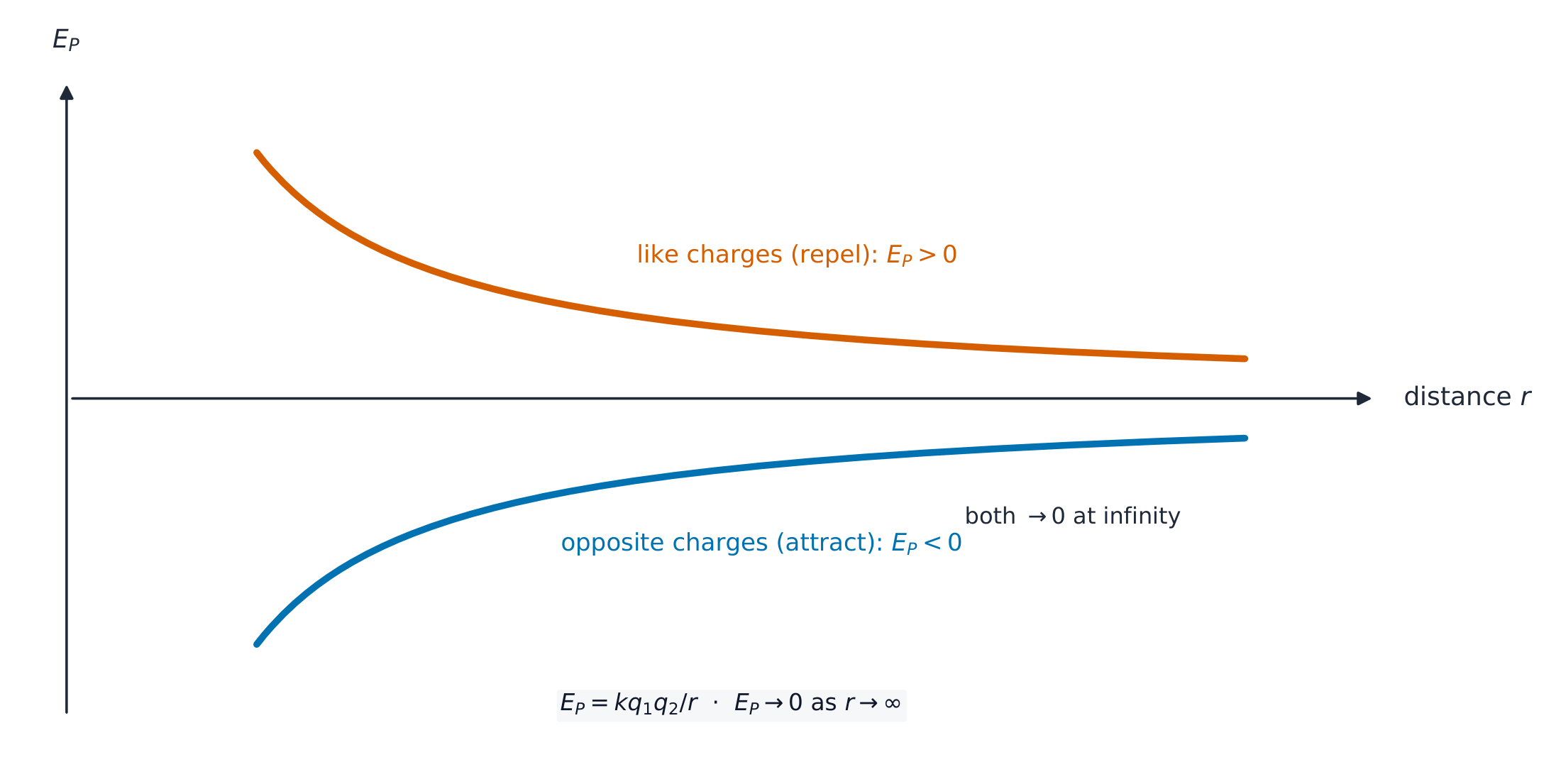
Acima do eixo elas voariam para longe; abaixo delas estão ligadas
The electric potential energy of a charge $q$ at a point of potential $V$ is: · A energia potencial elétrica de uma carga $q$ em um ponto de potencial $V$ é:
$E_{\text{P}} = qV$; for two point charges this becomes $\dfrac{Qq}{4\pi\varepsilon_0 r}$. · $E_{\text{P}} = qV$; para duas cargas pontuais isso se torna $\dfrac{Qq}{4\pi\varepsilon_0 r}$.
Two opposite charges have a negative electric potential energy (a bound system). · Duas cargas opostas têm energia potencial elétrica negativa (um sistema ligado).
Negative PE means energy must be supplied to pull them apart — they are bound, like an electron and a nucleus. · PE negativa significa que energia deve ser fornecida para separá-las — elas estão ligadas, como um elétron e um núcleo.
Two opposite charges have a negative electric potential energy, so the system is described as ____. · Duas cargas opostas têm energia potencial elétrica negativa, então o sistema é descrito como ____.
Work must be done to separate them to infinity, where the energy is zero. Like charges have positive energy and would fly apart if released. · Trabalho deve ser feito para separá-las até o infinito, onde a energia é zero. Cargas iguais têm energia positiva e voariam se fossem liberadas.
Electric and gravitational, side by side
| gravitational | electric | |
|---|---|---|
| force | $F = \dfrac{Gm_1m_2}{r^2}$ | $F = \dfrac{Q_1Q_2}{4\pi\varepsilon_0 r^2}$ |
| field | $g = \dfrac{GM}{r^2}$ | $E = \dfrac{Q}{4\pi\varepsilon_0 r^2}$ |
| potential | $\phi = -\dfrac{GM}{r}$ | $V = \dfrac{Q}{4\pi\varepsilon_0 r}$ |
- Identical shapes throughout. The one difference: mass has a single sign so gravity always attracts and $\phi$ is always negative, while charge has two signs so the electric quantities can be either.
Elétrico e gravitacional lado a lado
| gravitacional | elétrico | |
|---|---|---|
| força | $F = \dfrac{Gm_1m_2}{r^2}$ | $F = \dfrac{Q_1Q_2}{4\pi\varepsilon_0 r^2}$ |
| campo | $g = \dfrac{GM}{r^2}$ | $E = \dfrac{Q}{4\pi\varepsilon_0 r^2}$ |
| potencial | $\phi = -\dfrac{GM}{r}$ | $V = \dfrac{Q}{4\pi\varepsilon_0 r}$ |
- Formas idênticas em tudo. A única diferença: massa tem um único sinal, logo a gravidade sempre atrai e $\phi$ é sempre negativo, enquanto a carga tem dois sinais, assim as grandezas elétricas podem ser ambas.
Match each quantity to how it changes with distance from a point charge. · Combine cada quantidade com como ela muda com a distância de uma carga pontual.
The field is inverse-square; the potential is inverse (one power of r gentler). · O campo é inverso-quadrático; o potencial é inverso (uma potência de r mais suave).
Worked example: describe the motion
- A positive charge is placed at a point P on the two-sphere line and released. Describe and explain its motion.
- It moves towards lower potential, that is, down the slope of the $V$ graph, because the field points that way and the force on a positive charge is along the field.
- The force, and so the acceleration, is not constant: it equals $-q\,dV/dx$, and the gradient changes along the line.
- It speeds up wherever it moves to lower potential, gaining kinetic energy equal to $q\Delta V$ lost in potential energy.
Exemplo resolvido: descreva o movimento
- Uma carga positiva é colocada num ponto P na linha de duas esferas e liberada. Descreva e explique seu movimento.
- Ela se move para potencial mais baixo, isto é, descendo a inclinação do gráfico de $V$, porque o campo aponta nessa direção e a força sobre uma carga positiva é na direção do campo.
- A força, e consequentemente a aceleração, não é constante: é igual a $-q\,dV/dx$, e o gradiente muda ao longo da linha.
- Ela ganha velocidade sempre que se move para potencial mais baixo, ganho de energia cinética igual a $q\Delta V$ perdido em energia potencial.
Marks that slip away
- Potential is $\dfrac{1}{r}$; field is $\dfrac{1}{r^2}$. Check which the question wants before substituting.
- The definition needs per unit positive charge and from infinity. Zero at infinity is what the definition rests on.
- Potentials add as scalars with signs; fields add as vectors. Never resolve potentials.
- Zero field is where the $V$ graph has zero gradient, not where $V$ itself is zero. Between opposite charges the curve crosses zero while its gradient is not zero.
Marcas que escapam
- Potencial é $\dfrac{1}{r}$; campo é $\dfrac{1}{r^2}$. Verifique qual a questão quer antes de substituir.
- A definição precisa de por unidade de carga positiva e de infinito. Zero no infinito é sobre o que a definição se apoia.
- Potenciais somam-se como escalares com sinais; campos somam-se como vetores. Nunca resolva potenciais.
- Campo zero é onde o gráfico $V$ tem gradiente zero, não onde $V$ em si é zero. Entre cargas opostas a curva cruza zero enquanto seu gradiente não é zero.
You've got it
- electric potential is the work done per unit positive charge bringing a small test charge from infinity; it is zero at infinity, positive near a positive charge
- $V = \dfrac{Q}{4\pi\varepsilon_0 r}$ varies as $\dfrac{1}{r}$ and is a scalar, so several charges add with signs
- $E = -\dfrac{dV}{dx}$: the field is minus the potential gradient, so zero field means zero gradient, and in a uniform field this gives $E = V/d$
- electric potential energy $E_{\text{P}} = qV = \dfrac{Qq}{4\pi\varepsilon_0 r}$: positive for like charges, negative for opposite ones, which are bound
Entendeu?
- potencial elétrico é o trabalho realizado por unidade de carga positiva ao trazer uma pequena carga de prova do infinito; é zero no infinito, positivo próximo a uma carga positiva
- $V = \dfrac{Q}{4\pi\varepsilon_0 r}$ varia conforme $\dfrac{1}{r}$ e é um escalar, então várias cargas somam-se com sinais
- $E = -\dfrac{dV}{dx}$: o campo é o negativo do gradiente de potencial, então campo zero significa gradiente zero, e em um campo uniforme isso resulta em $E = V/d$
- energia potencial elétrica $E_{\text{P}} = qV = \dfrac{Qq}{4\pi\varepsilon_0 r}$: positiva para cargas iguais, negativa para opostas, que estão ligadas (bound)