Kinetic theory of gases · Teoria cinética dos gases
| English | Português |
|---|---|
| kinetic theory/kɪˈnetɪk ˈθɪəri/ | teoria cinética |
| random motion/ˈrændəm ˈməʊʃn/ | movimento aleatório |
| elastic/ɪˈlæstɪk/ | elástica |
| momentum/məʊˈmentəm/ | momento |
| mean-square speed/miːn skweə spiːd/ | velocidade média ao quadrado |
| root-mean-square/ruːt miːn skweə/ | raiz da média quadrática |
| average translational kinetic energy/ˈævrɪdʒ trænˈsleɪʃənl kɪˈnetɪk ˈenədʒi/ | energia cinética translacional média |
Pressure is a drum roll, not a push
- A balloon feels like it is being pushed steadily outwards. Nothing is pushing steadily. Molecules are striking the rubber at random, each blow lasting a fraction of a nanosecond.
- There are so many blows, so close together, that the average is perfectly smooth. Pressure is a drum roll heard from far enough away that the individual beats disappear.
- Taking that picture seriously, and applying nothing but Newton's laws to it, produces the gas laws from scratch and reveals what temperature actually is.
- This lesson is the assumptions of kinetic theory 分子动理论, the pressure derivation, r.m.s. speed and the meaning of temperature.
Pressão é um redobrar de tambores, não um empurrão
- Um balão parece estar sendo empurrado constantemente para fora. Nada está empurrando constantemente. Moléculas estão batendo na borracha aleatoriamente, cada golpe durando uma fração de nanosegundo.
- Há tantos golpes, tão próximos uns dos outros, que a média é perfeitamente suave. Pressão é um redobrar de tambores ouvido de longe o suficiente para que os batimentos individuais desapareçam.
- Levar aquela imagem a sério, e aplicar apenas as leis de Newton a ela, produz as leis dos gases do zero e revela o que a temperatura realmente é.
- Esta lição é os pressupostos da teoria cinética 分子动理论, a derivação da pressão, velocidade eficaz e o significado da temperatura.
The assumptions
- A large number of identical molecules in continuous random motion 无规则运动.
- The molecules' own volume is negligible compared with the volume of the gas.
- There are no forces between molecules except during collisions, so they travel in straight lines between them.
- Collisions are perfectly elastic 弹性, losing no kinetic energy, and the time of a collision is negligible compared with the time between collisions. Newton's laws apply throughout.
- These fail at very high pressure, where molecular volume matters, and at very low temperature, where intermolecular forces matter.
As suposições
- Um grande número de moléculas idênticas em movimento aleatório contínuo 无规则运动.
- O próprio volume das moléculas é negligível comparado ao volume do gás.
- Não há forças entre moléculas exceto durante colisões, então elas viajam em linhas retas entre elas.
- As colisões são perfeitamente elásticas 弹性, sem perda de energia cinética, e o tempo de uma colisão é desprezível em comparação com o tempo entre colisões. As leis de Newton se aplicam durante todo o processo.
- Elas falham a pressões muito altas, onde o volume molecular importa, e a temperaturas muito baixas, onde as forças intermoleculares importam.
Select all · todos the assumptions of the kinetic theory of an ideal gas. · Selecione todas as premissas da teoria cinética de um gás ideal.
Forces between molecules are ignored except during (elastic) collisions — they do not attract strongly at all times. · As forças entre moléculas são ignoradas exceto durante (colisões) elásticas — elas não se atraem fortemente em todos os momentos.
Deriving the pressure
- Take a cube of side $L$ holding $N$ molecules of mass $m$, and follow one moving along $x$ with velocity $u_1$.
- One collision with the right wall reverses its velocity, so its momentum 动量 changes by $-2mu_1$ and, by Newton's third law, the wall receives $+2mu_1$.
- Between hits on that wall it travels $2L$, so $\Delta t = 2L/u_1$, giving an average force $F_1 = \Delta p/\Delta t = mu_1^2/L$.
- Summing over all molecules and dividing by the wall area $L^2$ gives $p = Nm\langle u_x^2\rangle / V$. In three dimensions, symmetry means $\langle u_x^2\rangle = \tfrac13\langle c^2\rangle$, so:
One molecule, one wall, then multiply up
Derivando a pressão
- Considere um cubo de lado $L$ contendo $N$ moléculas de massa $m$, e acompanhe uma movendo-se ao longo de $x$ com velocidade $u_1$.
- Uma colisão com a parede direita inverte sua velocidade, então seu momento linear 动量 muda em $-2mu_1$ e, pela terceira lei de Newton, a parede recebe $+2mu_1$.
- Entre os impactos nessa parede, ela percorre $2L$, logo $\Delta t = 2L/u_1$, resultando em uma força média $F_1 = \Delta p/\Delta t = mu_1^2/L$.
- Somando sobre todas as moléculas e dividindo pela área da parede $L^2$, obtemos $p = Nm\langle u_x^2\rangle / V$. Em três dimensões, a simetria implica $\langle u_x^2\rangle = \tfrac13\langle c^2\rangle$, portanto:

Uma molécula, uma parede, depois multiplique
Boyle's law · Lei de Boyle
p ∝ 1/V
At constant temperature, pressure is inversely proportional to volume — squash the gas and the pressure rises. · A temperatura constante, a pressão é inversamente proporcional ao volume — esprema o gás e a pressão aumenta.
A gas exerts pressure on its container because the molecules: · Um gás exerce pressão sobre seu recipiente porque as moléculas:
Each collision pushes on the wall; the combined effect of countless collisions is the pressure. · Cada colisão empurra a parede; o efeito combinado de incontáveis colisões é a pressão.
Worked example: explain the pressure in words
- Explain how molecular movement causes the pressure exerted by a gas. [3]
- The molecules move randomly and collide with the walls of the container.
- At each collision a molecule rebounds, so its momentum changes; by Newton's second law the wall exerts a force on it, and by the third law it exerts an equal and opposite force on the wall.
- There are very many collisions each second, so the individual impulses average to a steady total force, and pressure is that force divided by the area.
- Three sentences, three marks. The middle one must name both of Newton's laws to earn its mark.
Exemplo resolvido: explique a pressão em palavras
- Explique como o movimento molecular causa a pressão exercida por um gás. [3]
- As moléculas movem-se aleatoriamente e colidem com as paredes do recipiente.
- Em cada colisão, uma molécula rebota, mudando seu momento linear; pela segunda lei de Newton, a parede exerce uma força sobre ela, e pela terceira lei, ela exerce uma força igual e oposta na parede.
- Há muitíssimas colisões por segundo, então os impulsos individuais se media para uma força total estável, e a pressão é essa força dividida pela área.
- Três frases, três pontos. A frase do meio deve citar ambas as leis de Newton para ganhar seu ponto.
Put the three-mark explanation of gas pressure in order. · Organize a explicação de três pontos sobre a pressão do gás na ordem correta.
Random motion, momentum change with both of Newton's laws, the averaging over many collisions, then force per area. · Movimento aleatório, mudança de momento com ambas as leis de Newton, a média sobre muitas colisões, depois força por área.
The density form
- $Nm$ is the total mass of the gas, so $Nm/V$ is its density $\rho$. The same result reads:
- Use this version whenever a question gives a density instead of $N$ and $m$, which it often does.
A forma da densidade
- $Nm$ é a massa total do gás, então $Nm/V$ é sua densidade $\rho$. O mesmo resultado lê-se:
- Use esta versão sempre que uma questão fornecer uma densidade em vez de $N$ e $m$, o que acontece frequentemente.
Root-mean-square speed
- $\langle c^2 \rangle$ is the mean-square speed 均方速率: square each molecule's speed, then average. Its square root is the root-mean-square 均方根 speed:
- It is a single useful measure of molecular speed, slightly larger than the mean speed because squaring weights the fast molecules more heavily.
- The molecules do not all move at this speed. They have a wide spread, and raising the temperature shifts the whole spread to higher speeds.
A distribution, of which the r.m.s. speed is one summary
Velocidade eficaz (raiz quadrada da média dos quadrados)
- $\langle c^2 \rangle$ é a média dos quadrados das velocidades 均方速率: eleve ao quadrado a velocidade de cada molécula e tire a média. Sua raiz quadrada é a velocidade eficaz 均方根:
- É uma única medida útil da velocidade molecular, ligeiramente maior que a velocidade média porque elevar ao quadrado pondera mais fortemente as moléculas rápidas.
- As moléculas não se movem todas a essa velocidade. Elas têm uma ampla distribuição, e aumentar a temperatura desloca toda a distribuição para velocidades maiores.
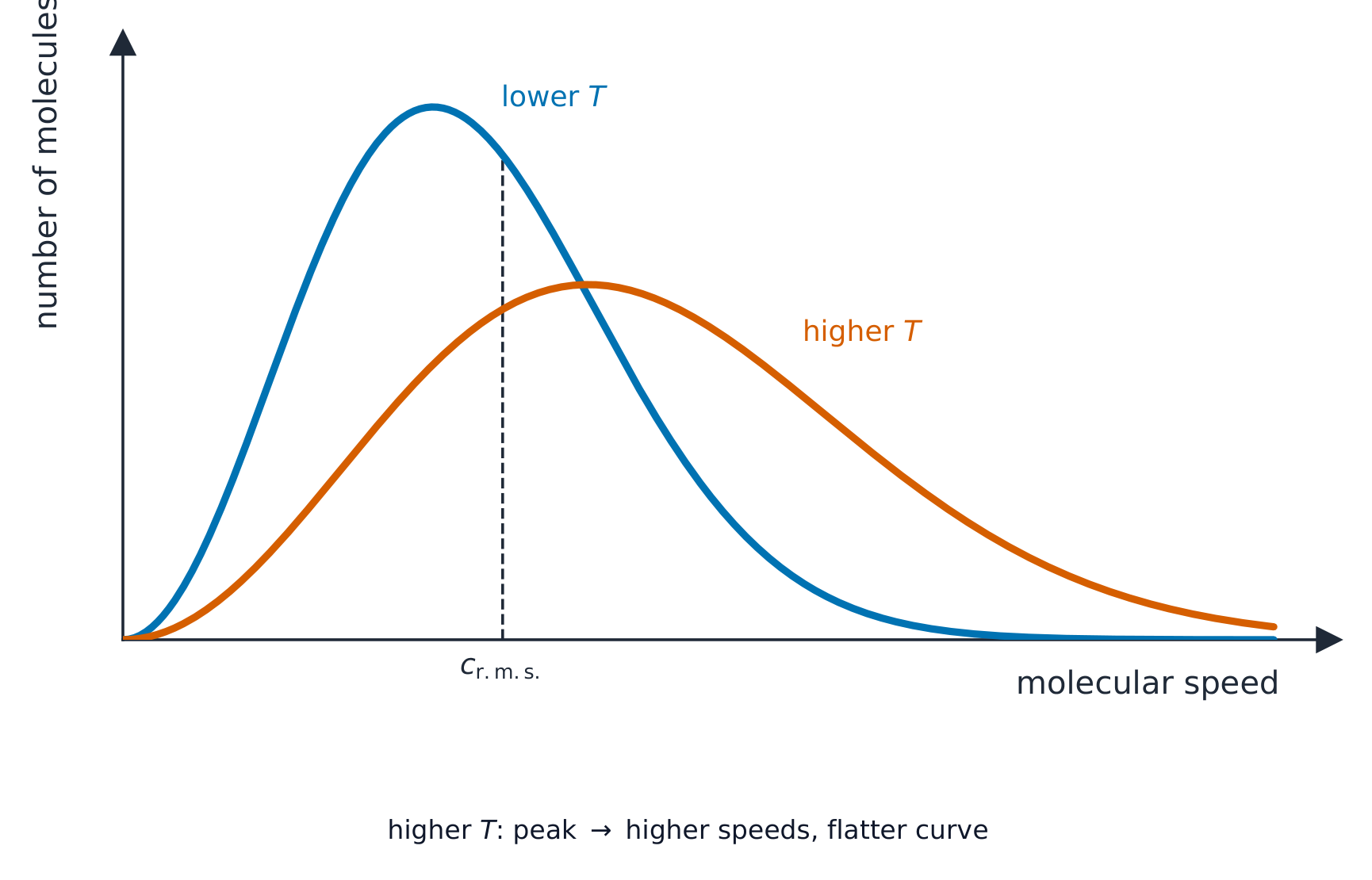
Uma distribuição, da qual a velocidade r.m.s. é um resumo
The r.m.s. speed is the square root of the ____ speed. · A velocidade eficaz média (r.m.s.) é a raiz quadrada da ____ velocidade.
Take the mean of the squared speeds, then square-root it: $c_{\text{r.m.s.}} = \sqrt{\langle c^{2}\rangle}$. · Tire a média das velocidades ao quadrado, depois tire a raiz quadrada: $c_{\text{r.m.s.}} = \sqrt{\langle c^{2}\rangle}$.
How is the root-mean-square speed calculated from a set of molecular speeds? · Como se calcula a velocidade eficaz média (rms) a partir de um conjunto de velocidades moleculares?
Square, average, root, in that order. Squaring first weights the fast molecules more, which is why c_rms is slightly larger than the mean speed. · Elevação ao quadrado, média, raiz, nessa ordem. Elevar ao quadrado primeiro dá mais peso às moléculas rápidas, o que explica por que c_rms é ligeiramente maior que a velocidade média.
Worked example: r.m.s. speed from a density
- An ideal gas at a pressure of $1.6 \times 10^5\ \text{Pa}$ has a density of $1.9\ \text{kg/m}^3$. Show that the r.m.s. speed of its molecules is about $500\ \text{m/s}$.
- From $p = \tfrac13\rho\langle c^2\rangle$: $\langle c^2 \rangle = \dfrac{3p}{\rho} = \dfrac{3 \times 1.6 \times 10^5}{1.9} = 2.53 \times 10^5\ \text{m}^2\text{/s}^2$.
- Then $c_{\text{r.m.s.}} = \sqrt{2.53 \times 10^5} = 503\ \text{m/s} \approx 500\ \text{m/s}$.
- In a "show that", carry an extra significant figure and quote it (503) before comparing with the value given. Rounding to 500 first proves nothing.
Exemplo resolvido: velocidade r.m.s. a partir de uma densidade
- Um gás ideal a uma pressão de $1.6 \times 10^5\ \text{Pa}$ tem uma densidade de $1.9\ \text{kg/m}^3$. Mostre que a velocidade r.m.s. de suas moléculas é cerca de $500\ \text{m/s}$.
- De $p = \tfrac13\rho\langle c^2\rangle$: $\langle c^2 \rangle = \dfrac{3p}{\rho} = \dfrac{3 \times 1.6 \times 10^5}{1.9} = 2.53 \times 10^5\ \text{m}^2\text{/s}^2$.
- Então $c_{\text{r.m.s.}} = \sqrt{2.53 \times 10^5} = 503\ \text{m/s} \approx 500\ \text{m/s}$.
- Num "mostre que", mantenha uma casa decimal extra e cite-a (503) antes de comparar com o valor dado. Arredondar para 500 primeiro não prova nada.
An ideal gas at 1.6 x 10^5 Pa has density 1.9 kg/m^3. What is the r.m.s. speed of its molecules, in m/s? · Um gás ideal a 1.6 x 10^5 Pa possui densidade 1.9 kg/m^3. Qual é a velocidade eficaz (r.m.s.) de suas moléculas, em m/s?
Use p = rho <c^2>/3, so <c^2> = 3p/rho = 2.53e5 and c_rms = 503 m/s. In a 'show that' question, quote the extra figure before rounding. · Use p = rho <c^2>/3, so <c^2> = 3p/rho = 2.53e5 e c_rms = 503 m/s. Em uma questão do tipo 'mostre que', cite o algarismo adicional antes de arredondar.
What temperature actually is
- Two expressions for the same $pV$: $pV = NkT$ from the equation of state, and $pV = \tfrac13 Nm\langle c^2\rangle$ from kinetic theory. Set them equal, cancel $N$ and multiply by $\tfrac32$:
- The left side is the average translational kinetic energy 平动动能 of one molecule. So temperature is a measure of average molecular kinetic energy, and nothing else.
- Two consequences the exam asks for. Double the absolute temperature and the average kinetic energy doubles, so $c_{\text{r.m.s.}}$ grows by $\sqrt{2}$. And at the same temperature, lighter molecules move faster, since $\tfrac12 m\langle c^2\rangle$ is the same for both.
O que a temperatura realmente é
- Duas expressões para a mesma $pV$: $pV = NkT$ da equação de estado, e $pV = \tfrac13 Nm\langle c^2\rangle$ da teoria cinética. Iguale-as, cancele $N$ e multiplique por $\tfrac32$:
- O lado esquerdo é a energia cinética translacional média 平动动能 de uma molécula. Portanto, a temperatura é uma medida da energia cinética molecular média, e nada mais.
- Duas consequências que a prova pede. Dobre a temperatura absoluta e a energia cinética média dobra, logo $c_{\text{r.m.s.}}$ aumenta em $\sqrt{2}$. E, à mesma temperatura, moléculas mais leves movem-se mais rápido, já que $\tfrac12 m\langle c^2\rangle$ é o mesmo para ambas.
The average translational kinetic energy of a gas molecule depends only on: · A energia cinética translacional média de uma molécula de gás depende apenas de:
$\langle E_k\rangle = \tfrac{3}{2}kT$ — only the thermodynamic temperature matters. · $\langle E_k\rangle = \tfrac{3}{2}kT$ — apenas a temperatura termodinâmica importa.
If the absolute temperature doubles, the r.m.s. speed grows by a factor of: · Se a temperatura absoluta dobrar, a velocidade eficaz média aumenta por um fator de:
$\langle c^{2}\rangle \propto T$, so $c_{\text{r.m.s.}} \propto \sqrt{T}$ — doubling $T$ multiplies it by $\sqrt{2} \approx 1.41$. · $\langle c^{2}\rangle \propto T$, então $c_{\text{r.m.s.}} \propto \sqrt{T}$ — dobrar $T$ multiplica-o por $\sqrt{2} \approx 1.41$.
At the same temperature, lighter molecules move faster on average than heavier ones. · Na mesma temperatura, moléculas mais leves movem-se em média mais rápido que as mais pesadas.
Same average KE $\tfrac{3}{2}kT$, but smaller mass means a larger $\langle c^{2}\rangle$ — so lighter molecules are faster. · Mesma energia cinética média $\tfrac{3}{2}kT$, mas menor massa significa uma maior $\langle c^{2}\rangle$ — então moléculas mais leves são mais rápidas.
Comparing pV = NkT with pV = Nm<c^2>/3 shows that the average translational kinetic energy of a molecule equals ____ kT. · Comparando pV = NkT com pV = Nm<c^2>/3, vê-se que a energia cinética translacional média de uma molécula é igual a ____ kT.
So temperature is a direct measure of average molecular kinetic energy, and the internal energy of an ideal gas is (3/2)nRT. · Então a temperatura é uma medida direta da energia cinética molecular média, e a energia interna de um gás ideal é (3/2)nRT.
Internal energy of an ideal gas
- An ideal gas has no forces between molecules, so there is no molecular potential energy: its internal energy is entirely kinetic.
- Multiplying the average kinetic energy by the number of molecules:
- So the internal energy of an ideal gas depends only on its temperature, not on its pressure or volume. That single fact does most of the work in the next lesson.
Energia interna de um gás ideal
- Um gás ideal não tem forças entre moléculas, logo não há energia potencial molecular: sua energia interna é inteiramente cinética.
- Multiplicando a energia cinética média pelo número de moléculas:
- Logo, a energia interna de um gás ideal depende apenas de sua temperatura, não de sua pressão ou volume. Esse único fato faz a maior parte do trabalho na próxima aula.
The internal energy of an ideal gas equals: · A energia interna de um gás ideal é igual a:
Ideal-gas molecules have only kinetic energy, so $U = \tfrac{3}{2}NkT = \tfrac{3}{2}nRT$ — proportional to $T$. · As moléculas de gás ideal possuem apenas energia cinética, então $U = \tfrac{3}{2}NkT = \tfrac{3}{2}nRT$ — proporcional a $T$.
Marks that slip away
- The r.m.s. speed is the square root of the mean of the squares, not the mean speed. Order matters: square, average, then root.
- Average kinetic energy depends on temperature alone. Two different gases at the same temperature have the same average molecular kinetic energy.
- $T$ doubling makes $c_{\text{r.m.s.}}$ grow by $\sqrt{2}$, not by 2. The energy is proportional to $T$, so the speed goes as $\sqrt{T}$.
- An "explain the pressure" answer needs the momentum change, both of Newton's laws, and the very many collisions per second.
Marcas que escapam
- A velocidade r.m.s. é a raiz quadrada da média dos quadrados, não a velocidade média. A ordem importa: eleve ao quadrado, tire a média, depois tire a raiz.
- A energia cinética média depende apenas da temperatura. Dois gases diferentes à mesma temperatura têm a mesma energia cinética molecular média.
- Dobrar $T$ faz $c_{\text{r.m.s.}}$ crescer em $\sqrt{2}$, não em 2. A energia é proporcional a $T$, logo a velocidade varia com $\sqrt{T}$.
- Uma resposta "explique a pressão" precisa da mudança de momento linear, ambas as leis de Newton, e das muitas colisões por segundo.
You've got it
- assumptions: many identical molecules in random motion, negligible molecular volume, no forces except in collisions, elastic collisions of negligible duration, Newton's laws apply
- $pV = \tfrac13 Nm\langle c^2\rangle$, or $p = \tfrac13\rho\langle c^2\rangle$ when a density is given; pressure is momentum change at the walls, averaged over very many collisions
- $c_{\text{r.m.s.}} = \sqrt{\langle c^2\rangle}$, one summary of a wide spread of speeds
- comparing with $pV = NkT$ gives $\tfrac12 m\langle c^2\rangle = \tfrac32 kT$: temperature is average molecular kinetic energy, so $U = \tfrac32 nRT$ depends on temperature alone
Entendeu?
- pressupostos: muitas moléculas idênticas em movimento aleatório, volume molecular desprezível, nenhuma força exceto nas colisões, colisões elásticas de duração desprezível, leis de Newton se aplicam
- $pV = \tfrac13 Nm\langle c^2\rangle$, ou $p = \tfrac13\rho\langle c^2\rangle$ quando uma densidade é dada; a pressão é a mudança de momento linear nas paredes, média sobre muitas colisões
- $c_{\text{r.m.s.}} = \sqrt{\langle c^2\rangle}$, um resumo de uma ampla distribuição de velocidades
- comparando com $pV = NkT$ obtém-se $\tfrac12 m\langle c^2\rangle = \tfrac32 kT$: a temperatura é a energia cinética molecular média, logo $U = \tfrac32 nRT$ depende apenas da temperatura